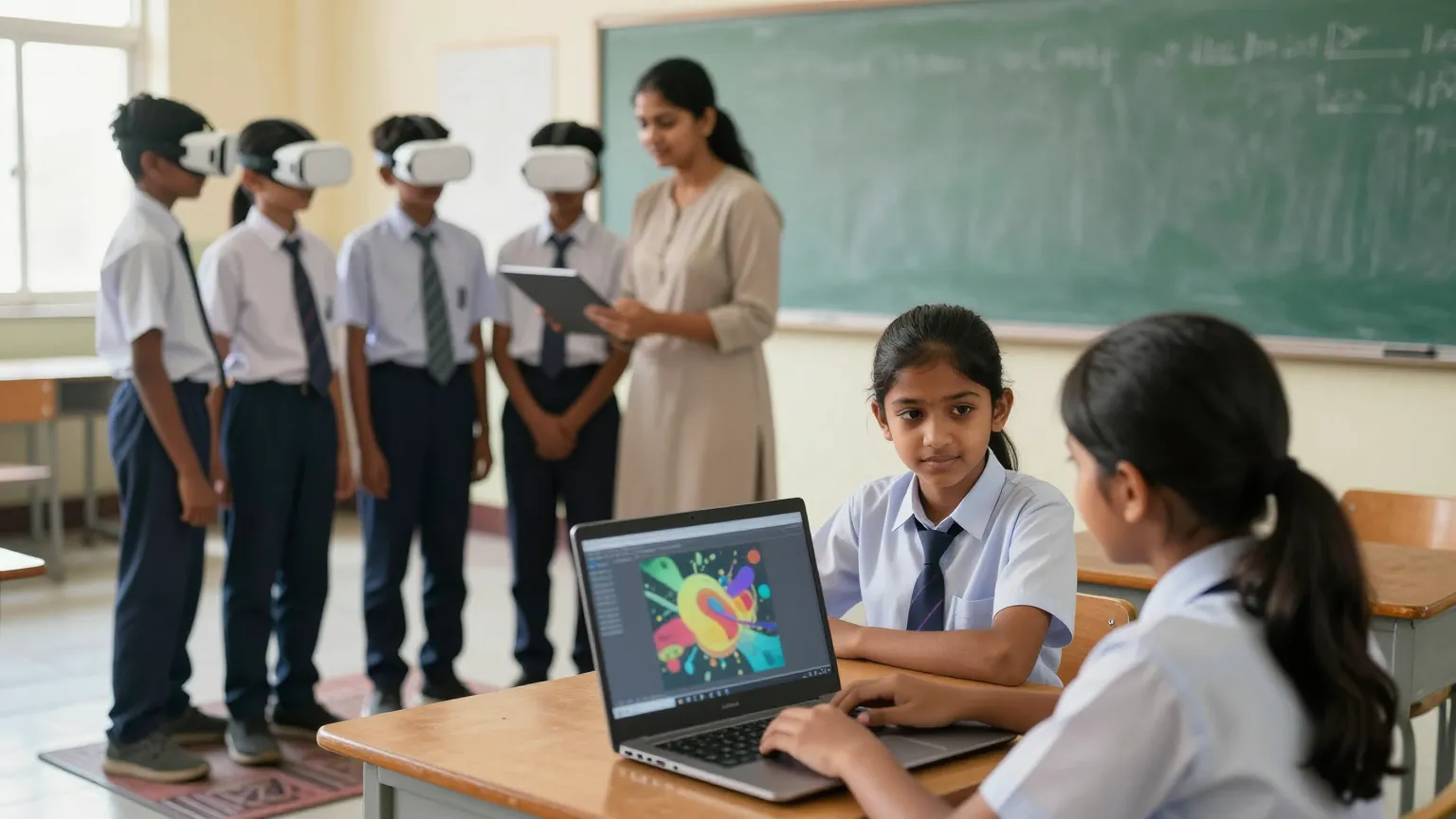
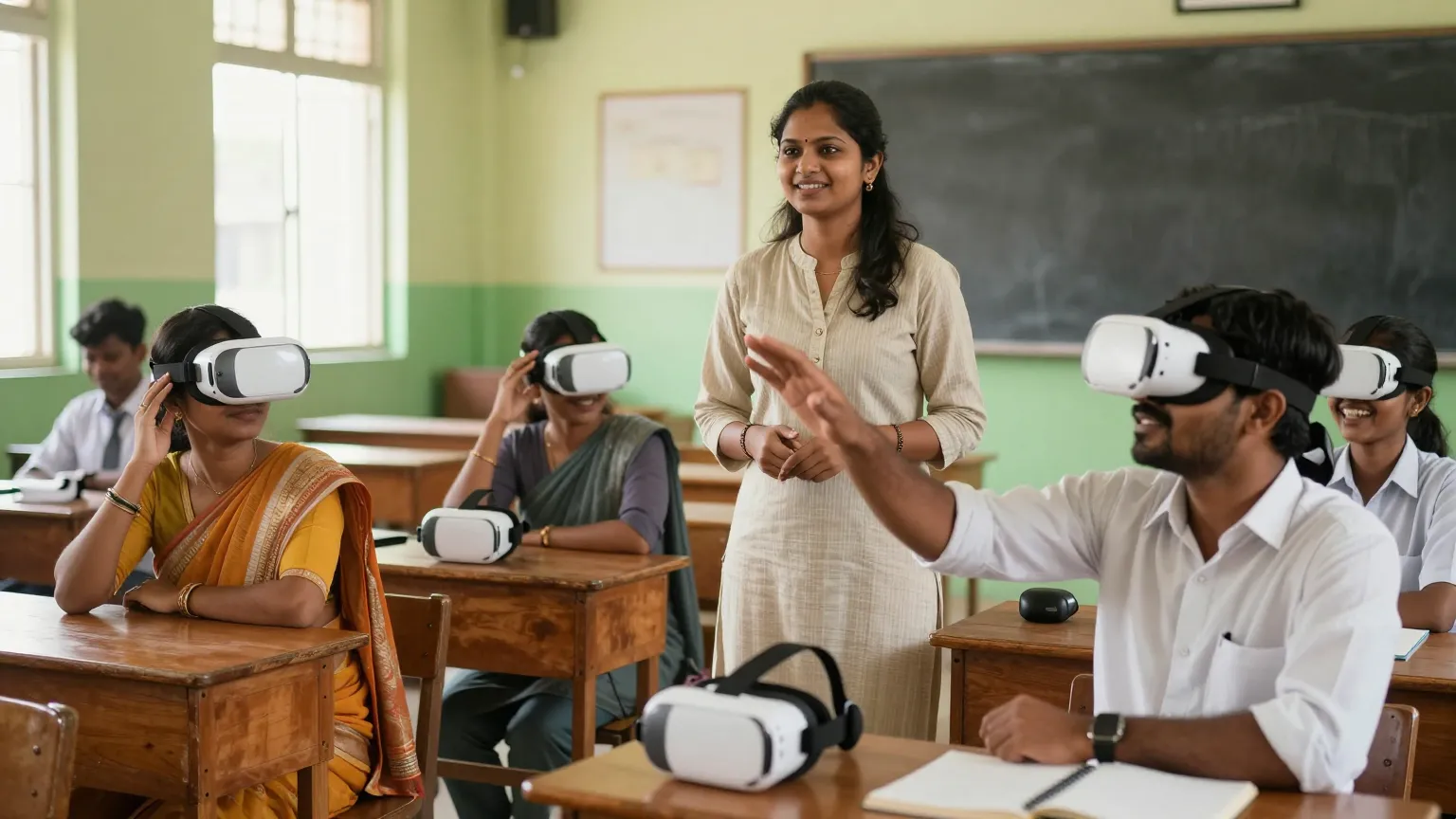
How do you measure whether a school VR lab actually improves learning outcomes in India?
November 26, 2026
November 26, 2026
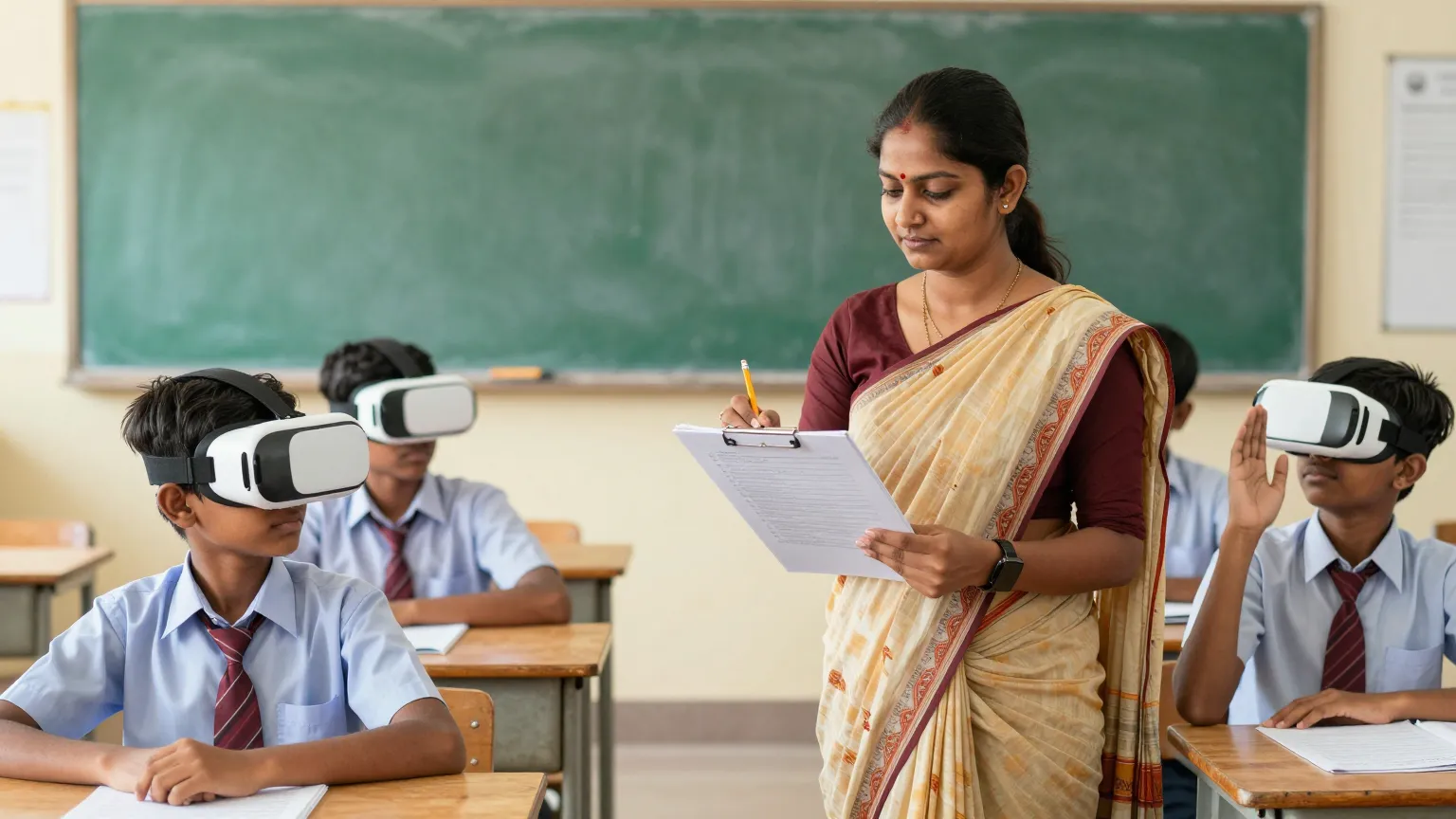
Measure it the way PARAKH measures schools: pick the NCERT or state-board learning outcomes a VR module targets, test students on those competencies before and after the module, compare the gain with a section that learned the same chapter without VR, and keep per-student usage data from the headsets. A lab that cannot show a competency gain within one term is an attraction, not an intervention.
School leaders who have installed a VR lab, and CSR funders who paid for one, eventually face the same question from a management committee or a district officer: did it change what children can do? Attendance in the lab and the smiles in the inauguration photographs are not an answer. This guide sets out how we think an Indian school should measure a VR lab, using the same competency-based approach that the Ministry of Education now uses to measure the school itself.
Engagement is easy to see and easy to report, which is why most VR lab reviews stop there. It is also the wrong unit. Since NEP 2020, India’s assessment system has moved to stage-wise competencies: the Performance Assessment, Review and Analysis of Knowledge for Holistic Development (PARAKH), set up under NCERT, replaced the National Achievement Survey with the PARAKH Rashtriya Sarvekshan, which tests Classes 3, 6 and 9 against the learning outcomes of the foundational, preparatory and middle stages.
Ministry of Education officials treat any item that fewer than 50% of students answer correctly as a learning gap. That is a usable standard for a school: a VR module earns its place when it moves a specific competency from below that line to above it, for the children who used it. An August 2026 Ministry of Education blog post on VR labs in PM SHRI schools, reported by EduAdvice, framed the test the same way: the question that matters is whether students understand better, not whether the equipment attracts interest.
The PARAKH Rashtriya Sarvekshan 2024 results, published in July 2025, give every school a national and management-type baseline for the subjects VR labs are usually bought for. The figures below are average percentage scores.
| Stage and class | Subject | All India | State government schools | Private recognised schools | Central government schools |
|---|---|---|---|---|---|
| Foundational, Class 3 | Mathematics | 60 | 61 | 60 | 57 |
| Preparatory, Class 6 | Mathematics | 46 | 43 | 49 | 61 |
| Preparatory, Class 6 | The World Around Us | 49 | 47 | 52 | 58 |
| Middle, Class 9 | Mathematics | 37 | 33 | 39 | 48 |
| Middle, Class 9 | Science | 40 | 37 | 44 | 51 |
| Middle, Class 9 | Social Science | 40 | 37 | 42 | 49 |
Two patterns matter for a VR lab plan. First, scores fall as children move up: the all-India maths average drops from 60% in Class 3 to 37% in Class 9. Second, the gap between state government and central government schools widens from four points in Class 3 to fifteen points in Class 9 mathematics. A VR lab in a Zilla Parishad or state-board school should therefore be aimed at Classes 6 to 9 science and mathematics, where the national data show the steepest decline, and its targets should be written as competencies drawn from the same framework. Our earlier guide on whether a VR lab counts as experiential learning under NEP 2020 and CBSE lists the outcome codes to map against.
The design below is the one we recommend to schools on Abhigyaan. It needs no external researcher, fits a single term and produces evidence a district officer or CSR committee will accept.
If your lab has fewer headsets than students, the rotation plan matters as much as the test design; we worked through station rotations in how many VR headsets a school needs.
| Metric | How to calculate it | Why a reviewer cares |
|---|---|---|
| Competency gain | Post-test minus pre-test on the mapped outcome, per section | The core evidence of learning |
| Mastery share | Percentage of students above 50% on the outcome after the module | Same threshold PARAKH uses to flag a learning gap |
| Retention | Score on the same items four weeks later | Shows whether the concept stayed |
| Coverage | Students who completed the module ÷ students enrolled | A lab used by one section is not a school intervention |
| Time on task | Minutes per student per module from headset telemetry | Links usage to gain; flags modules that are too long or too short |
| Teacher use | Number of teachers who ran at least one session a month | Labs stall when a single champion leaves |
| Cost per mastered outcome | Annual lab cost ÷ (students × outcomes moved above 50%) | The figure a CSR or Samagra Shiksha reviewer compares across schemes |
The last row deserves emphasis. Funders rarely ask for it, but a school that can state “₹X per student per outcome mastered” has an argument for renewal that an engagement survey will never provide. The teacher-use row is the early warning: in our experience the labs that fail are the ones where only one teacher was trained, which is why teacher training is a measurable part of the plan, not an afterthought.
Abhigyaan is deployed in 1,350 Maharashtra Zilla Parishad schools reaching 1.5M+ students, and the measurement lesson from that scale is unglamorous: the data has to be collected by the platform, because teachers in a two-teacher primary school will not maintain a register. Every Abhigyaan session therefore records which student used which module, for how long, with what in-experience quiz result, and maps it to the curriculum outcome the module was built for. The school dashboard shows usage and in-experience results per outcome and per class, and a teacher-facing AI agent nudges teachers whose sections have not run a scheduled module.
Two cautions from the same deployment. Telemetry shows usage and in-experience performance; it does not replace the paper pre-test and post-test, because a child can clear a quiz inside a simulation and still fail a transfer question on paper. And comparison sections are harder in single-section rural schools, so there we compare a class against its own previous chapter and against the district PARAKH baseline instead.
The Khanna lab is typical of how government-school VR labs are now appearing: a CSR donor, a PM SHRI school and a launch by a minister. The PM SHRI scheme runs from 2022-23 to 2026-27, which means the first cohort of such labs will be asked for results in the coming year. A one-page report per term, with the dashboard metrics above for each module and the national baseline alongside, answers the question before it is asked. It is also the format that makes a second lab fundable; we covered the funding routes themselves in how an Indian government school can pay for a VR lab.
If you run a school or a CSR education programme and want a measurement plan for a lab you already have, or one you are considering, book a 30-minute call with us. We will map your modules to learning outcomes and set up the pre-test, post-test and dashboard with your teachers.
PARAKH Rashtriya Sarvekshan is the national learning survey that replaced the National Achievement Survey under NEP 2020. Its 2024 round tested 21,15,022 students in Classes 3, 6 and 9 across 74,229 schools. It gives a VR lab both its baseline scores and its method: competency-based items, stage-wise outcomes and a 50% threshold for a learning gap.
One term is enough for a first answer. Run a pre-test, the VR module, a post-test within a week and a retention test after four weeks, for two or three chapters. Compare the gain with a section taught without VR. Year-on-year comparison against the school’s own PARAKH or board results then confirms whether the effect holds across the curriculum.
Yes. Without a comparison section, compare the class against its own result on a similar chapter taught without VR, and against the district or state average from the PARAKH Rashtriya Sarvekshan for that stage and subject. Keep the retention test, because it is the strongest single indicator that a concept was learned rather than merely experienced.
At minimum: which module was used, when, for how long, the number of attempts, the score on any quiz inside the experience, and the curriculum learning outcome the module maps to. Abhigyaan records these for every session and presents results by outcome and class, so teachers do not maintain registers by hand.
Classes 6 to 9 in mathematics and science. PARAKH Rashtriya Sarvekshan 2024 shows the all-India maths average falling from 60% in Class 3 to 37% in Class 9, with state government schools at 33% in Class 9 maths and 37% in science. These are the stages where the national data show the steepest decline and the widest gaps.

I am a founder director at Qodequay Technologies Pvt. Ltd., a leading digital transformation consulting firm that helps clients across industries to innovate, optimize, and grow their businesses. I have over two decades of experience in the digital domain, spanning product development, e-commerce, user experience, design thinking, web and app development, and business leadership. My core competencies include developing and executing digital transformation strategies, building teams globally, roadmaps, and solutions that leverage data, insights, and emerging technologies such as artificial intelligence, augmented reality, blockchain, and immersive experience. I also have expertise in digital commerce, supply chain integration, and product management, having worked with both B2B and B2C brands in various sectors. My mission is to create value for customers and stakeholders by delivering impactful and engaging digital experiences that drive growth and innovation.
November 26, 2026

November 25, 2026
November 24, 2026
November 23, 2026

November 22, 2026
Monthly insights on AI, VR and DPDPA compliance — straight from our team to your inbox.
Free 30-minute consultation with our team — or see our products in action.