Can a VR lab count as experiential learning under NEP 2020 and CBSE?
October 16, 2026
October 16, 2026
Yes, when it is used as pedagogy rather than a showcase. NEP 2020 para 4.6 makes experiential learning the standard pedagogy in every subject, and para 24.4 calls for virtual labs so every student gets hands-on, experiment-based learning. CBSE already lists AR/VR among its middle-school skill modules. A VR lab counts when each session maps to a learning outcome, is teacher-led, assessed, and recorded as evidence.
Principals ask us this in almost every school conversation: "Will a VR lab help with NEP compliance, and can we show it to CBSE as experiential learning?" Neither NEP 2020 nor CBSE mandates a VR lab, and neither forbids one. Both ask for a way of teaching. A VR lab counts when it delivers that way of teaching, and not when it is a room students visit twice a year for a demo.
Two paragraphs do most of the work. Para 4.6 states that, in all stages, experiential learning will be adopted, including hands-on learning, arts-integrated and sports-integrated education and story-telling pedagogy, as standard pedagogy within each subject. Para 24.4, under online and digital education, says existing platforms such as DIKSHA, SWAYAM and SWAYAMPRABHA will be leveraged to create virtual labs so that all students have equal access to quality practical and hands-on, experiment-based learning experiences.
Read together, the policy wants every subject taught through doing, and practical experiences that do not depend on a school's physical lab budget. A VR lab serves both. The Department of School Education's NEP implementation booklet adds that there is no substitute for direct, hands-on experience in a physical laboratory. We agree: VR complements the physics bench, it does not replace it.
CBSE has not issued a VR circular, but its existing framework already gives a VR lab three legitimate homes.
There is also a timely incentive. The CBSE Skill Expo and Guidance Festival 2026-27 is running 31 regional rounds through 17 November 2026, with a national event on 12 January 2027. One of its seven themes is Animation, VFX, Gaming and Comics, and the rubric now weights innovation and originality at 25 per cent and research depth at 20 per cent. Students who build or test a 3D learning scene in a VR lab have a ready-made project.
Inspection teams and parents can tell the difference. We use five tests.
| Test | VR demo | VR lesson that counts |
|---|---|---|
| Curriculum link | "Cool experience" with no chapter reference | Mapped to a specific NCERT learning outcome and textbook chapter |
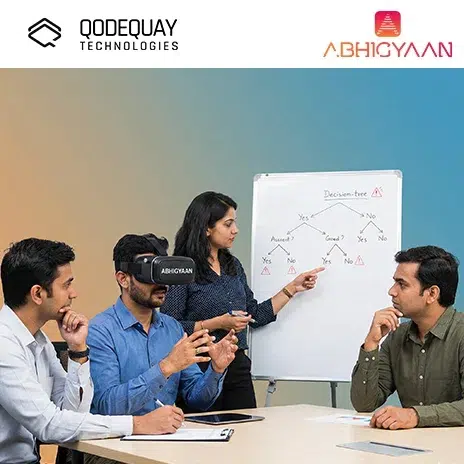
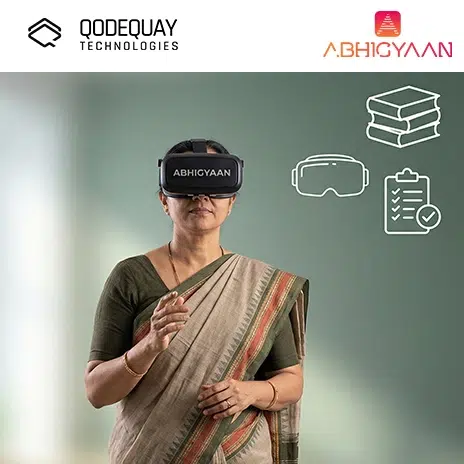
| Teacher role | Vendor runs it; teacher watches | Teacher plans, facilitates and debriefs using a 5E or similar structure |
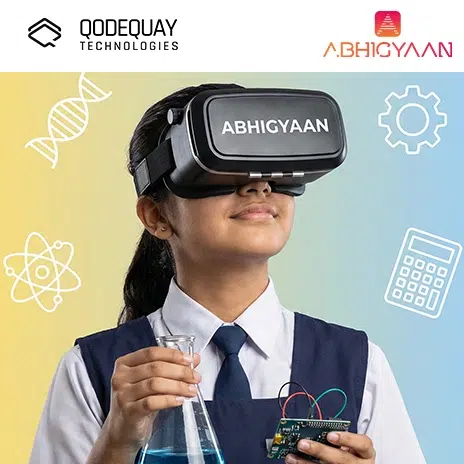
| Student activity | Passive 360° viewing | Student manipulates, predicts, measures or builds something inside the scene |
| Assessment | None | Exit ticket, quiz or reflection graded into subject enrichment or portfolio marks |
| Evidence | Photos for social media | Session log, outcome mapping, student work sample and teacher note on file |
If a session passes all five, it is experiential learning in the NEP sense, whatever the hardware. If it fails the first and fourth, it is enrichment at best.
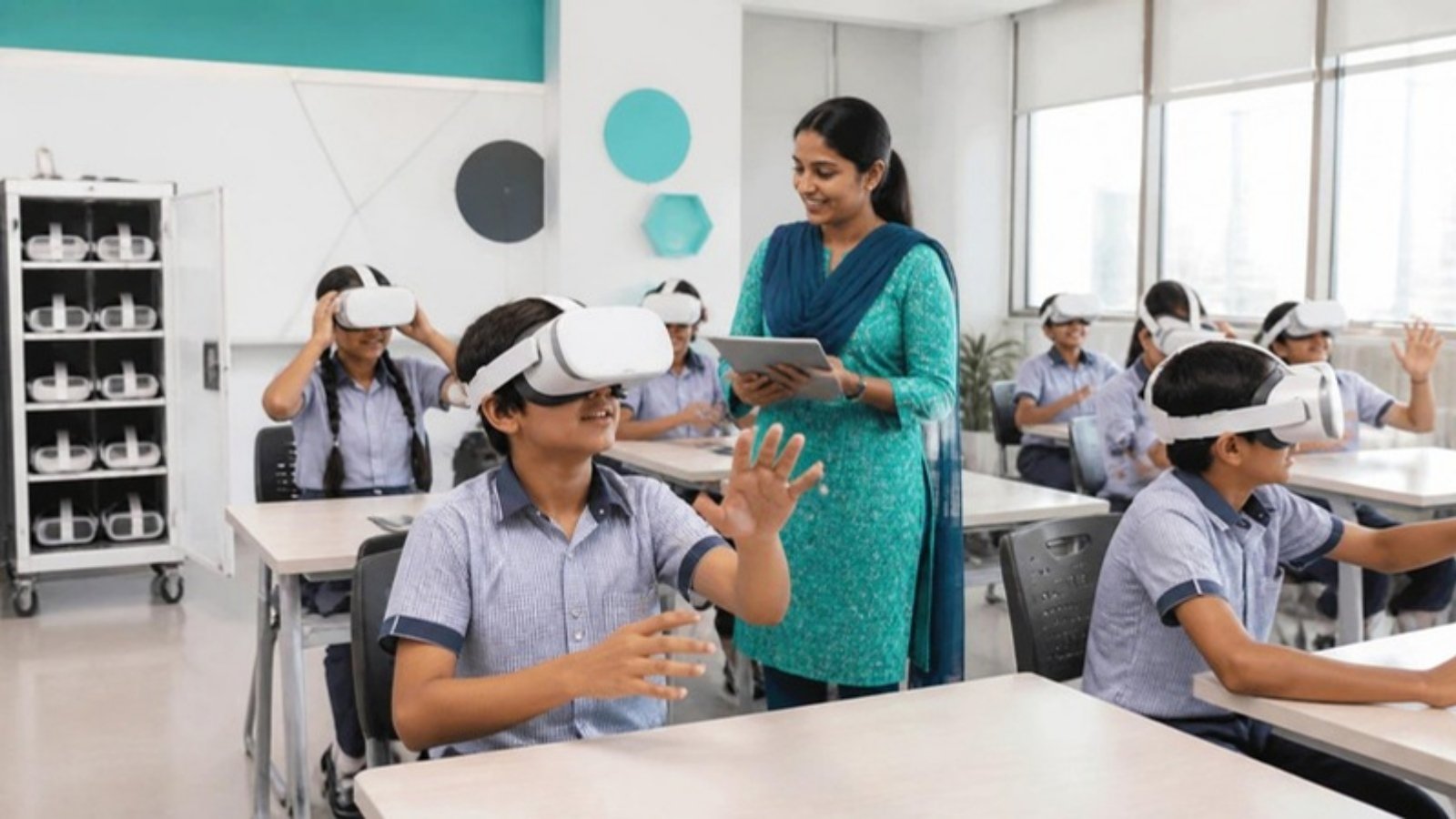
This is the structure we train teachers on, and it is the structure running in the 1,350 Maharashtra Zilla Parishad schools where Abhigyaan is deployed, reaching 1.5M+ students. It assumes a class of 40 and 10 headsets, which is a ratio most schools can afford; our VR lab budgeting guide for CBSE schools explains how to size the lab.
Short modules matter. A 3 to 5 minute module is what keeps the rotation inside one period and keeps the headset time purposeful, which is why we standardise on that length. Our teacher's guide to VR in the classroom covers the facilitation side in more detail.
Inspection and affiliation teams ask how experiential learning is planned and assessed. A thin folder answers that in minutes.
Yes. NEP 2020 applies to all boards, and state curriculum frameworks use the same experiential, competency-based language. Abhigyaan's Zilla Parishad programme in Maharashtra is built around the state board syllabus, which is why it reaches 1.5M+ students in government schools. The pedagogy and the evidence folder are identical; only the chapter references change.
If you are planning a VR lab for 2027-28, write the outcome map first and choose content second. Abhigyaan ships curriculum-aligned modules for CBSE and state boards in Indian languages, with teacher training and session logs built in, and Qodequay is ISO 9001:2015 and ISO 27001:2022 certified. Book a 30-minute planning call and we will map your first term of VR lessons to your board's learning outcomes together.
Not by name. NEP 2020 para 4.6 makes experiential learning standard pedagogy in every subject, and para 24.4 calls for virtual labs on platforms such as DIKSHA so all students get hands-on, experiment-based learning. A VR lab is one way to deliver both, alongside, not instead of, physical laboratories.
No. CBSE does not mandate VR hardware. It does direct schools, through Circular 14/2025, to integrate experiential learning and competency-based assessment, offers AR/VR as a skill module for Classes 6 to 8, and counts enrichment activities and portfolios in internal assessment. A VR lab fits all three without being compulsory.
No. The Department of School Education's NEP implementation booklet states there is no substitute for direct hands-on experience in a physical laboratory. Use VR for experiments that are unsafe, expensive, invisible or impossible at school scale, such as eclipses or molecular structure, and keep bench practicals for the rest.
Ten headsets serve a class of 40 comfortably when modules are 3 to 5 minutes long and students rotate in groups of four within a 40-minute period. What makes the lesson count is the outcome mapping, teacher facilitation and assessment, not the headset-to-student ratio.
Yes. CIET-NCERT runs an online course, Integration of Virtual Labs in Teaching-Learning and Assessment, with five modules covering science, mathematics, social science and languages. The self-paced version is open until 31 March 2027 and certifies teachers who score 70 per cent or more.

I am a founder director at Qodequay Technologies Pvt. Ltd., a leading digital transformation consulting firm that helps clients across industries to innovate, optimize, and grow their businesses. I have over two decades of experience in the digital domain, spanning product development, e-commerce, user experience, design thinking, web and app development, and business leadership. My core competencies include developing and executing digital transformation strategies, building teams globally, roadmaps, and solutions that leverage data, insights, and emerging technologies such as artificial intelligence, augmented reality, blockchain, and immersive experience. I also have expertise in digital commerce, supply chain integration, and product management, having worked with both B2B and B2C brands in various sectors. My mission is to create value for customers and stakeholders by delivering impactful and engaging digital experiences that drive growth and innovation.
October 16, 2026

October 15, 2026

October 14, 2026
October 13, 2026

October 7, 2026
Monthly insights on AI, VR and DPDPA compliance — straight from our team to your inbox.
Free 30-minute consultation with our team — or see our products in action.