How do you train teachers to run a school VR lab in India?
November 8, 2026
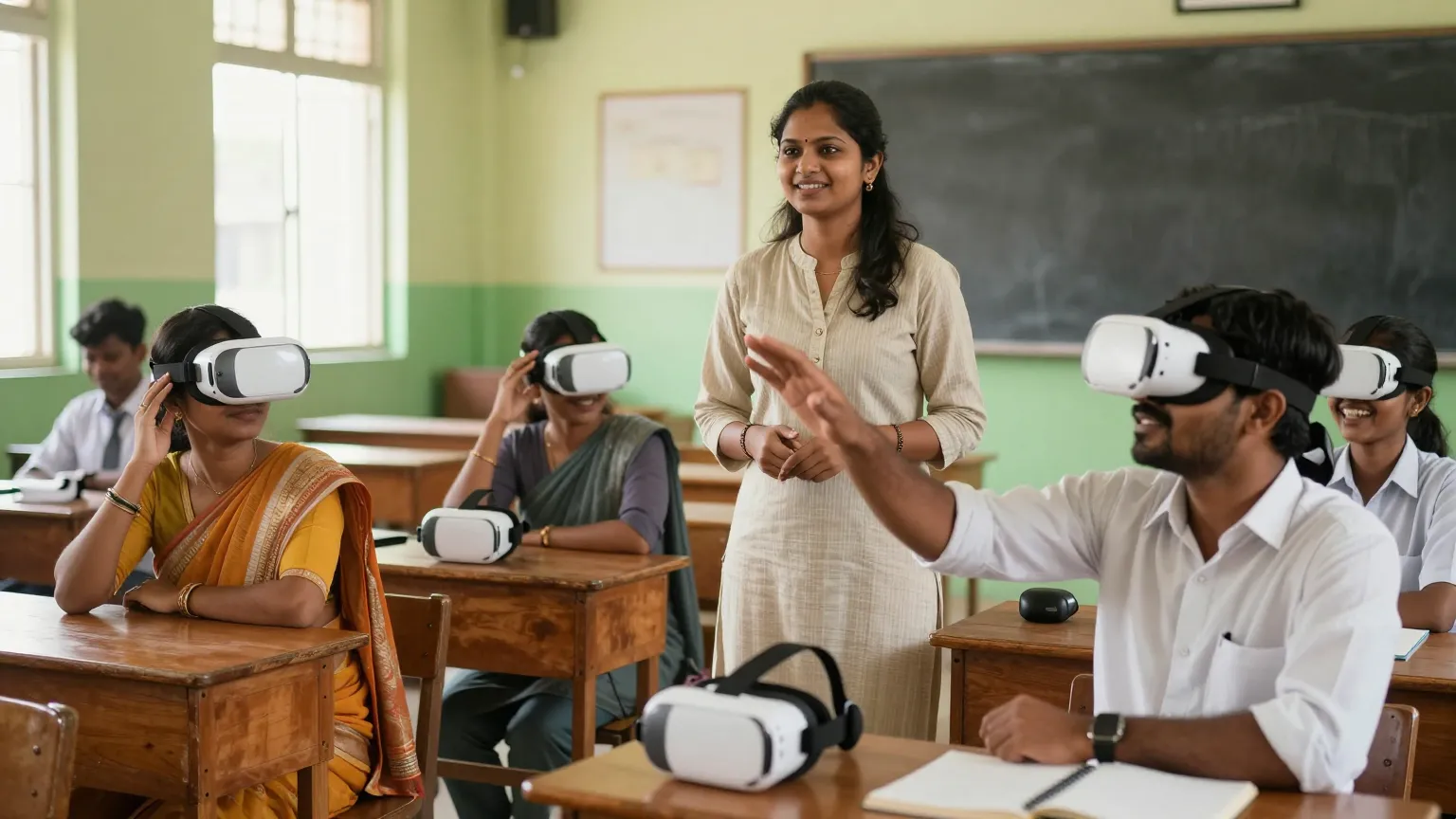
Plan 12 to 16 hours of structured training per teacher across the first term, not a one-day vendor demo. Start with a three-hour hands-on onboarding for all staff, run subject-wise lesson-mapping workshops, appoint two VR lab coordinators, and protect a weekly 30-minute practice slot. Document every session so the hours can count toward CBSE's 50-hour annual CPD requirement.
On 30 October 2026, the Raghbir Singh Freedom Fighter PM SHRI Government High School in Khanna, Punjab, opened what the state minister called the first AI lab in any government school in the state, with VR headsets, tablets and 3D learning modules funded through CSR. The coverage of the launch raised the question every school head eventually faces: who will train the teachers to use it? In our work deploying Abhigyaan across 1,350 Maharashtra Zilla Parishad schools, teacher training has been the single strongest predictor of whether a VR lab is used every week or becomes a room that is opened for visitors.
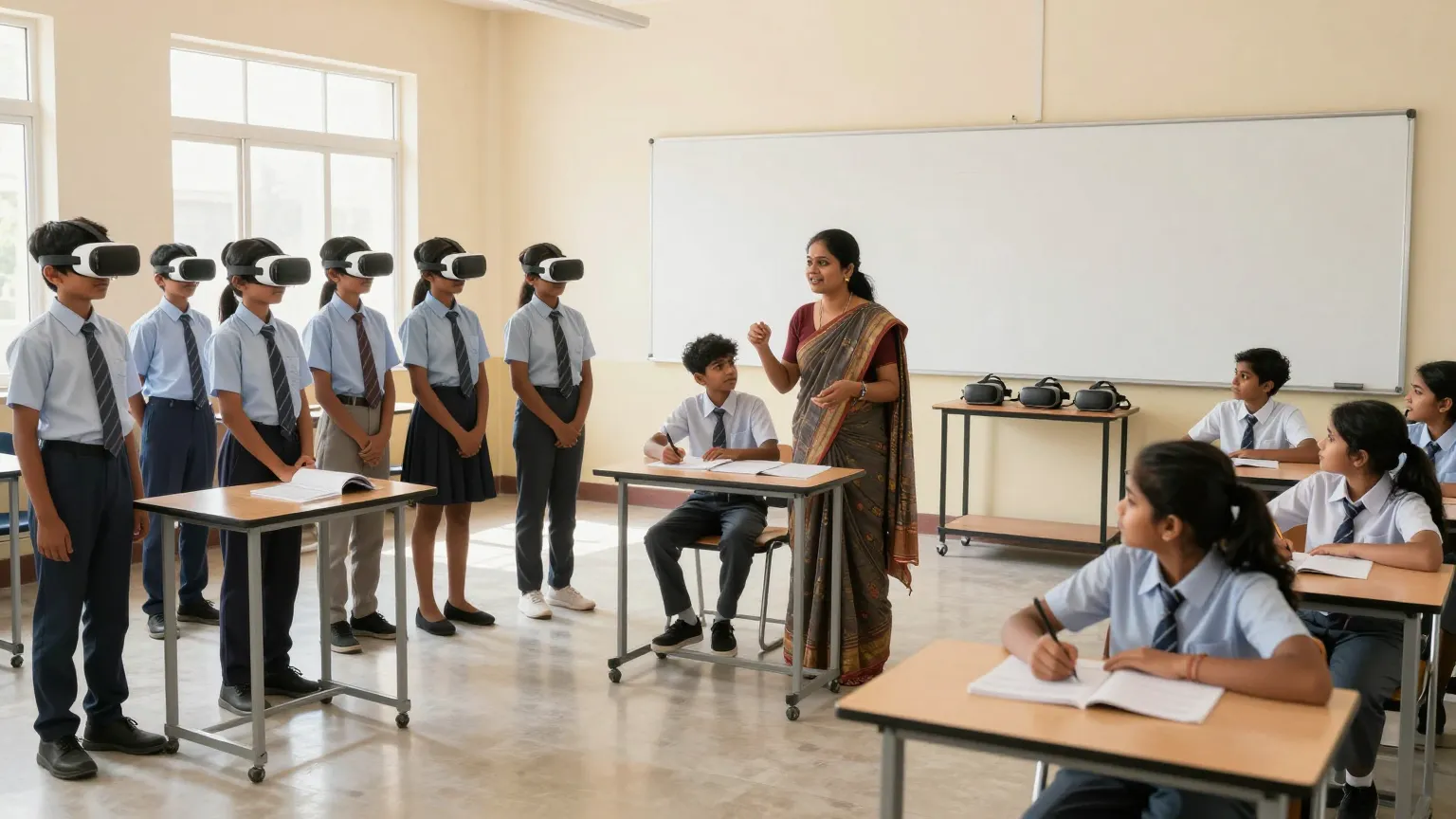
A VR lab changes the teacher's job for 40 minutes at a time. Instead of explaining a diagram, the teacher briefs a group, fits headsets, runs a rotation, handles a student who feels dizzy, and then debriefs the class so the experience turns into marks. None of that is hard, but none of it is instinctive either. Teachers who have done it three times with support will do it on their own; teachers who watched a vendor demo once will avoid the room.
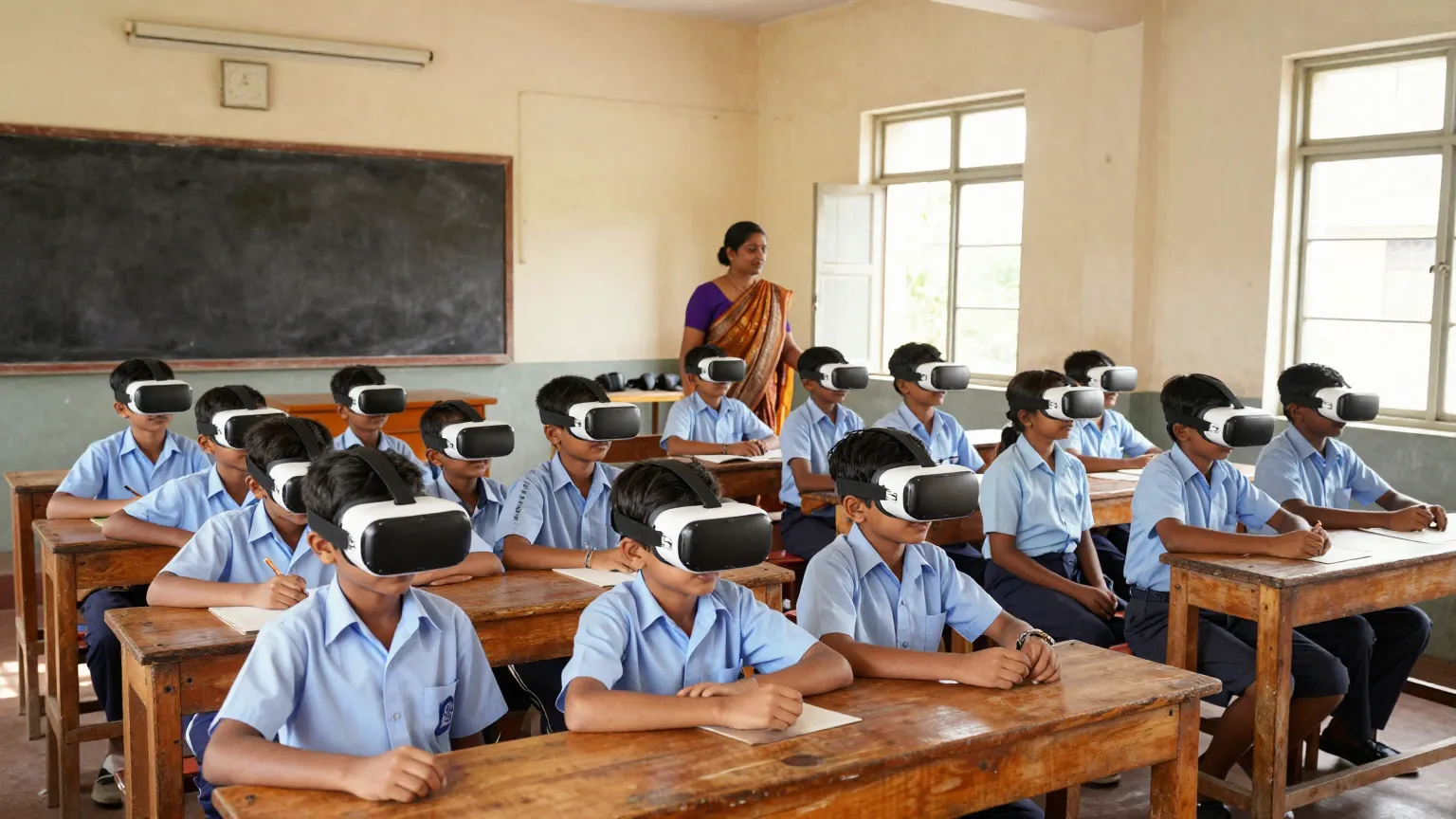
The pattern we see in Indian schools is consistent. Labs that scheduled training before the headsets arrived reach regular use within a month. Labs that relied on an inauguration-day walkthrough stall after the first novelty week, and the headsets end up locked in a cupboard with 60 per cent battery. Before you decide on how many headsets to buy, decide who will be trained and when.
Our recommendation for a typical CBSE or state-board school with 25 to 60 teachers is 12 to 16 hours per teacher in the first term, delivered in five phases. Two of those phases are only for the lab coordinators.
| Phase | Who | Hours | Format | Outcome |
|---|---|---|---|---|
| 0. Coordinator setup (before installation) | 2 VR lab coordinators | 4 | Vendor-led, on site or online | Coordinators can set up, charge, update and troubleshoot every headset |
| 1. Whole-staff onboarding | All teachers | 3 | Hands-on, groups of 10 to 12 | Every teacher has run one 15-minute experience and one rotation |
| 2. Subject lesson mapping | Each department | 4 | Workshop with the syllabus open | 6 to 8 chapters per subject mapped to VR modules with a lesson plan each |
| 3. Weekly practice slot | All teachers | 4 (30 min × 8 weeks) | Coordinator-supported | Each teacher has taught at least two solo VR periods |
| 4. Term review | Coordinators + HoDs | 2 | Data-led review | Utilisation, issues and next-term mapping agreed |
What matters most is spacing: a single eight-hour Saturday session is forgotten by Monday, whereas three hours followed by weekly practice sticks.
The three-hour whole-staff session should be hands-on from the first ten minutes. In the Abhigyaan onboarding format, the agenda is:
Every teacher leaves having run a full mini-lesson with colleagues as the students.
Phase 2 is where the lab stops being a gadget and becomes part of teaching. Each department picks the chapters where VR adds something a textbook cannot: scale (the solar system, cell structure), danger (chemical reactions, electrical circuits), invisibility (magnetic fields, blood circulation) or distance (a Harappan site, a river delta). Six to eight chapters per subject per term is enough; more than that and the lab timetable cannot cope.
For each chapter the teacher writes a one-page plan on a fixed template: learning objective, the VR module and its duration, the pre-brief question, the worksheet for students waiting their turn, the debrief activity, and the assessment item that will appear in the next test. This is the same experiential-learning structure that NEP 2020 and CBSE expect from a VR lab, and it is what an inspector or a parent will ask to see.
In April 2025 CBSE made 50 hours of continuing professional development per year mandatory for every teacher in an affiliated school, split as 25 hours through CBSE or government training institutions and 25 hours through in-house or school-complex training, with the principal certifying the record. For 2026-27 the annual training theme is Computational Thinking and Understanding Artificial Intelligence, with one-day district workshops worth 6 CPD hours and half-day expert sessions worth 3 hours.
A structured, documented VR lab programme fits naturally into the 25 in-house hours: Phases 1 to 4 above add up to 13 hours for a classroom teacher. The conditions are the same as for any in-house training: a written agenda, an attendance record, a named facilitator and evidence of the output, such as the mapped lesson plans. E-content creation, which VR lesson design arguably is, is also among the activities CBSE lists as creditable. Schools should confirm the current circular with their CBSE regional office before recording hours, since the framework is updated each year.
Schools are not on their own. CIET-NCERT runs teacher capacity-building sessions on virtual labs and DIKSHA navigation; in January 2026 it co-hosted a programme with Amrita University that put teachers through five VR stations covering upper-primary physics, chemistry and mathematics on a rotation basis, which is a good model for a district-level workshop. NCERT also hosts the HP Virtual Reality Lab for Teachers Training and R&D in Delhi, set up in 2023 as a template for State Councils of Educational Research and Training to replicate. If your state SCERT or DIET offers a VR or virtual-labs module, it can be counted in the 25 external CPD hours. Government schools funding a lab through Samagra Shiksha or CSR can read how a government school pays for a VR lab for the budget side.
Four numbers tell you within one term whether the programme has landed:
Abhigyaan, Qodequay's VR/XR immersive learning platform, is deployed in 1,350 Maharashtra Zilla Parishad schools reaching 1.5M+ students, and one-time teacher training is part of every deployment. The onboarding follows the five phases above, with CBSE and state-board chapter mapping done with each department, a multilingual AI voice assistant inside the experiences, an AI agent that reminds teachers of scheduled VR periods, and student telemetry that gives school leaders the utilisation and learning numbers without manual registers. We also provide the agenda and attendance templates schools need to record the hours as in-house CPD.
If you are planning a VR lab or have one that is under-used, book a 30-minute call with our education team and we will map a teacher-training plan to your staff size and timetable.
All subject teachers whose chapters are mapped to VR should complete the three-hour onboarding, so that the lab is not dependent on one person. Appoint two lab coordinators, typically a science teacher and the computer teacher, who receive an extra four hours on setup, charging, updates and troubleshooting.
Most teachers run a solo VR period confidently after one three-hour hands-on session followed by two or three supported periods, usually within four to six weeks. Weekly 30-minute practice slots in the first term matter more than the length of the initial session, because spacing is what makes the routine stick.
No. School VR platforms are designed to be run by subject teachers from a tablet or laptop dashboard. Two trained lab coordinators handle charging, software updates and Wi-Fi issues, and the vendor provides remote support. Dedicated IT staff help in larger schools but are not a requirement for daily use.
A structured and documented in-house VR training programme can be recorded within the 25 in-house hours of CBSE's 50-hour annual CPD requirement, provided there is an agenda, attendance record, facilitator and evidence of output. Schools should confirm the current CBSE circular with their regional office before certifying the hours.
A one-page plan per chapter: the learning objective, the VR module and its duration, a pre-brief question, a worksheet for students waiting their turn in the rotation, a debrief activity that links the experience back to the textbook, and the assessment item that will appear in the next class test.

I am a founder director at Qodequay Technologies Pvt. Ltd., a leading digital transformation consulting firm that helps clients across industries to innovate, optimize, and grow their businesses. I have over two decades of experience in the digital domain, spanning product development, e-commerce, user experience, design thinking, web and app development, and business leadership. My core competencies include developing and executing digital transformation strategies, building teams globally, roadmaps, and solutions that leverage data, insights, and emerging technologies such as artificial intelligence, augmented reality, blockchain, and immersive experience. I also have expertise in digital commerce, supply chain integration, and product management, having worked with both B2B and B2C brands in various sectors. My mission is to create value for customers and stakeholders by delivering impactful and engaging digital experiences that drive growth and innovation.
November 8, 2026

November 7, 2026

November 6, 2026
November 5, 2026

November 4, 2026
Monthly insights on AI, VR and DPDPA compliance — straight from our team to your inbox.
Free 30-minute consultation with our team — or see our products in action.