How many VR headsets does a school need for a VR lab?
November 3, 2026
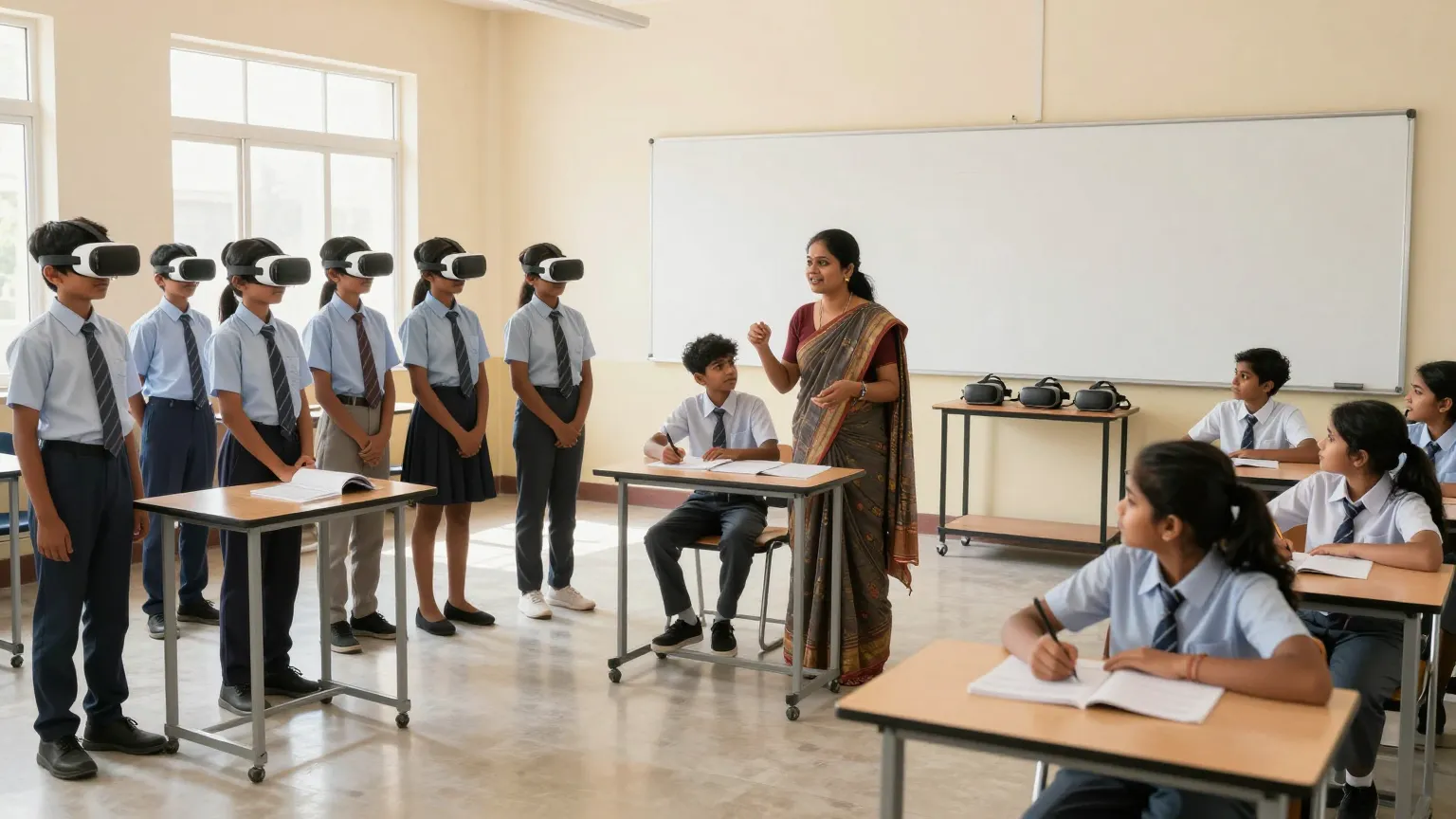
Between 10 and 22 headsets for most Indian schools, not one per student. Size the lab for the largest group that will wear headsets at the same time, plus 10% spares. A 40-student section on a half-class rotation needs 22; a three-station rotation needs 14; a shared mobile cart serving pairs needs 10 to 12.
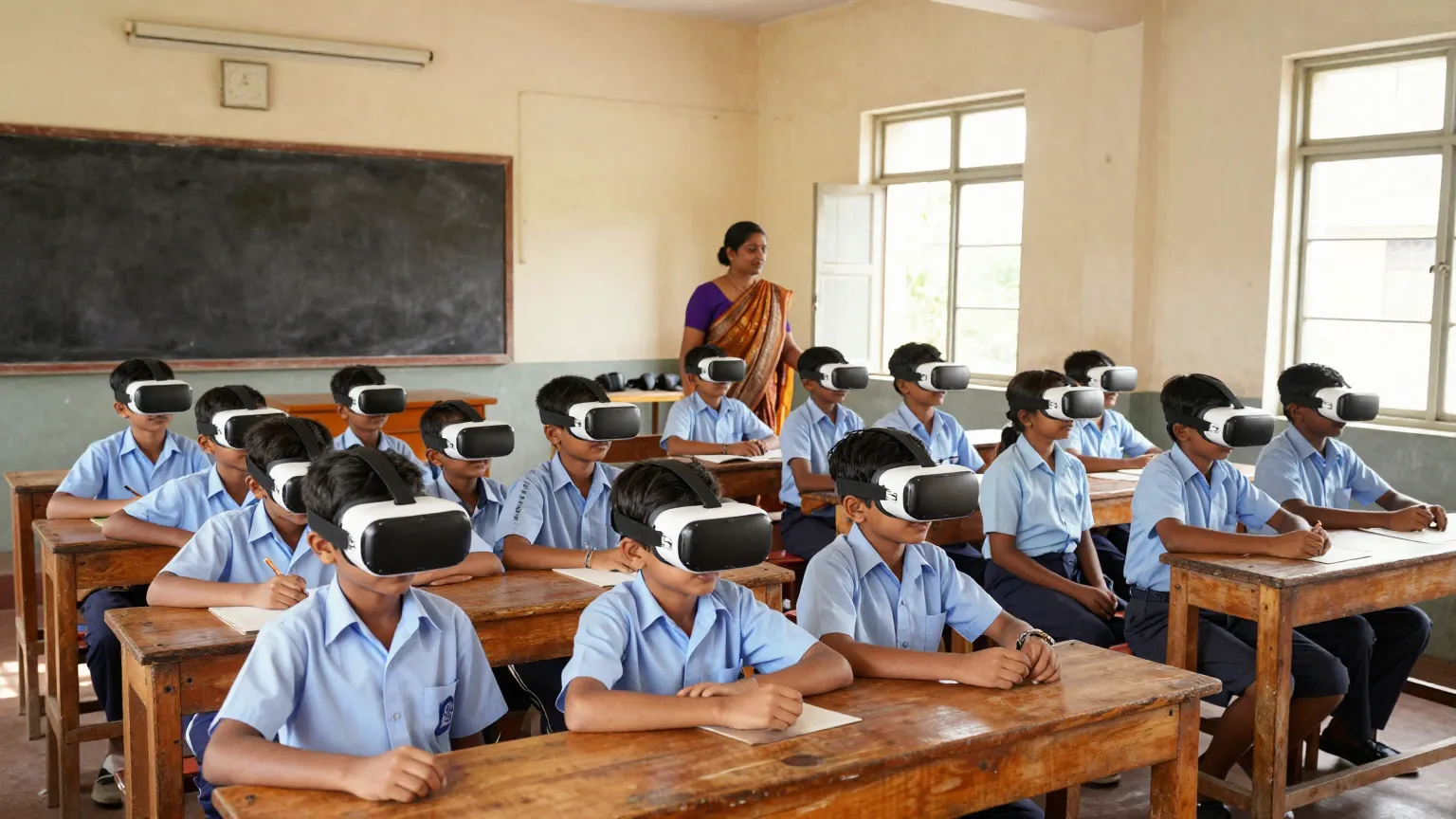
On 30 October 2026, Raghbir Singh Freedom Fighter PM SHRI Government High School in Khanna became the first government school in Punjab with a dedicated AI lab, funded under CSR and inaugurated by Cabinet Minister Tarunpreet Singh Sond. The design is instructive: VR headsets for science and mathematics sit alongside eight tablets with headphones and a projector. Nobody planned a headset for every child. That is the right instinct, and it is the question principals ask us most often after price: how many headsets do we actually need?
Three constraints make a 1:1 ratio wasteful. First, session length: Meta rates its Quest headsets for ages 10 and above and advises a break at least every 30 minutes, and the Indian schools we work with keep younger students to turns of 10 to 15 minutes, as we set out in our guide to VR safety for school children. A 40-minute period therefore cannot keep 40 students immersed for 40 minutes, whatever the budget.
Second, supervision: one teacher cannot monitor 40 headsets, help students who need a fit adjustment, and run the lesson at the same time. Third, pedagogy: coverage of PM SHRI VR labs built on the Ministry of Education's own reporting stresses that VR is not instruction by itself; what happens before and after the headset is where the concept is consolidated. A lab designed around rotation gives every student a VR turn and a teacher-led turn in the same period.
We use one rule in every deployment: headsets needed = the largest group wearing headsets at the same time + 10% spares. The spares matter because a dead battery or a cracked strap should never cost a group its turn. The largest simultaneous group depends on the rotation model you choose, and the table shows what each model means for a typical 40-student section.
| Rotation model | Students in VR at once (40-student section) | Headsets incl. 10% spares | Where it fits |
|---|---|---|---|
| Whole class at once | 40 | 44 | Rarely justified; supervision and cost both fail |
| Half-class rotation (two stations) | 20 | 22 | Dedicated lab with a co-teacher or lab assistant |
| Three-station rotation | 13–14 | 14–15 | Single teacher, 40-minute period, most CBSE and state board schools |
| Pairs: one in VR, one guiding (1:2) | 20 in pairs = 20 headsets, or 10 if pairs alternate | 11–22 | Practical-style lessons where the partner records observations |
| Shared mobile cart | 8–12 | 10–13 | Pilots, or headsets travelling between classrooms |
The 1:2 pairing ratio is not our invention. A headset-sizing guide published by the nursing-simulation platform UbiSim recommends roughly one headset for every two learners when peers work together, one per three or four when some learners observe, and a floor of three headsets per 50 learners. School classes are larger and periods shorter than nursing cohorts, which is why the three-station model lands at 14 for most Indian sections.
The three-station rotation is the model we recommend to schools with a single teacher per section. It turns the lab into three parallel activities on the same concept, so the headset is one step in the lesson rather than the whole lesson.
Each student gets one 10-minute immersive turn, well inside the 30-minute break guidance, and the teacher never has more than 14 headsets live. The Khanna lab's combination of headsets, tablets and a projector is exactly this three-station layout in hardware form.
For government and aided schools the budget is usually fixed before the lab is designed. The Samagra Shiksha ICT and digital initiatives component provides a non-recurring grant of ₹6.40 lakh per school and a recurring ₹2.40 lakh a year, as we explained in how an Indian government school can pay for a VR lab. Rather than quote headset prices, which shift with import duty and model refreshes, work backwards: set aside roughly a quarter of the non-recurring grant for the charging trolley, a teacher device, Wi-Fi and room preparation, then divide the balance by the per-headset price on your vendor's quotation. Whatever number that gives, compare it with the 14-headset three-station figure; if the grant stretches to more, spend the surplus on content and teacher training rather than extra devices, because the recurring ₹2.40 lakh has to carry licences, device management and repairs every year.
Private and CBSE schools budgeting from fees or CSR should run the same arithmetic over three years. Our VR lab budgeting guide for CBSE schools lists the ten cost lines, and headsets are only one of them.
Count periods, not students. A dedicated lab with six usable periods a day across a five-day week offers 30 slots. If every section visits once a week, a single 14-headset lab serves 30 sections, which is a school of roughly 1,200 students. Beyond that, a second headset set on a mobile cart is cheaper than a second room, and it lets Classes 6 to 8, who use VR most for science and geography, get two visits a week while senior classes keep one. Schools with more than 50 sections should plan two labs or one lab plus two carts, and should stagger timetables so the same content package is not needed in both places at the same hour.
The same timetable logic applies at scale. Abhigyaan, our immersive learning platform, is deployed in 1,350 Maharashtra Zilla Parishad schools reaching 1.5M+ students, and the deployment works because every school runs small, teacher-controlled headset sets on a rotation rather than attempting one headset per child.
Four decisions shape the number more than the budget does. Content mapping: if your lessons are mapped to CBSE, NEP 2020 and your state board chapter by chapter, every period in the lab is a syllabus period and utilisation stays high; generic experiences get used twice and then gather dust. Teacher control: the teacher must be able to launch, pause and monitor every headset from one device, otherwise 14 is already too many. Multi-user experiences: platforms where several students share one virtual space let a group of 14 learn together rather than 14 students in 14 isolated apps. Session data: if the platform records which student completed which experience, the teacher knows who still needs a turn, and the school has evidence for the management committee and the district.
Abhigyaan is built around those four decisions: complete CBSE and NEP 2020-aligned curriculum coverage, a teacher dashboard with session control, multi-user immersive experiences, a multilingual AI voice tutor, and student telemetry that shows exactly who has learned what. Qodequay Technologies is ISO 9001:2015 and ISO 27001:2022 certified.
If you are sizing a lab for your school, we will build the headset count, rotation plan and three-year budget from your actual timetable, and run a free demo for your teachers. Book a 30-minute VR lab planning call.
Fourteen to fifteen headsets with a three-station rotation, where about 13 students are in VR while the others work with the teacher or on a written task. A half-class rotation needs 22 including spares. Only a whole-class-at-once model needs 40, and that model fails on supervision, session length and cost.
Ten to fifteen minutes per student turn for school-age learners. Meta rates its Quest headsets for ages 10 and above and advises a break at least every 30 minutes. A 40-minute Indian school period therefore fits one immersive turn per student inside a three-station rotation, with briefing and debrief around it.
A published simulation guide from UbiSim recommends about one headset per two learners when peers work in pairs, one per three or four when some observe, and a minimum of three per 50 learners. For Indian school sections of 40, a rotation of 13 or 14 students in VR at once is the practical equivalent.
The Samagra Shiksha ICT and digital initiatives component provides ₹6.40 lakh non-recurring and ₹2.40 lakh a year recurring per school. After reserving roughly a quarter of the non-recurring grant for charging, a teacher device and Wi-Fi, divide the remainder by the quoted headset price; the recurring grant must then cover content licences and repairs.
A lab used for six periods a day over a five-day week has 30 slots. If each section visits once a week, one 14-headset lab serves 30 sections, roughly 1,200 students. Larger schools add a second headset set on a mobile cart, which costs less than a second room and lets junior classes visit twice weekly.

I am a founder director at Qodequay Technologies Pvt. Ltd., a leading digital transformation consulting firm that helps clients across industries to innovate, optimize, and grow their businesses. I have over two decades of experience in the digital domain, spanning product development, e-commerce, user experience, design thinking, web and app development, and business leadership. My core competencies include developing and executing digital transformation strategies, building teams globally, roadmaps, and solutions that leverage data, insights, and emerging technologies such as artificial intelligence, augmented reality, blockchain, and immersive experience. I also have expertise in digital commerce, supply chain integration, and product management, having worked with both B2B and B2C brands in various sectors. My mission is to create value for customers and stakeholders by delivering impactful and engaging digital experiences that drive growth and innovation.
November 3, 2026

November 2, 2026

November 1, 2026
October 31, 2026
October 30, 2026
Monthly insights on AI, VR and DPDPA compliance — straight from our team to your inbox.
Free 30-minute consultation with our team — or see our products in action.