Can VR train Indian workers for confined-space and work-at-height jobs?
November 5, 2026
November 5, 2026
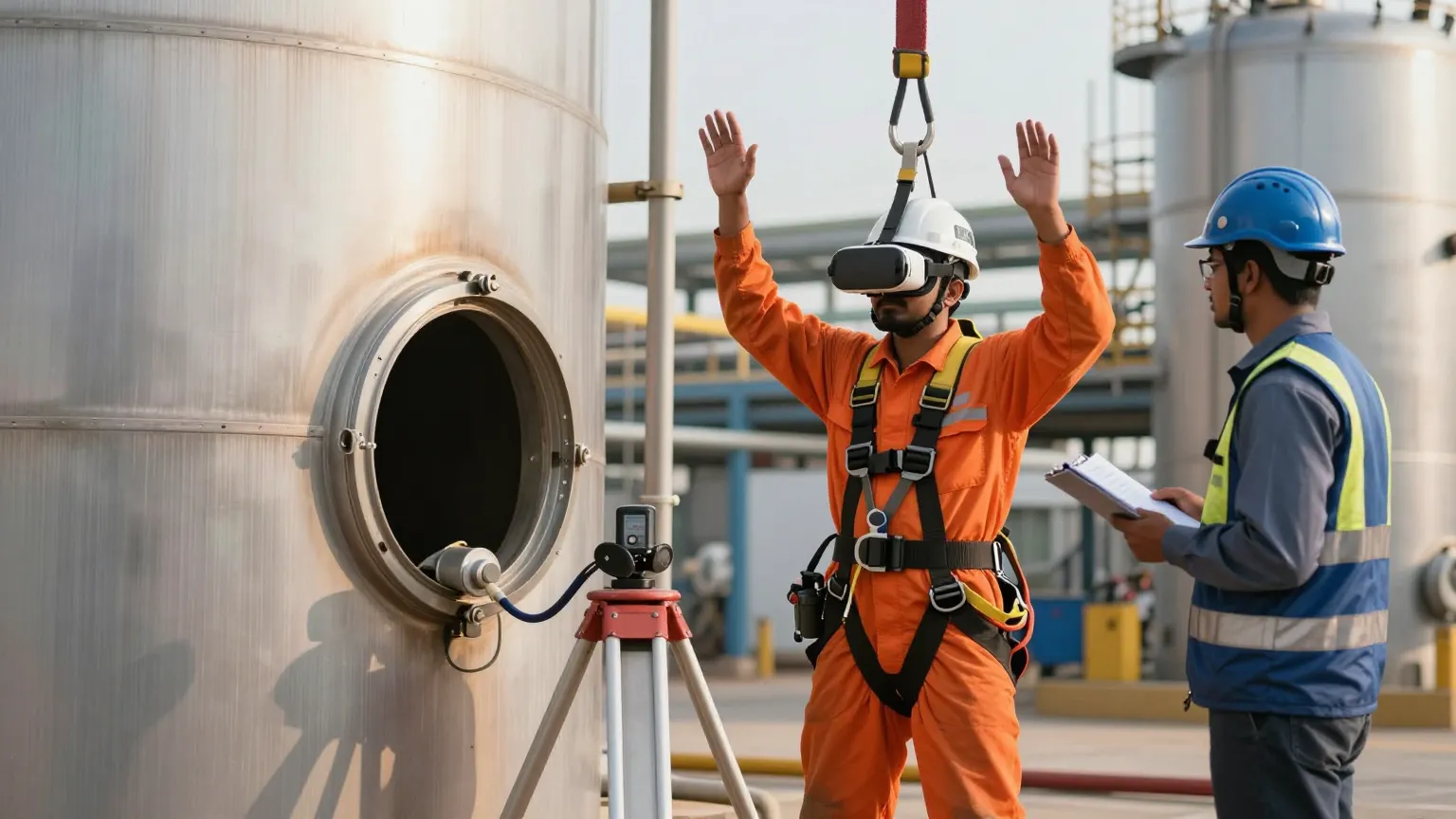
Yes, for the decision-making and rescue parts of the job. VR lets a worker rehearse gas testing, permit checks, harness anchoring and a casualty rescue dozens of times without entering a live tank or climbing a live structure. It does not replace the competent-person certificate under Section 36 of the Factories Act, physical equipment checks or a supervised practical assessment; it makes those steps far likelier to be done correctly.
Confined spaces and heights are where Indian industry keeps losing people. A tank that was "checked yesterday", a manhole opened without a gas test, a harness clipped to a handrail instead of an anchor point, a rescuer who goes in after a collapsed colleague without breathing apparatus and becomes the second casualty. Most of these deaths follow the same script, and most involve contract workers who were inducted in a classroom and never practised the one decision that mattered.
This post looks at what virtual reality can realistically add to confined-space and work-at-height training in an Indian plant, what it cannot replace, and how to run it for a contract workforce that changes every quarter.
The numbers are grim and remarkably stable. The National Commission for Safai Karamcharis recorded 31 deaths during sewer and septic-tank cleaning in 2026 up to 20 October, after 51 in 2025 and 54 in 2024; across 2016 to 2026 it counts 773. A Lok Sabha reply in August 2026 put the figure at 498 deaths between January 2019 and June 2026. Those are only the sanitation cases that reach a database. Confined-space entries inside refineries, fertiliser plants, breweries, sugar mills and shipyards are not counted anywhere nationally.
Falls from height are a similar story. They remain one of the largest contributors to fatal industrial accidents in India across construction, steel, power and maintenance work, yet the fatality data sits scattered across state factory inspectorates. The pattern behind the headlines is consistent: an IndustriALL review in June 2026 noted that inspection coverage in hazardous-process factories stayed below 40 per cent in 2023, that a third of injured manufacturing workers had received no training at all and had learnt on the machine, and that contract workers are increasingly doing core hazardous work.
In other words, the gap is not knowledge of the rules. Most workers can recite "test the atmosphere before entry". The gap is behaviour under pressure, and that is what classroom training cannot rehearse.
VR has to fit inside a statutory framework, not float above it. The core obligations sit in the Factories Act, 1948 and the state Factories Rules made under it, with the Occupational Safety, Health and Working Conditions Code, 2020 now layered on top. We covered how VR maps to the Code in Can VR safety training meet OSH Code requirements?; the specific duties for these two hazards are below.
| Hazard | What the Factories Act requires | What training must therefore cover |
|---|---|---|
| Confined-space entry | Section 36: no entry into a chamber, tank, vat, pit, pipe or flue until a competent person certifies in writing that it is free of dangerous fumes and fit for entry, or the worker wears suitable breathing apparatus with a belt and rope held by a person outside | Reading the certificate, gas-test sequence, isolation, continuous monitoring, when to refuse entry |
| Rescue readiness | Section 36 also requires breathing apparatus, reviving apparatus, belts and ropes to be kept ready, and a sufficient number of persons to be trained and practised in their use and in restoring respiration | Non-entry rescue with tripod and winch, breathing-apparatus donning, resuscitation, the rule that a rescuer never enters unprotected |
| Work at height | Section 32: where any person has to work at a height from which they are likely to fall, provision must be made by fencing or otherwise to ensure safety; construction sites follow the BOCW Central Rules, 2008 | Anchor-point selection, harness inspection, three-point contact, edge protection, dropped-object control, suspension-trauma response |
| Contract workers | The principal employer carries responsibility for safety on its premises under the OSH Code and the Contract Labour (Regulation and Abolition) Act, 1970 | Induction before the gate pass is issued, in the worker's own language, with a record the principal employer can produce |
Two things stand out. Section 36 explicitly demands people who are practised in rescue, not merely informed about it. And the duty to train contract workers sits with the principal employer, whoever signs their wage slip.
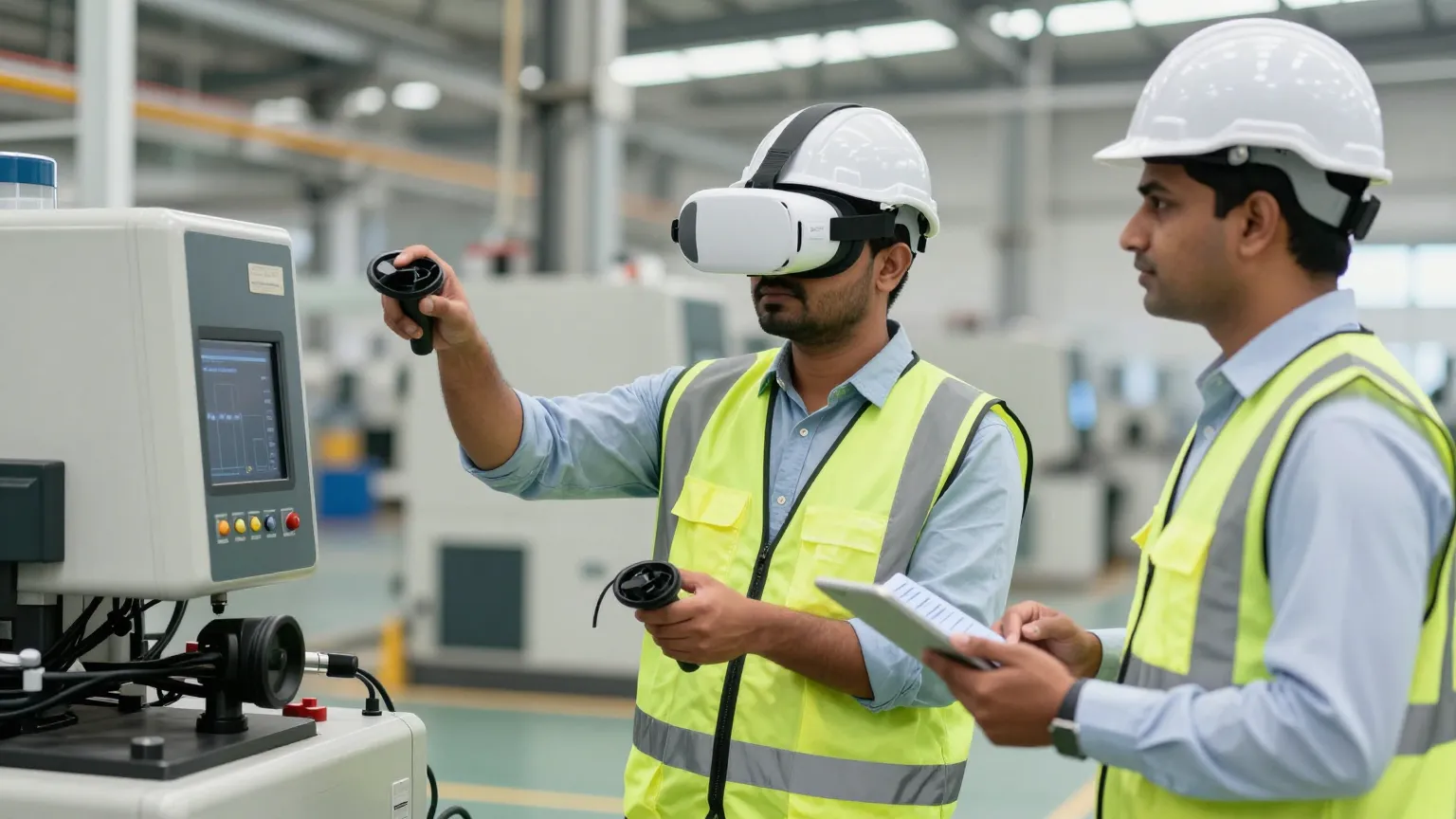
Immersive VR puts the worker at the manhole or on the structure, with the physiological stress that comes with it: the hesitation at an edge, the urge to climb in after a collapsed colleague. The value is in rehearsing the decisions that get skipped under time pressure. A well-built module runs these drills, scoring each decision rather than each click:
Rescue is the drill that matters most and is practised least, because live rescue exercises are disruptive and expensive. A September 2026 industry guide on working-at-height VR puts the time budget at a 20 to 30 minute guided pass and a 10 to 15 minute scored assessment, roughly 45 minutes per worker including headset fitting, plus a separate rescue practice of about 20 minutes. Every worker on every shift can get that; nobody gets it from an annual mock drill.
Be clear with auditors and with yourself about the boundary. VR does not issue the Section 36 certificate; a competent person with a calibrated instrument does. It does not fit-test a harness or a breathing-apparatus mask on a real face. It does not replace the permit-to-work system, the physical inspection of tripods, lanyards and gas detectors, or a supervised practical assessment on a real structure. What VR replaces is the classroom decision-making component and the "rescue awareness" slide, and what it adds is a scored record that the worker has actually done the sequence.
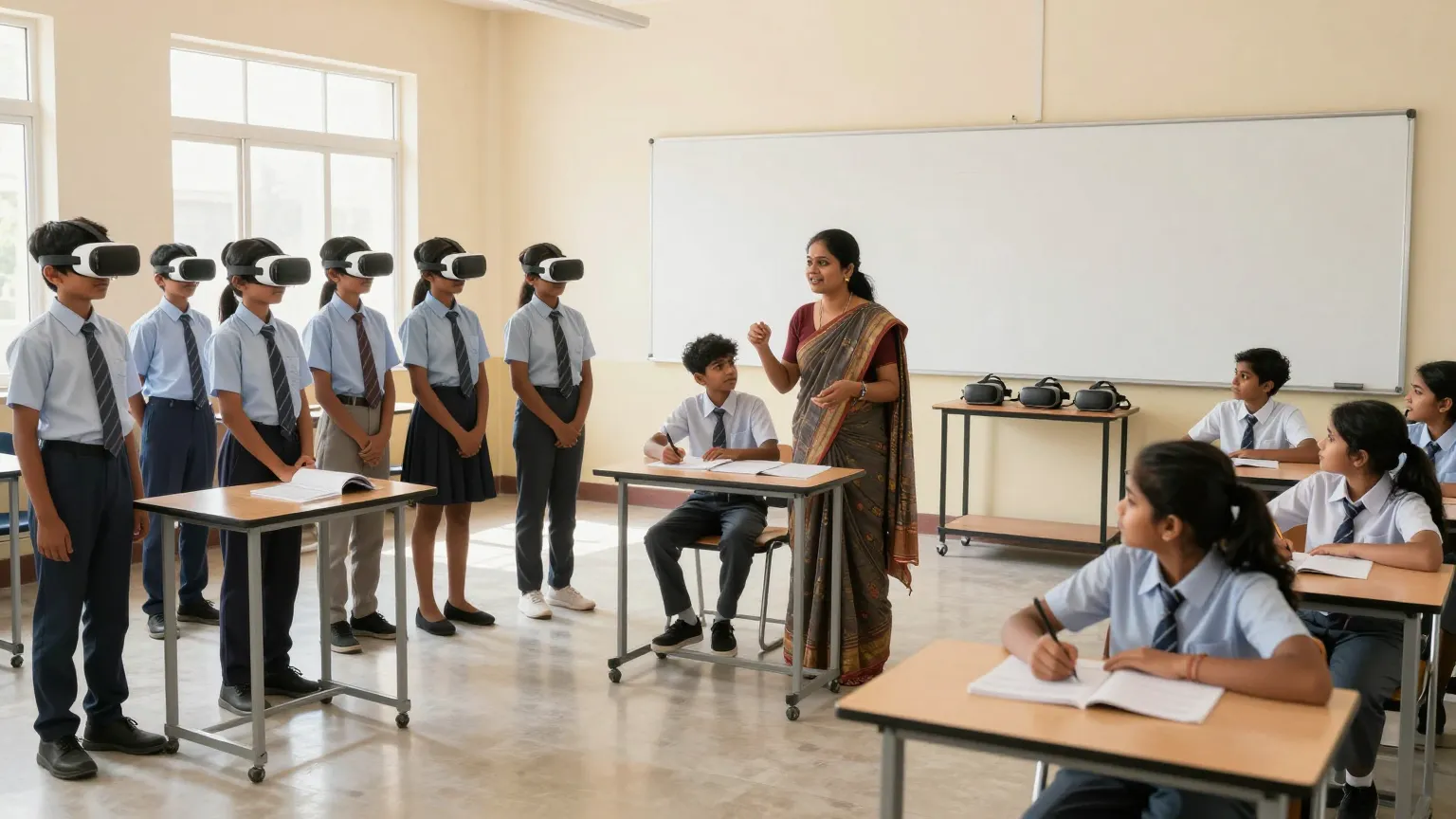
The workforce problem is churn. A refinery turnaround or a steel-plant shutdown can bring in several hundred contract workers for six weeks, many of whom have never seen that site. A classroom induction for 300 people is a formality; a 45-minute VR module per person, run on a bank of ten headsets, processes 300 workers in a working week and leaves a score against each gate pass. In practice the model we see working looks like this:
On cost, the ranges in our earlier post on what VR safety training costs an Indian factory apply: roughly ₹6 to 45 lakh per module depending on fidelity, headsets at ₹50,000 to 70,000 each, 8 to 14 weeks to build, and cost parity with instructor-led training somewhere between 200 and 400 trainees. Confined-space and height modules sit at the upper-middle of that range because rescue sequences need physics and multi-user support, but they also cover the two hazards with the worst fatality record on most sites.
Attendance sheets prove presence. VR produces decision records: did the worker test the atmosphere before entry, in the right order, every time? How long did they take to notice the expired permit? Did they go in after the casualty? Track three things over a year: assessment scores on first attempt and after refresh, near-miss reports on confined-space and height work (which usually rise at first as workers learn to recognise them), and permit audit findings. Pair them with the physical practical sign-off. We do not promise a specific reduction in incidents, and you should be sceptical of any vendor who does; what the format gives you is evidence of competence that stands up when an inspector, or a court, asks what training the worker actually received. Our fire-safety post covers the same evidence logic for evacuation drills.
Abhigyaan Pro is Qodequay's immersive training platform for industry and defence, built in Pune and developed to professional grade with AFMC. It runs multi-user training simulations and collaborative rooms, works on a VR headset and in a browser in the same session, hosts in Indian data centres by default with an air-gapped option for sensitive sites, and supports regional-language voice-over. Qodequay is ISO 9001:2015 and ISO 27001:2022 certified. If you want to scope a confined-space or work-at-height module for a plant or a contractor pool, book a 30-minute call and bring your current permit-to-work format; that is where the module design starts.
Partly. Section 36 requires a competent-person certificate or breathing apparatus before entry, and a sufficient number of workers trained and practised in rescue and resuscitation. VR is strong evidence of practised rescue and entry decisions, but the certificate, equipment fit and a supervised practical check remain physical, statutory steps that VR does not replace.
Plan for about 45 minutes per worker on the first pass: a 20 to 30 minute guided walk-through, a 10 to 15 minute scored assessment and headset fitting. A separate rescue practice takes around 20 minutes. Refresher assessments every six or twelve months are shorter because the worker skips the guided pass.
Yes, and that is one of its strengths. A module with voice-over in Hindi, Marathi, Odia, Tamil or another regional language, driven by looking and reaching rather than reading, removes literacy as a hidden filter. The score records what the worker did, not what they could read, which matters for turnaround crews drawn from many states.
Using the ranges from our cost guide, a custom module runs roughly ₹6 to 45 lakh depending on fidelity, with headsets at ₹50,000 to 70,000 each and 8 to 14 weeks to build. Confined-space and height modules sit in the upper-middle of that range because rescue sequences need physics and multi-user support.
No. It makes the physical drill rarer and better. Workers arrive at the tripod already knowing the sequence, so the live exercise tests equipment handling and teamwork rather than teaching basics. Keep at least one supervised physical drill per crew and record the VR score and the practical sign-off together in one training file.
This article is for general information and is not legal advice. Confirm obligations against the official text of the Factories Act, 1948, your state Factories Rules, the Occupational Safety, Health and Working Conditions Code, 2020 and the rules notified under it, and consult qualified counsel or a certified safety professional for your situation.

I am a founder director at Qodequay Technologies Pvt. Ltd., a leading digital transformation consulting firm that helps clients across industries to innovate, optimize, and grow their businesses. I have over two decades of experience in the digital domain, spanning product development, e-commerce, user experience, design thinking, web and app development, and business leadership. My core competencies include developing and executing digital transformation strategies, building teams globally, roadmaps, and solutions that leverage data, insights, and emerging technologies such as artificial intelligence, augmented reality, blockchain, and immersive experience. I also have expertise in digital commerce, supply chain integration, and product management, having worked with both B2B and B2C brands in various sectors. My mission is to create value for customers and stakeholders by delivering impactful and engaging digital experiences that drive growth and innovation.
November 5, 2026

November 4, 2026
November 3, 2026

November 2, 2026

November 1, 2026
Monthly insights on AI, VR and DPDPA compliance — straight from our team to your inbox.
Free 30-minute consultation with our team — or see our products in action.