How often must an Indian factory run an emergency mock drill, and can VR make it count?
November 10, 2026
November 10, 2026
Every six months, if the plant handles hazardous chemicals above the threshold quantities. Rule 13(4) of the Manufacture, Storage and Import of Hazardous Chemicals Rules, 1989 requires a mock drill of the on-site emergency plan every six months, with a report made available to the authority. VR cannot replace that drill, but it can rehearse the decisions each worker must make before the siren sounds.
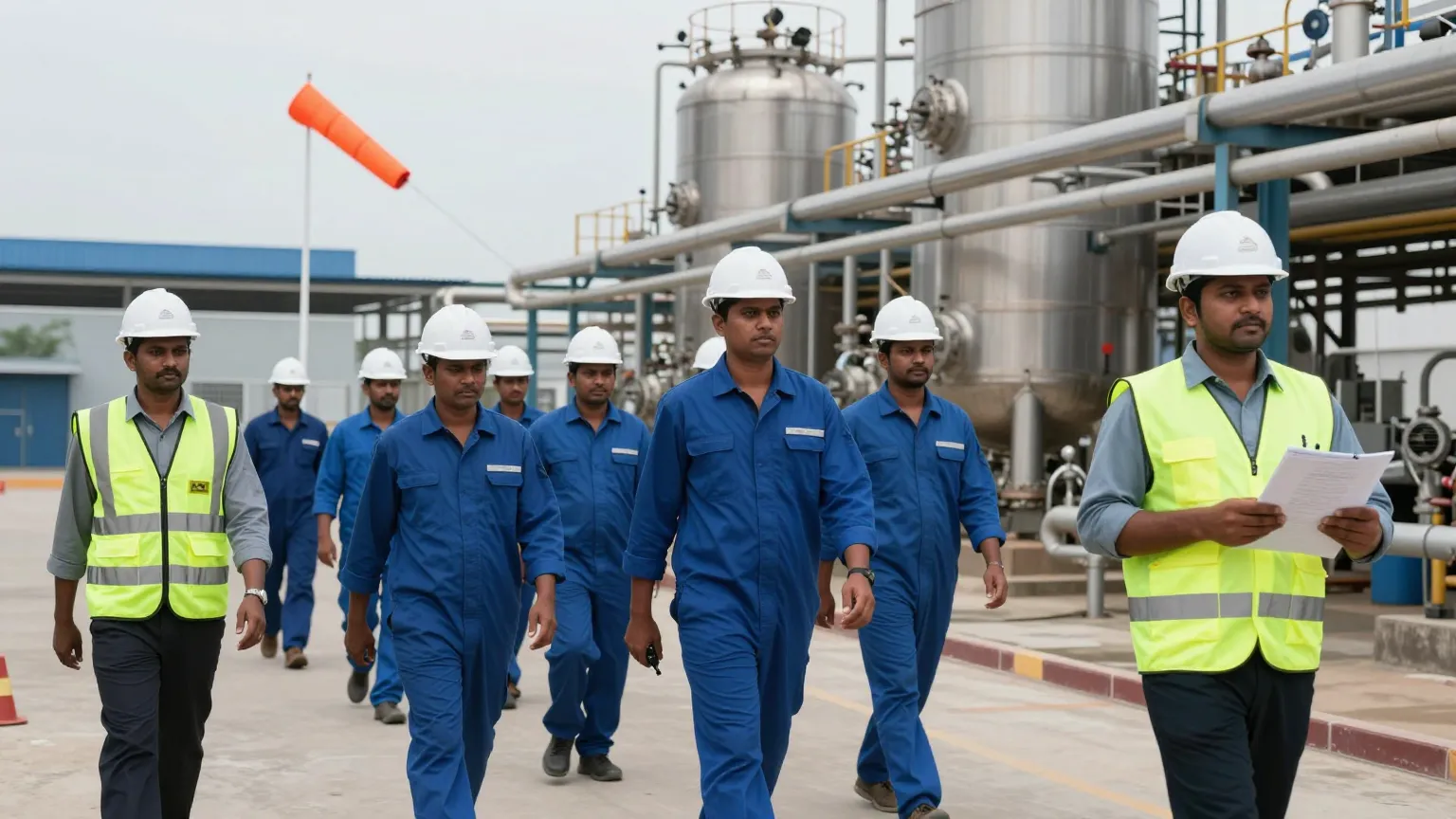
On many Indian sites the six-monthly mock drill is a siren at 11 a.m., a walk to the assembly point, a head count and a signature. Nobody is tested on whether they would have gone upwind, whether the shift electrician knew who the incident controller was, or whether the contract crew in the effluent-treatment plant even heard the alarm.
The deaths near Hosur on 9 November 2026, where press reports say three contract workers collapsed after inhaling gas inside a wastewater-treatment tank at an electronics component plant, are a reminder that the people most exposed to a chemical emergency are often the least rehearsed for it. This post sets out what Indian law requires on drill frequency, what a drill must demonstrate, and where immersive VR can raise the standard without pretending to replace it.
Three instruments stack on top of each other. The Factories Act, 1948 sets the duty; the Manufacture, Storage and Import of Hazardous Chemicals (MSIHC) Rules, 1989 set the frequency; and the Chemical Accidents (Emergency Planning, Preparedness and Response) Rules, 1996 add the district and local layers for Major Accident Hazard (MAH) sites.
| Obligation | Source | What it says |
|---|---|---|
| On-site emergency plan | Factories Act, Section 41B(4); MSIHC Rule 13(1) | The occupier of a hazardous-process factory must draw up an on-site emergency plan and disaster-control measures and make the safety measures known to workers and the public living nearby. Rule 13(1) requires the plan to contain the Schedule 11 particulars and to name the person responsible for site safety. |
| Everyone on site briefed | MSIHC Rule 13(2) | The plan must be kept current with any change to the industrial activity, and every person on site affected by it must be informed of its relevant provisions. |
| Mock drill frequency | MSIHC Rule 13(4) | A mock drill of the on-site emergency plan must be conducted every six months. The sub-rule was inserted by notification S.O. 2882(E) of 3 October 1994. |
| Drill report | MSIHC Rule 13(5) | A detailed report of each mock drill must be made immediately available to the concerned authority, in most states the Directorate of Industrial Safety and Health. |
| Local full-scale drill | Chemical Accidents Rules, Rule 10(2)(e) | The Local Crisis Group conducts at least one full-scale mock drill of a chemical accident at a site every six months. |
| District full-scale drill | Chemical Accidents Rules, Rule 9(2)(g) | The District Crisis Group conducts at least one full-scale mock drill of a chemical accident at a site each year. |
The MAH trigger is quantity. A site becomes a Major Accident Hazard installation when it handles a listed chemical at or above the threshold quantity in column 3 of Schedule 2 or Schedule 3 of the MSIHC Rules. Below the threshold, the Factories Act duties for hazardous processes still apply, and most state Factories Rules and the Occupational Safety, Health and Working Conditions Code, 2020 expect periodic drills in any case, which we covered in Can VR safety training meet OSH Code requirements?
The frequency is not the problem; the limit is what a drill can physically test. A full plant evacuation stops production, so it is scheduled, announced and run in daylight on a weekday. The night shift, the contractors who arrived last month and the tanker driver at the loading bay are rarely in it. The scenario is almost always a fire or a generic "gas leak", because releasing a real toxic cloud to test shelter-in-place is impossible.
So the drill tests the alarm, the muster and the head count. It cannot test whether a worker in the tank farm moves crosswind rather than downwind, whether an operator isolates a valve or runs, whether the incident controller calls the District Emergency Authority early enough, or whether a rescuer enters a tank after a fallen colleague without breathing apparatus. Those decisions are what kill people, as our post on VR for confined-space and work-at-height jobs argued about rescue.
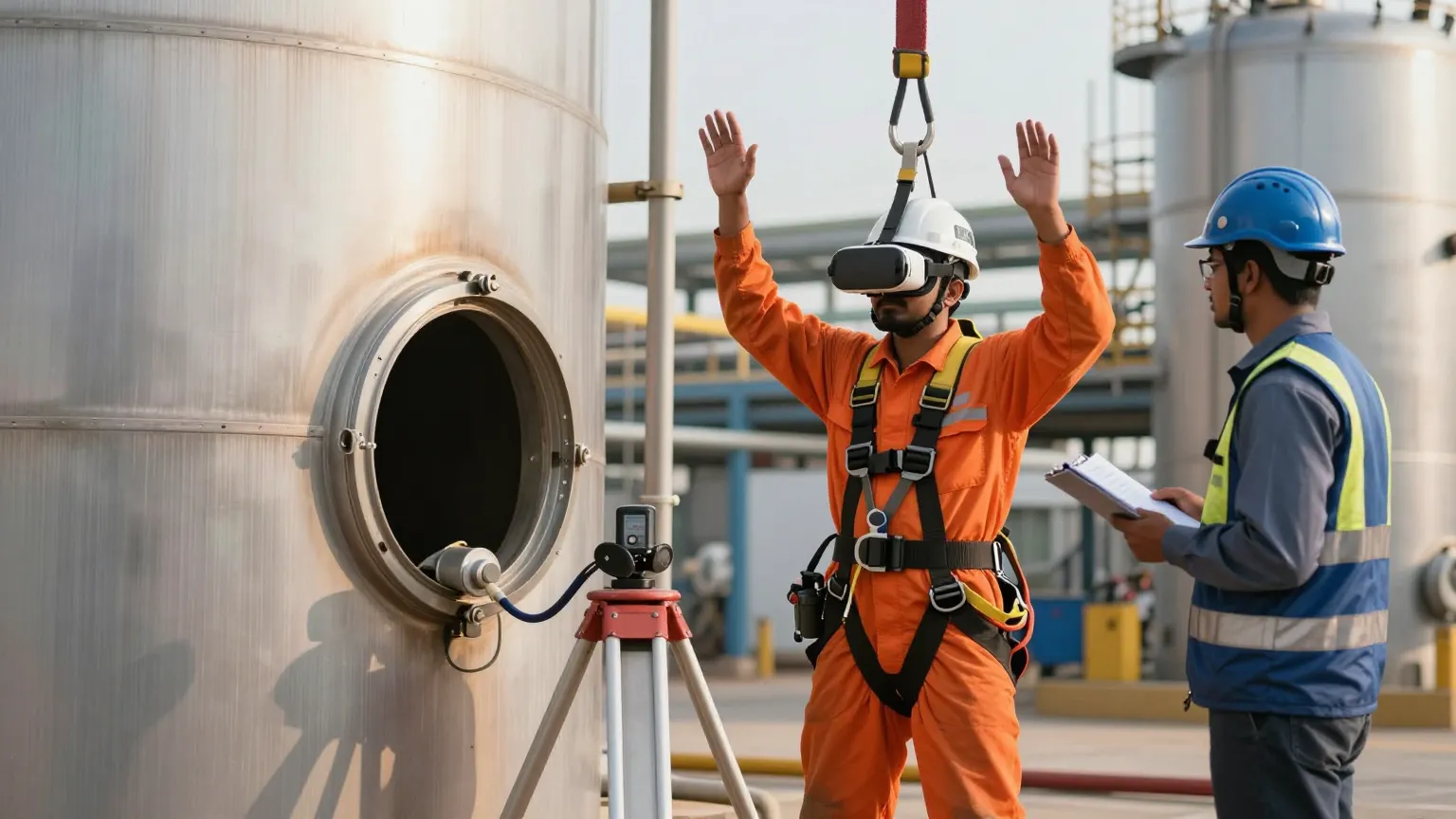
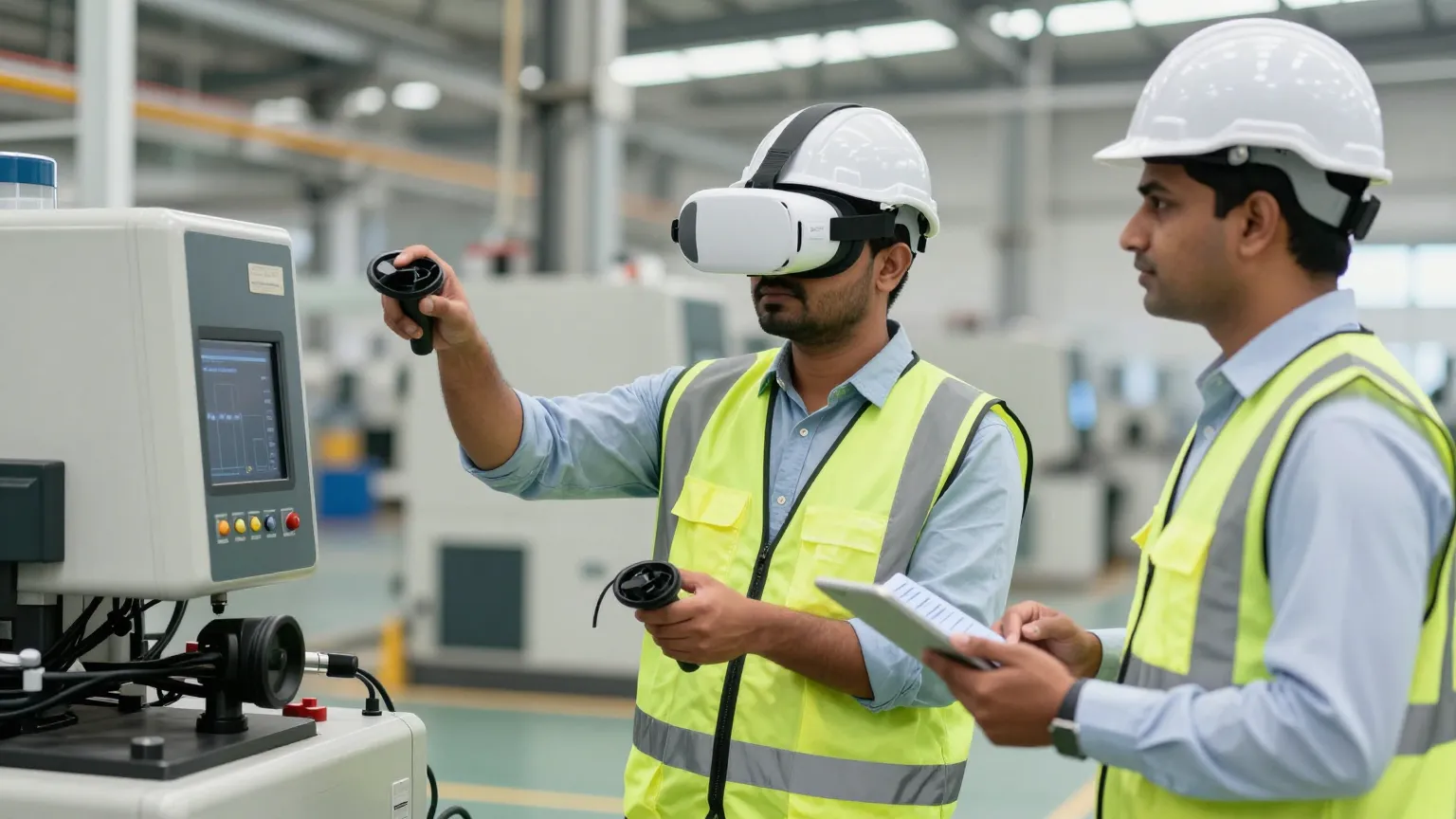
Immersive VR lets every worker, on every shift, experience the first ten minutes of a chemical emergency in their own plant, with consequences, and be scored on the decisions they make. In the modules we build for Indian process sites, a gas-release scenario typically tests the following:
Each decision is logged with a timestamp. A plant EHS manager gets a competence record for 400 people in a fortnight, in Hindi, Tamil, Marathi or Odia voice-over, rather than a muster-sheet signature. Contract crews can be run through the same module before the gate pass is issued, which is where the pattern of inducted-but-unrehearsed contract workers has to be broken.
Be precise with the inspector and with yourself. VR does not satisfy Rule 13(4). The sub-rule requires a mock drill of the on-site emergency plan: the siren, the muster, the emergency control centre, the communication chain to the police and the District Collector's office, the fire tender at the gate. VR also does not test the alarm wiring, the faded windsock, the gate security's contractor count or the time the local fire station actually takes to arrive. Only a physical drill reveals those.
The practical model is VR as the pre-brief and the post-drill remediation, with the physical drill in the middle testing coordination rather than basics.
On cost, the ranges in our guide to what VR safety training costs an Indian factory apply: roughly ₹6 to 45 lakh per custom module depending on fidelity, headsets at ₹50,000 to 70,000 each and 8 to 14 weeks to build. A gas-release module for a specific plant sits in the middle of that range.
Abhigyaan Pro is Qodequay's immersive training platform for industry and defence, built in Pune and developed to professional grade with AFMC. It runs multi-user emergency scenarios in which an incident controller, operators and rescuers train together, works on a VR headset and in a browser in the same session, hosts in Indian data centres by default with an air-gapped option for sensitive sites, and supports regional-language voice-over. Qodequay is ISO 9001:2015 and ISO 27001:2022 certified. If your next six-monthly drill is due this half-year, book a 30-minute call and bring your on-site emergency plan; the Schedule 11 scenario list is where the module design starts.
Rule 13(4) of the Manufacture, Storage and Import of Hazardous Chemicals Rules, 1989 requires the occupier to conduct a mock drill of the on-site emergency plan every six months. Rule 13(5) adds that a detailed report of each drill must be made immediately available to the concerned authority. Both sub-rules were inserted by a 1994 amendment.
Section 41B(4) of the Factories Act, 1948 requires the occupier of every factory involving a hazardous process to draw up an on-site emergency plan and disaster-control measures. MSIHC Rule 13 applies the plan, drill and reporting duties to sites handling listed hazardous chemicals, with Major Accident Hazard status triggered at the Schedule 2 and 3 threshold quantities.
No. Rule 13(4) requires a mock drill of the on-site emergency plan, which means the physical siren, muster, emergency control centre and communication chain to the district authorities. VR is a training and assessment tool that prepares individuals for that drill and records their decisions; it complements the statutory drill and should be filed alongside the drill report, not in place of it.
Beyond the muster and head count, a useful drill measures time to alarm, time to full muster including contractors and the night shift, time to the first call to the District Emergency Authority, whether the incident controller applied the correct shelter-in-place or evacuation rule for the chemical involved, and whether anyone attempted an unprotected rescue.
The Local Crisis Group conducts at least one full-scale mock drill of a chemical accident at a site every six months under Rule 10(2)(e), and the District Crisis Group conducts at least one full-scale drill at a site each year under Rule 9(2)(g). These sit above the occupier's own six-monthly on-site drill under MSIHC Rule 13(4).
This article is for general information and is not legal advice. Confirm obligations against the official text of the Factories Act, 1948, your state Factories Rules, the Manufacture, Storage and Import of Hazardous Chemicals Rules, 1989, the Chemical Accidents (Emergency Planning, Preparedness and Response) Rules, 1996, the Occupational Safety, Health and Working Conditions Code, 2020 and the rules notified under it, and consult qualified counsel or a certified safety professional for your situation.

I am a founder director at Qodequay Technologies Pvt. Ltd., a leading digital transformation consulting firm that helps clients across industries to innovate, optimize, and grow their businesses. I have over two decades of experience in the digital domain, spanning product development, e-commerce, user experience, design thinking, web and app development, and business leadership. My core competencies include developing and executing digital transformation strategies, building teams globally, roadmaps, and solutions that leverage data, insights, and emerging technologies such as artificial intelligence, augmented reality, blockchain, and immersive experience. I also have expertise in digital commerce, supply chain integration, and product management, having worked with both B2B and B2C brands in various sectors. My mission is to create value for customers and stakeholders by delivering impactful and engaging digital experiences that drive growth and innovation.
November 10, 2026

November 9, 2026

November 8, 2026

November 7, 2026

November 6, 2026
Monthly insights on AI, VR and DPDPA compliance — straight from our team to your inbox.
Free 30-minute consultation with our team — or see our products in action.