Can VR help students prepare for CBSE and Maharashtra board practical exams in 2027?
November 21, 2026
November 21, 2026
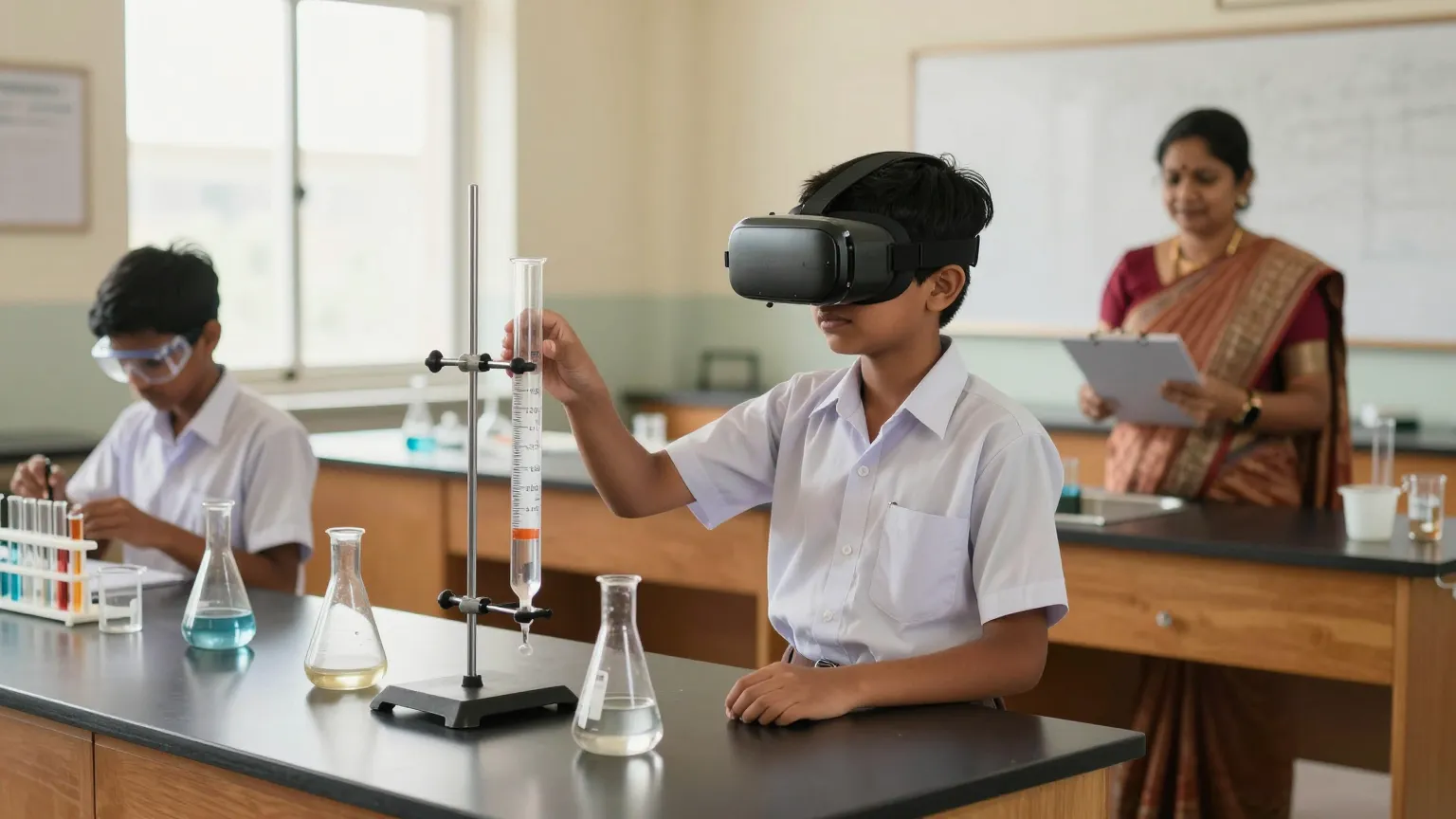
Yes, as a rehearsal tool, not a replacement. CBSE has scheduled Class 10 and 12 practicals from 1 January to 13 February 2027 and Maharashtra's HSC practicals from 20 January; the exam itself must still happen at the school bench with an examiner. VR lets students run the procedure, apparatus and safety steps repeatedly beforehand, so limited lab sessions go into marks rather than first attempts.
On 5 November 2026 CBSE released the practical examination schedule for the 2026-27 session, and a day later the Class 10 date sheet. For most schools that means Physics, Chemistry, Biology and Computer Science practicals between 1 January and 13 February 2027, with theory papers following from 16 February. Maharashtra's state board published its own calendar in September. Principals now have roughly six weeks of teaching time before the lab becomes an examination hall, and the question we are being asked is whether a school VR lab can help students use that time better.
Our answer is a qualified yes. VR does not conduct a board practical and should never be sold as if it does. What it can do is take the first, fumbling attempt at every experiment out of the physical lab, so that scarce bench time is spent refining technique and recording observations rather than learning where the burette clamp goes.
The CBSE circular of 5 November 2026 fixes two windows. Winter-bound schools conduct practicals, project assessments and internal assessments from 9 November to 19 December 2026. All other affiliated schools conduct them from 1 January to 13 February 2027. Only students whose names appear in the online List of Candidates may sit, external examiners are appointed through the regional offices, and Class 12 practical answer books go back to the regional office after the exam.
Two operational instructions matter for planning. Where a subject has more than 30 candidates, the Board requires the practical to be held in two or three sessions in a day, depending on the school's laboratory infrastructure. And schools must upload one group photograph of each batch through a Board-provided app link. In other words, a 60-student Class 12 science cohort is at least two examination sessions per subject, each needing a fully set-up lab.
| Board and class | Practical / internal assessment window | Theory papers begin |
|---|---|---|
| CBSE Class 10 and 12, winter-bound schools | 9 November to 19 December 2026 | 16 February 2027 (Class 10) |
| CBSE Class 10 and 12, all other schools | 1 January to 13 February 2027 | 16 February 2027 (Class 10) |
| Maharashtra HSC (Class 12) | 20 January to 6 February 2027 | 8 February 2027 |
| Maharashtra SSC (Class 10) | 28 January to 13 February 2027 | 15 February 2027 |
Dates are as announced by CBSE on 5 and 6 November 2026 and by the Maharashtra State Board on 17 September 2026; schools should confirm the final subject-wise schedule with their regional or divisional board.
More than many students assume. In the CBSE scheme, Physics, Chemistry, Biology, Computer Science and Informatics Practices in Class 12 carry 70 marks of theory and 30 of practical, with an external examiner and Board-supplied practical answer books. Class 10 Science is 80 theory and 20 internal practical. Because the practical component is assessed over a few hours in January, a student who has handled each experiment only once in the whole year is carrying 20 to 30 percent of the subject on a single rehearsal.
The practical mark is also the most coachable part of the paper. It rewards knowing the sequence of steps, reading an instrument correctly, recording observations in the expected format and answering viva questions about why each step is done. None of that requires a chemical to be consumed.
Ask any Class 12 Chemistry teacher what happens in the first practical period on a new titration and the answer is the same: the hour goes into finding the apparatus, explaining the set-up, correcting the first rinse and watching students overshoot the end point. The second attempt is where learning happens, and most schools cannot afford a second attempt for every student across twelve or more prescribed experiments.
The arithmetic is unforgiving. A school with one Physics lab, 60 Class 12 students and a 40-minute period can give each student perhaps one supervised run per experiment before the Board's window opens. Consumables, breakages and absent students eat into even that. The constraint is not the syllabus; it is bench-hours.
We are careful about this distinction because it is where VR in education has over-promised in the past. The table below is how we brief school leaders.
| Practical component | What VR can rehearse | What still needs the physical lab |
|---|---|---|
| Apparatus and set-up | Identify every piece, assemble the circuit or titration set-up, repeat until automatic | Handling real glassware, loose connections, calibration of actual instruments |
| Procedure and sequence | Step order, common errors, what to do when a reading is wrong | Timing and dexterity of the real procedure |
| Observations and readings | Reading a vernier, ammeter or burette scale; recording in the prescribed table | Parallax and judgement on real instruments |
| Safety | Acid handling, flame and electrical hazards practised with zero risk | Actual conduct under examiner observation |
| Viva voce | Guided questions on principle and purpose after each virtual run | Answering a live examiner |
| Fine motor skill | Limited: VR shows what to do, not how it feels | Everything: colour change at end point, focusing a microscope, cutting a section |
Put simply, VR moves the cognitive load forward. When a student walks into the January practical already knowing the sequence, the apparatus and the expected observation, the examiner sees technique rather than hesitation. That is a different proposition from the browser-based simulations many schools already use; we have written about how DIKSHA virtual labs differ from a school VR lab.
A VR lab that sits idle until the exam window is wasted money. The plan below assumes a lab of ten to twenty headsets running in rotation, which is what most Indian schools install; we explain how many headsets a school VR lab needs in a separate guide.
Teachers, not headsets, make this work, which is why we always pair a lab installation with a teacher programme; see how to train teachers to run a VR lab.
Yes, and the window is tighter. The Maharashtra State Board has scheduled HSC practical, oral, grade and internal assessments from 20 January to 6 February 2027 and SSC assessments from 28 January to 13 February 2027, with written papers starting on 8 and 15 February respectively, across its nine divisional boards. Many state board schools have fewer lab resources than CBSE schools, so the value of rehearsing before the bench is greater, not smaller.
This is the environment our platform grew up in. Abhigyaan, our VR and XR immersive learning platform, is deployed in 1,350 Maharashtra Zilla Parishad schools, reaching 1.5 million-plus students, with content mapped to the state board and CBSE curricula and delivered in regional languages as well as English. When a Zilla Parishad school runs a VR module on an electrical circuit a week before the physical practical, that is exactly the sequence described above.
If you lead a CBSE or state board school and want to see which of your 2027 practicals already have VR modules, and how a six-week rehearsal timetable would fit your lab, book a 30-minute call with our team. We will bring the practical list, not a sales deck.
CBSE's circular of 5 November 2026 schedules practical examinations, project and internal assessments from 1 January to 13 February 2027 for regular schools, and from 9 November to 19 December 2026 for winter-bound schools. Class 10 theory papers run from 16 February to 9 March 2027. Schools should confirm subject-wise dates with their regional office.
No. CBSE and state boards require the practical to be conducted in the school laboratory, with an external examiner where prescribed, and only for students on the List of Candidates. VR is a rehearsal tool used before the examination window, so that students arrive knowing the apparatus, the procedure and the expected observations.
In Class 12, Physics, Chemistry, Biology, Computer Science and Informatics Practices carry 70 marks of theory and 30 of practical, with an external examiner. Class 10 Science carries 80 theory marks and 20 internal practical marks. The practical is assessed over a few hours during the January to February window, so preparation time matters.
VR is strongest on apparatus identification and set-up, the order of steps, reading scales such as a vernier or burette, recording observations in the prescribed format, safety procedure and viva preparation. It is weakest on fine motor skill, for example judging a colour change at the end point of a titration or focusing a microscope.
The Maharashtra State Board announced on 17 September 2026 that HSC practical, oral, grade and internal assessments run from 20 January to 6 February 2027, before written papers from 8 February, and SSC assessments run from 28 January to 13 February 2027, before written papers from 15 February. Subject-wise schedules are published separately by the Board.

I am a founder director at Qodequay Technologies Pvt. Ltd., a leading digital transformation consulting firm that helps clients across industries to innovate, optimize, and grow their businesses. I have over two decades of experience in the digital domain, spanning product development, e-commerce, user experience, design thinking, web and app development, and business leadership. My core competencies include developing and executing digital transformation strategies, building teams globally, roadmaps, and solutions that leverage data, insights, and emerging technologies such as artificial intelligence, augmented reality, blockchain, and immersive experience. I also have expertise in digital commerce, supply chain integration, and product management, having worked with both B2B and B2C brands in various sectors. My mission is to create value for customers and stakeholders by delivering impactful and engaging digital experiences that drive growth and innovation.
November 21, 2026
November 20, 2026
November 19, 2026
November 18, 2026
November 17, 2026
Monthly insights on AI, VR and DPDPA compliance — straight from our team to your inbox.
Free 30-minute consultation with our team — or see our products in action.