DPDPA Penalties Up to ₹250 Crore: The Real Cost of Waiting
July 2, 2026
February 9, 2026
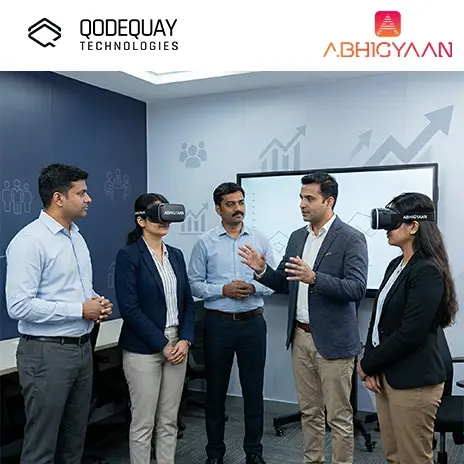
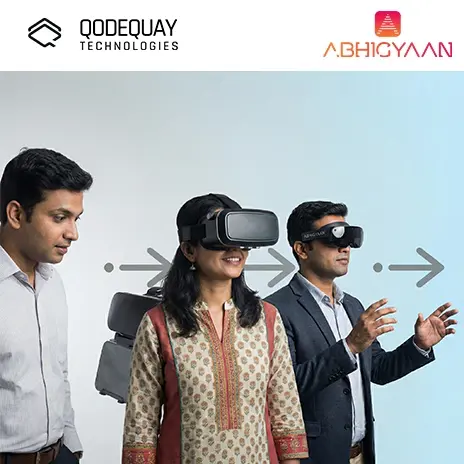
Business training has a problem, it’s expensive, inconsistent, slow to scale, and often forgotten within days. That’s exactly why VR for business training is becoming one of the most valuable tools in digital transformation today.
As a CTO, CIO, Product Manager, Startup Founder, or Digital Leader, you’re under pressure to train faster, reduce risk, and improve workforce performance without increasing cost. Virtual Reality gives you a rare advantage: you can train people through realistic simulations, repeatable experiences, and measurable outcomes, all without putting them in danger or pulling senior employees away from work.
In this article, you’ll learn what VR business training really is, where it works best, how it delivers ROI, real-world examples, best practices, and what the future of immersive training will look like.
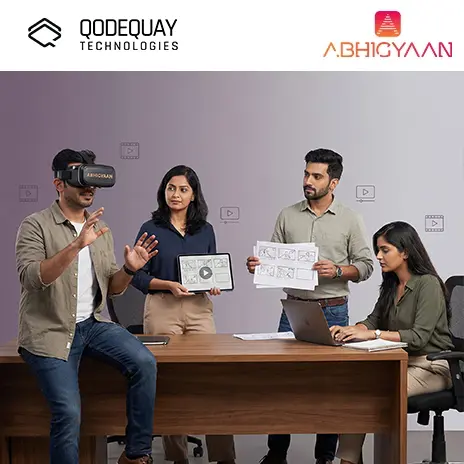
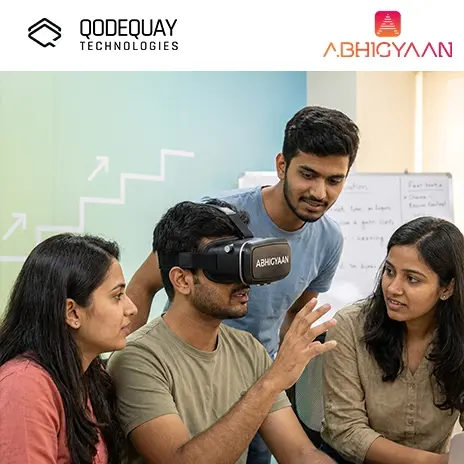
VR for business training is the use of virtual reality simulations to teach employees skills in a safe, repeatable, and measurable environment.
Instead of reading manuals or watching videos, you learn by doing. VR places you inside a realistic workplace scenario where you can:
This works especially well for training that is either high-risk, high-cost, or hard to standardize.
VR training matters because it reduces training cost while improving consistency, speed, and performance outcomes.
Traditional training has major issues:
VR changes the equation. Once the simulation is built, you can train thousands of people with the same quality, at any location, at any time.
For CIOs, VR becomes a scalable learning platform. For CTOs, VR becomes a technology investment with measurable KPIs. For product leaders, VR becomes a new category of customer education and employee enablement.
VR improves learning outcomes because it activates experiential learning, which builds memory faster than passive learning.
In simple terms, your brain remembers experiences better than slides.
VR training helps you learn through:
If you’re training a warehouse employee, reading a safety manual is abstract. But walking through a VR warehouse, identifying hazards, and practicing correct actions becomes real.
VR works best for training that is dangerous, expensive, complex, or people-intensive.
Here are the strongest categories:
VR is ideal for:
This is where VR often delivers the fastest ROI.
VR helps you practice:
This reduces real-world mistakes and downtime.
VR onboarding is powerful because:
This is one of the fastest-growing VR training areas.
VR can simulate:
Soft skills improve when you practice realistic conversations, not when you memorize theory.
Many global enterprises use VR training to improve performance, reduce accidents, and standardize learning.
Large retailers have used VR to train employees on:
VR reduces training inconsistency across locations.
Manufacturing organizations use VR for:
Instead of shutting down a production line for training, you train in VR.
Hospitals and medical institutions use VR for:
The key benefit is realism without risk.
The ROI of VR training comes from faster learning, fewer mistakes, reduced injuries, and lower training delivery cost.
You typically see ROI in these areas:
VR can reduce time-to-competency because people learn by doing, not watching.
When employees practice tasks in VR first, real-world errors drop.
Safety training in VR can lower injury rates by improving hazard awareness.
VR allows you to scale training without requiring senior staff to run sessions repeatedly.
Every trainee gets the same experience, same steps, same evaluation.
You measure VR training effectiveness by tracking performance data inside the simulation and comparing it to real-world outcomes.
VR gives you analytics that traditional training cannot.
You can measure:
Instead of asking, “Did training happen?” you can ask, “Did performance improve?”
That shift is huge.
The main challenges are content development cost, device management, and ensuring long-term engagement.
Here are common obstacles:
High-quality VR simulations require:
The good news is that reusable modules reduce cost over time.
VR headsets require:
Not every VR experience is comfortable. Bad VR design causes:
Comfort-first design is non-negotiable.
The best VR training programs start small, focus on KPIs, and scale through repeatable modules.
The strongest VR training programs behave like products, not like one-time projects.
The best VR headset for training is usually a standalone device that is comfortable, easy to manage, and reliable.
For many organizations, standalone headsets are preferred because:
A “top headset” is the one that survives real training environments.
The future of VR training will be AI-driven, personalized, and integrated into daily workflows.
Here are the trends shaping the next 3–5 years:
VR training will include virtual instructors that:
Training will blend real-world environments with digital overlays.
Organizations will treat VR training like performance systems, with dashboards and KPIs.
Hardware will get lighter and cheaper, accelerating adoption.
Teams will train together in shared VR spaces across locations.
The result is clear: VR training will move from “innovation pilot” to “standard enterprise tool.”
VR for business training is one of the most practical and measurable uses of immersive technology today. It helps you train people faster, reduce risk, and standardize learning across locations. When designed correctly, VR becomes more than a training tool, it becomes a performance engine.
At Qodequay (https://www.qodequay.com), you approach VR training with a design-first mindset, focusing on real human needs first and using technology as the enabler. That’s how you build immersive learning experiences that people actually enjoy, and businesses can confidently scale.

As the CEO and Founder of Qodequay Technologies, I bring over 20 years of expertise in design thinking, consulting, and digital transformation. Our mission is to merge cutting-edge technologies like AI, Metaverse, AR/VR/MR, and Blockchain with human-centered design, serving global enterprises across the USA, Europe, India, and Australia. I specialize in creating impactful digital solutions, mentoring emerging designers, and leveraging data science to empower underserved communities in rural India. With a credential in Human-Centered Design and extensive experience in guiding product innovation, I’m dedicated to revolutionizing the digital landscape with visionary solutions.
Follow the expert :


July 2, 2026
July 2, 2026
July 2, 2026
July 2, 2026

July 2, 2026
Monthly insights on AI, VR and DPDPA compliance — straight from our team to your inbox.
Free 30-minute consultation with our team — or see our products in action.