DPDPA Penalties Up to ₹250 Crore: The Real Cost of Waiting
July 2, 2026
February 9, 2026
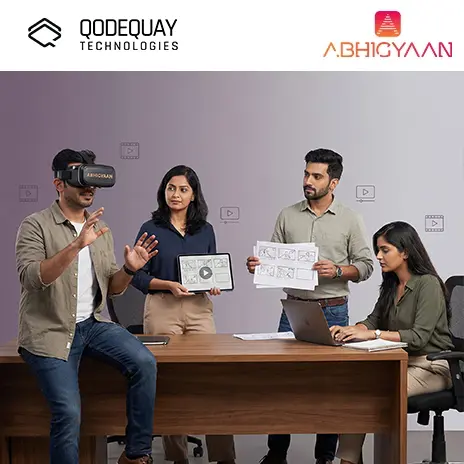
VR content creation is where the real magic happens, and where most VR projects either succeed brilliantly or fail quietly.
You can buy the best headset on the market and still get zero business value if your VR experience is poorly designed, hard to use, or built without a clear goal. On the other hand, even a simple VR training module can deliver massive ROI if it is created with the right strategy, UX thinking, and technical planning.
If you’re a CTO, CIO, Product Manager, Startup Founder, or Digital Leader, VR content creation matters because it directly impacts adoption, learning outcomes, customer engagement, and long-term scalability. This article walks you through how VR content is made, what tools and workflows are used, how much it costs, best practices, and what trends will shape the future of immersive content.
VR content creation is the process of designing and building interactive 3D experiences that people can explore inside a virtual reality headset.
Unlike traditional video or 2D web content, VR content places you inside the experience. You can look around, move, interact, and learn by doing.
VR content can include:
In business, VR content creation is not about making something flashy. It is about solving a real problem using immersion, interactivity, and presence.
LSI terms used: immersive content, VR training simulation, 3D modeling, Unity development, Unreal Engine, spatial design, VR UX, interactive experiences, XR content pipeline, digital twins, volumetric video, real-time rendering
VR content creation matters because content quality directly determines VR adoption, ROI, and scalability.
Most business leaders think VR success depends on hardware. That’s only partially true. Hardware is easy to buy. Content is what makes VR useful.
If your content is:
For CTOs and CIOs, VR content creation is also a governance challenge. You need security, device management, content updates, and performance consistency.
You can create VR content for training, operations, customer experience, marketing, and product development.
This is the most proven category.
Examples:
Walmart famously used VR training across many stores to improve employee preparedness and operational consistency. This is one of the best-known enterprise VR examples.
Instead of explaining a product, you let people experience it.
Examples:
A digital twin is a virtual representation of a real-world space, product, or facility.
Examples:
You can build environments where teams meet and work together remotely.
Examples:
The VR content creation workflow typically includes discovery, design, 3D production, development, testing, and deployment.
A clean pipeline prevents wasted budget and endless rework.
You define:
This phase is where you stop VR from becoming a “cool demo.”
VR UX is not the same as mobile UX.
In VR, you must plan:
You build:
3D assets can be:
Most VR experiences are built in:
Here you implement:
VR testing is critical because:
Enterprise VR needs:
This is where many teams struggle, especially when scaling.
VR content creation uses a mix of game engines, 3D tools, UX tools, and deployment platforms.
Game engines
3D modeling
Texturing
UI and planning
Motion capture and animation
Photogrammetry
Enterprise deployment
Your tool stack should match your team skills. The “best” tools are the ones you can maintain long-term.
VR content creation cost depends on complexity, interactivity, realism, and the amount of 3D work required.
Typical cost drivers include:
A short, well-designed VR module often performs better than a long, expensive simulation.
Short modules:
Good VR content is measurable, comfortable, easy to use, and aligned with real workflows.
The best VR experiences do not feel like games. They feel like tools.
Strong VR content typically includes:
A powerful example is safety training. In VR, you can simulate hazards without real-world risk. That reduces accidents while improving confidence.
The biggest challenges are UX comfort, performance optimization, and content maintenance at scale.
This happens when the brain senses motion but the body does not.
To reduce discomfort:
VR requires high frame rates. A small drop in performance can break immersion and cause nausea.
Performance issues usually come from:
In enterprise VR, content changes frequently:
If your VR content is hard to update, it becomes obsolete quickly.
The best practices are to design for comfort, build modular content, and measure learning outcomes.
VR content creation is not just design plus development. It is product thinking in 3D.
You measure VR content success using training outcomes, behavior change, operational metrics, and adoption.
Here are strong business KPIs:
VR becomes easy to justify when you treat it like a performance tool, not entertainment.
The future of VR content creation will be faster, cheaper, and more AI-assisted.
Here are key trends you should watch:
AI tools will help generate:
This will reduce cost and speed up prototyping.
VR is increasingly blending with AR through mixed reality.
You will see more:
More organizations will build digital twins for:
These will connect to real-time data for monitoring and planning.
More VR content will shift from one-off apps to scalable platforms with:
This will make enterprise VR far easier to manage.
VR content creation is not just about building something impressive. It is about designing an experience that people will actually use, trust, and benefit from. When you approach VR like a product, with strong UX, clear business outcomes, and scalable architecture, you unlock the true value of immersive technology.
At Qodequay (https://www.qodequay.com), you take a design-first approach to VR, solving human problems first and using technology as the enabler. That is how you create VR experiences that feel natural, deliver measurable ROI, and scale across teams, locations, and industries.

As the CEO and Founder of Qodequay Technologies, I bring over 20 years of expertise in design thinking, consulting, and digital transformation. Our mission is to merge cutting-edge technologies like AI, Metaverse, AR/VR/MR, and Blockchain with human-centered design, serving global enterprises across the USA, Europe, India, and Australia. I specialize in creating impactful digital solutions, mentoring emerging designers, and leveraging data science to empower underserved communities in rural India. With a credential in Human-Centered Design and extensive experience in guiding product innovation, I’m dedicated to revolutionizing the digital landscape with visionary solutions.
Follow the expert :


July 2, 2026
July 2, 2026
July 2, 2026
July 2, 2026

July 2, 2026
Monthly insights on AI, VR and DPDPA compliance — straight from our team to your inbox.
Free 30-minute consultation with our team — or see our products in action.