DPDPA Penalties Up to ₹250 Crore: The Real Cost of Waiting
July 2, 2026
February 9, 2026
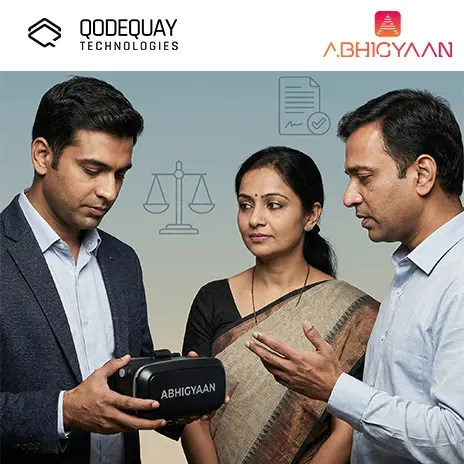
Virtual Reality is not just a new interface, it is a new kind of reality you place people inside. That single fact changes the ethical rules completely.
In a mobile app, you can scroll away. In VR, you cannot. You are surrounded. Your body reacts. Your brain treats the experience as real enough to trigger stress, joy, fear, and social pressure. That is why VR design ethics is no longer a “nice-to-have” topic, it is a business-critical requirement.
If you’re a CTO, CIO, Product Manager, Startup Founder, or Digital Leader, VR ethics matters for three reasons. First, immersive systems collect more sensitive data than traditional software. Second, the psychological influence of VR is stronger than screens. Third, one ethical failure can destroy adoption, create legal risk, and damage your brand permanently.
In this article, you’ll learn what VR design ethics means, the biggest risks, real-world examples, best practices, and future trends. You’ll also walk away with a practical framework you can apply immediately to any VR product, training module, or enterprise immersive program.
VR design ethics is the practice of creating immersive experiences that protect privacy, autonomy, safety, and human dignity.
Ethical VR design means you treat people as humans, not as data points or “engagement metrics.” In VR, you can influence attention, emotion, and behavior more deeply than in any other digital channel.
VR design ethics covers:
VR is powerful. Ethical design is how you keep that power from becoming abuse.
LSI terms used: responsible design, privacy in VR, biometric data, immersive UX, dark patterns, user autonomy, digital wellbeing, safety-by-design, inclusive VR, accessibility, ethical AI, spatial computing
VR ethics matters more because immersion increases vulnerability, influence, and the potential for harm.
Traditional apps sit on a screen. VR surrounds your senses. That makes experiences feel more real, and it makes your responses more automatic.
In VR:
This is why ethical mistakes in VR can have bigger consequences than the same mistakes in web or mobile products.
For digital leaders, the ethical challenge is simple: you are building an environment, not just an interface.
The biggest ethical risks in VR are privacy invasion, manipulation, harassment, exclusion, and unsafe physical experiences.
Let’s break them down in a way that’s practical and business-relevant.
VR can collect data far beyond clicks and page views. Many headsets track:
This information can become a biometric fingerprint. Even if you remove a name, movement patterns can still identify a person.
Dark patterns are design tricks that push you into decisions you didn’t freely choose.
In VR, these tricks become stronger because:
A VR experience can nudge behavior so effectively that it crosses into coercion.
In multi-user VR, harassment is not just verbal. It can include:
Because the environment feels physical, harassment feels more personal and more traumatic.
Ethical VR design must account for:
These issues may seem “technical,” but they are ethical because they affect wellbeing.
If your VR experience requires:
Then you exclude people. Ethical design means you design for real diversity in ability.
Ethical consent in VR means you clearly explain what you collect, why you collect it, and give real control without punishment.
Consent cannot be buried in a long policy. It must be:
For example, if your VR training app records voice to analyze communication skills, you should explain:
Ethical consent also means:
Consent is not a legal checkbox. It is trust-building design.
You protect privacy by minimizing data collection, securing storage, and avoiding unnecessary tracking.
A simple rule works well: If you do not need the data to deliver value, do not collect it.
This is especially important in enterprise VR, where employee trust is fragile and surveillance fears are real.
You prevent psychological harm by respecting emotional boundaries, avoiding coercion, and designing for wellbeing.
VR can be emotionally intense even when it is not meant to be. Training simulations often include:
These experiences can be valuable, but they can also trigger stress responses.
Ethical VR training should improve confidence, not create anxiety.
You design safe social VR by making safety features default, not optional.
Social VR requires stronger guardrails than normal chat apps because the experience feels embodied.
Ethical social VR should include:
A widely used ethical pattern is the “personal bubble,” where other avatars cannot get too close unless you allow it. This reduces harassment without killing social interaction.
You ensure accessibility by offering multiple interaction modes and designing for different physical abilities.
VR accessibility is hard, but it is not optional if you want enterprise scale.
Inclusive VR design includes:
Ethical VR is not just about avoiding harm. It is about enabling participation.
Real-world VR ethics failures include harassment in social spaces, unclear data collection, and VR being used for surveillance instead of learning.
Common patterns seen across the industry include:
Even if your company is not building a social VR platform, these examples matter. They show how quickly trust can collapse when ethics is treated as an afterthought.
You should use a framework based on autonomy, privacy, safety, fairness, and transparency.
You do not need a complicated ethics department to do the right thing. You need a repeatable process.
If you can answer “yes” to all six, you are already ahead of most VR products.
You embed VR ethics by treating it like security, performance, and QA from day one.
Ethics must be part of:
Ethics is not a blocker. It is a scaling strategy.
The future of VR design ethics will be driven by biometric tracking, AI personalization, and stricter regulation.
Here are the biggest trends you should prepare for.
Eye tracking, facial tracking, and body tracking will become standard in many headsets.
This increases ethical pressure around:
AI will personalize training and experiences in real time.
This can improve:
But it can also increase manipulation risk if personalization is used to push purchases, behaviors, or engagement loops.
More organizations will introduce internal policies for:
As VR becomes mainstream, regulators will treat VR data as highly sensitive. You should expect:
The organizations that build ethical VR early will move faster later.
VR is one of the most powerful experience technologies you can deploy in business, and that power makes ethics a strategic requirement, not a philosophical side note. When you design VR responsibly, you protect people, strengthen trust, and create experiences that scale without backlash.
At Qodequay (https://www.qodequay.com), you bring a design-first approach to immersive technology, solving real human problems first and using technology as the enabler. That is how you build VR experiences that are not only innovative, but also safe, inclusive, and worthy of long-term trust.

As the CEO and Founder of Qodequay Technologies, I bring over 20 years of expertise in design thinking, consulting, and digital transformation. Our mission is to merge cutting-edge technologies like AI, Metaverse, AR/VR/MR, and Blockchain with human-centered design, serving global enterprises across the USA, Europe, India, and Australia. I specialize in creating impactful digital solutions, mentoring emerging designers, and leveraging data science to empower underserved communities in rural India. With a credential in Human-Centered Design and extensive experience in guiding product innovation, I’m dedicated to revolutionizing the digital landscape with visionary solutions.
Follow the expert :


July 2, 2026

July 2, 2026

July 2, 2026

July 2, 2026

July 2, 2026

Monthly insights on AI, VR and DPDPA compliance — straight from our team to your inbox.
Free 30-minute consultation with our team — or see our products in action.