DPDPA Penalties Up to ₹250 Crore: The Real Cost of Waiting
July 2, 2026
February 9, 2026
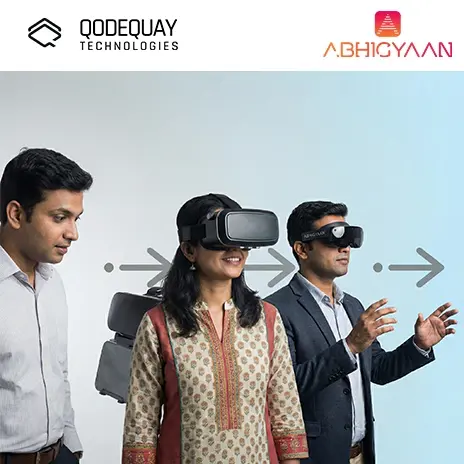
Virtual Reality has one of the strangest journeys in modern technology. It started as an ambitious dream, became a research experiment, disappeared into hype cycles, then returned as a serious platform for business, training, and product innovation.
If you’re a CTO, CIO, Product Manager, Startup Founder, or Digital Leader, understanding the evolution of VR matters because it helps you separate hype from reality. When you know how VR matured, you understand why it is now reliable enough for enterprise training, remote collaboration, and immersive customer experiences. You also gain insight into what’s coming next, which is critical for planning investments and product roadmaps.
In this article, you’ll learn how VR began, the key milestones that shaped it, what made modern VR possible, real-world examples of adoption, and what future trends will define the next decade of immersive technology.
VR is a technology that creates a simulated 3D environment you can experience through a headset, and it took decades because hardware, computing, and content tools were not ready.
The idea of VR is simple: you put on a headset and feel present inside a digital world. But to make that work smoothly, you need:
For most of the 20th century, these pieces were either too expensive, too heavy, or too immature.
LSI terms used: virtual reality history, VR milestones, immersive technology, head-mounted display, spatial computing, motion tracking, VR headset evolution, enterprise VR, VR training, mixed reality, metaverse, digital transformation
VR began as early as the 1950s and 1960s with experimental simulation machines and early head-mounted display research.
Many people think VR started with gaming. It didn’t. VR started with inventors and researchers trying to simulate reality.
One of the earliest immersive systems was the Sensorama, developed in the 1950s. It was a mechanical device that combined:
It was not “VR” as we know it, but it proved a key concept: multi-sensory immersion changes perception.
In the late 1960s, computer scientist Ivan Sutherland created an early head-mounted display system sometimes called “The Sword of Damocles.” It was heavy, wired, and extremely limited, but it established the idea of tracking head movement and updating visuals in real time.
The 1980s and 1990s introduced the term “virtual reality” and produced the first commercial experiments, but the technology was too expensive and low-quality for mass adoption.
In the 1980s, VR became a formal field. Companies and research labs experimented with:
The 1990s saw a wave of VR hype. Arcade-style VR machines and early consumer headsets appeared, but they struggled with:
This created a pattern that repeats often in tech history: the idea was right, but the execution was not ready.
VR slowed down in the early 2000s because the market was not ready, and the hardware still could not deliver comfortable immersive experiences.
VR didn’t disappear completely, but it moved into niche areas:
Consumer tech at the time focused on:
VR simply could not compete with the convenience of screens.
VR returned in the 2010s because smartphones accelerated display technology, sensors became cheap, and real-time graphics became powerful.
This is where the evolution of VR becomes very interesting.
Smartphones accidentally solved major VR problems:
At the same time, gaming GPUs became extremely powerful, enabling real-time 3D rendering at high frame rates.
Key modern milestones include:
The biggest shift was moving from: wired, expensive VR to portable, standalone VR
That shift made VR usable outside labs and gaming rooms.
VR evolved into a business tool when organizations realized immersion improves learning, reduces risk, and speeds up decision-making.
VR is uniquely good at one thing: learning by doing in a safe simulated environment.
That is why VR has become popular in:
Imagine training forklift operators. Traditional training involves:
With VR, you can simulate scenarios repeatedly without real-world danger.
This is why enterprise VR adoption keeps growing, even when consumer hype cycles fluctuate.
AR and mixed reality accelerated VR adoption by blending digital content with the real world and making immersive technology more practical.
VR is fully immersive. AR overlays digital elements onto the real world. Mixed reality combines both.
Modern headsets increasingly include:
This means you can run VR experiences that feel safer and more comfortable because you still see parts of your environment.
This evolution is pushing VR toward “spatial computing,” where the boundary between VR and AR becomes less important than the experience itself.
VR hardware evolved from heavy experimental headsets to lightweight standalone devices with advanced tracking and better displays.
This matters for business because adoption depends heavily on comfort. If a headset feels heavy or causes nausea, your rollout fails.
VR content evolved from simple demos into structured training modules, simulations, and enterprise-grade applications.
Early VR content was mostly:
Modern VR content includes:
The biggest shift is that VR content is now designed with:
VR has matured from entertainment to operational value.
The biggest challenges are content cost, device management, comfort concerns, and proving ROI.
Even today, VR is not frictionless.
Common barriers include:
That said, these challenges are shrinking as tools improve.
The future of VR will be shaped by lighter hardware, AI-assisted content creation, mixed reality, and enterprise-scale platforms.
Here are the trends most likely to define the next decade:
VR will shift from “special device” to “work device” as headsets become:
AI will reduce the cost of:
This will make VR projects faster and cheaper.
Many experiences will blend:
This improves safety and reduces discomfort.
More companies will adopt:
This is how VR moves from pilots to scale.
The evolution of VR is a lesson in patience. The idea has been around for decades, but only recently has the technology become powerful, affordable, and usable enough to deliver real business outcomes. Today, VR is not a gimmick. It is a serious tool for training, collaboration, product innovation, and customer engagement.
At Qodequay (https://www.qodequay.com), you take a design-first approach to immersive technology, solving real human problems first and using technology as the enabler. That is how you move beyond hype and build VR experiences that deliver measurable value at scale.

As the CEO and Founder of Qodequay Technologies, I bring over 20 years of expertise in design thinking, consulting, and digital transformation. Our mission is to merge cutting-edge technologies like AI, Metaverse, AR/VR/MR, and Blockchain with human-centered design, serving global enterprises across the USA, Europe, India, and Australia. I specialize in creating impactful digital solutions, mentoring emerging designers, and leveraging data science to empower underserved communities in rural India. With a credential in Human-Centered Design and extensive experience in guiding product innovation, I’m dedicated to revolutionizing the digital landscape with visionary solutions.
Follow the expert :


July 2, 2026

July 2, 2026

July 2, 2026
July 2, 2026

July 2, 2026
Monthly insights on AI, VR and DPDPA compliance — straight from our team to your inbox.
Free 30-minute consultation with our team — or see our products in action.