DPDPA Penalties Up to ₹250 Crore: The Real Cost of Waiting
July 2, 2026
December 16, 2025
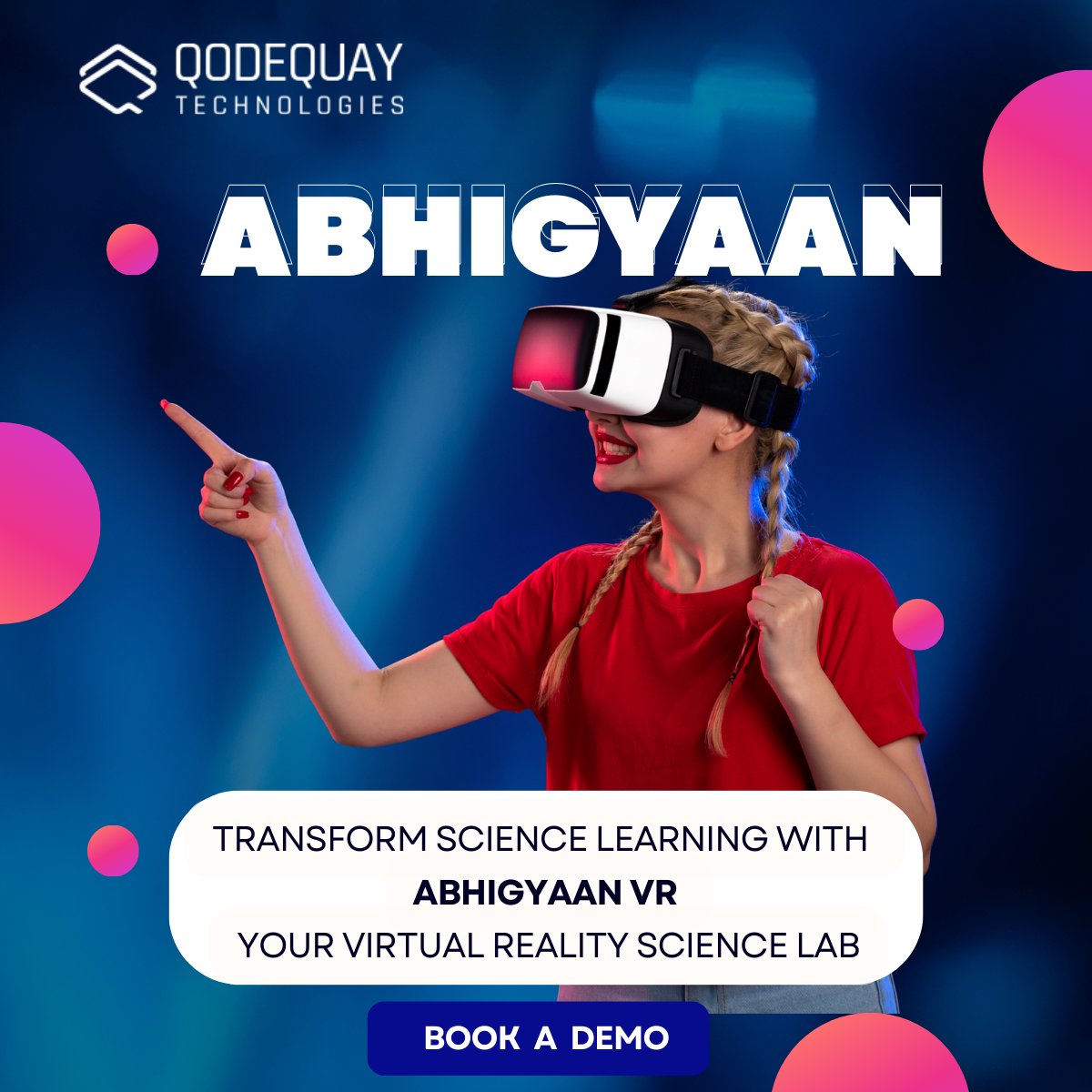
Virtual reality in education is the use of immersive, computer generated environments that allow you to learn by experiencing concepts rather than memorizing them. Instead of reading about ancient Rome, you walk through it. Instead of watching a diagram of the human heart, you step inside it.
If you’re a parent or teacher, this matters to you: education is under immense pressure to evolve. Today, attention spans are shrinking, learning gaps are widening, and traditional methods often fail to deliver measurable results. Virtual Reality (VR) tackles all these challenges by transforming learning into an active, immersive experience.
In this article, you will explore how VR works in education, its benefits, who it helps, real world use cases, implementation best practices, challenges to watch out for, and what the future holds.
Virtual reality works by placing you inside a simulated 3D environment using headsets and interactive software designed for learning. You wear a VR headset, use controllers or hand tracking, and interact with content as if it were real.
In education, this usually includes:
Virtual classrooms and labs
3D simulations of real world systems
Guided experiences aligned with curricula
For example, medical students use VR to practice surgeries, engineering students assemble virtual machines, and history students explore reconstructed civilizations. The technology combines visual immersion, spatial audio, and interactivity to create experiential learning.
Immersive learning works better because your brain retains experiences more effectively than passive information. When you actively engage with content, multiple senses are involved, which strengthens memory formation.
Research consistently shows that experiential learning improves retention. Studies indicate learners remember significantly more from immersive experiences compared to lectures or textbooks. You are not just hearing information, you are doing something with it.
VR shifts learning from “tell me” to “show me and let me try.”
VR improves understanding by turning abstract concepts into tangible experiences you can explore in 3D. Subjects like astronomy, molecular biology, architecture, and physics are hard to visualize on flat screens.
With VR:
You can travel through the solar system to understand scale and distance
You can manipulate molecules to see chemical reactions
You can walk through architectural designs before they are built
This spatial understanding helps you grasp relationships, structures, and processes that are otherwise difficult to imagine.
Yes, VR significantly increases engagement because it feels interactive, personal, and game like. Traditional classrooms often rely on passive consumption, which leads to boredom and distraction.
VR lessons:
Encourage curiosity and exploration
Use gamification to motivate participation
Reduce monotony by varying learning formats
When you are inside the lesson, checking your phone stops being interesting. Engagement becomes a natural outcome rather than something teachers have to force.
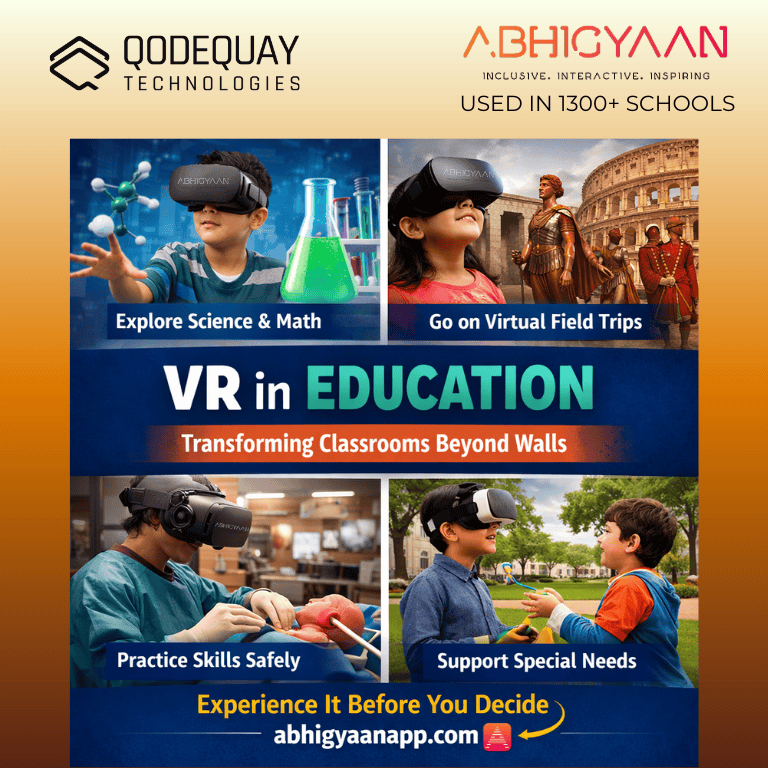
VR enables you to practice real world skills without real world risks. This is critical for subjects involving safety, cost, or complexity.
Examples include:
Virtual chemistry labs without hazardous chemicals
Medical simulations without patient risk
Industrial training without equipment damage
Mistakes become learning opportunities rather than disasters. You can repeat procedures until confidence builds, which is rarely possible in physical environments.
VR provides global exposure by offering virtual field trips and cultural experiences from anywhere in the world. Geography, cost, and logistics often limit traditional field trips.
With VR, you can:
Visit museums and heritage sites
Explore rainforests, oceans, or space
Observe global classrooms and cultures
This exposure broadens perspective and builds empathy, especially for students who may never travel physically.
VR supports personalized learning by adapting content to your pace, ability, and learning style. Unlike one size fits all classrooms, VR systems can adjust difficulty levels and offer guided support.
For inclusive education, VR can:
Provide visual or auditory enhancements
Offer safe spaces for students with anxiety
Enable alternative interaction methods for disabilities
This makes learning more equitable and accessible, especially for students who struggle in traditional settings.
Yes, VR improves retention and performance by combining emotional engagement with active participation. When learning feels meaningful and memorable, outcomes improve.
Institutions using VR report:
Higher test scores in science and technical subjects
Faster skill acquisition
Increased confidence and participation
The learning sticks because it feels real.
How do students benefit from VR?
You benefit from VR through deeper understanding, higher confidence, and reduced learning stress. Interactive environments allow you to learn by doing, which builds competence and motivation.
Key advantages include:
Better concept clarity
Increased retention
Reduced fear of failure
Teachers benefit from VR because it enhances teaching effectiveness and classroom engagement. Complex topics become easier to explain, and participation improves naturally.
Schools gain:
Innovative teaching tools
Improved academic results
Differentiated learning experiences
VR also helps institutions position themselves as forward thinking and tech enabled.
Parents benefit because VR improves learning outcomes in safer and more controlled environments. They gain visibility into engagement levels and progress, not just exam scores.
This builds trust in institutions and confidence in their child’s education.
Governments benefit from VR by modernizing education systems and building future ready skills at scale. Digital literacy, critical thinking, and problem solving are essential for tomorrow’s workforce.
VR helps reduce long term costs by minimizing dependence on physical infrastructure while improving reach and quality.
VR supports mental health by reducing anxiety, boredom, and performance pressure through engaging environments. It encourages creativity and exploration rather than rote learning.
From a physical safety perspective, VR reduces exposure to risky experiments and heavy equipment while keeping learning active and participatory.
VR is already being used across schools, universities, and corporate training environments worldwide.
Examples include:
Medical schools using VR surgery simulations
Engineering colleges training students on virtual machinery
Schools offering virtual science labs and history tours
Corporate academies using VR for onboarding and safety training
Major universities and global organizations report measurable improvements in engagement and learning efficiency through VR adoption.
The main challenges include cost, content quality, and infrastructure readiness. While VR is becoming more affordable, implementation still requires planning.
Key challenges:
Hardware and maintenance costs
Teacher training and adoption
Curriculum alignment
Motion sickness for some learners
These issues can be mitigated with phased rollouts, quality content partnerships, and thoughtful instructional design.
Successful VR adoption requires strategic planning, not just buying headsets.
Best practices include:
Align VR experiences with clear learning outcomes
Train educators thoroughly
Start with pilot programs
Use data to measure impact
Combine VR with traditional teaching methods
VR works best as an enhancement, not a replacement.
VR goes beyond screens by placing you inside the learning experience. Videos and slideshows deliver information, but VR delivers context and presence.
This distinction is why VR creates stronger emotional connections and deeper understanding, especially for complex or experiential subjects.
The future of VR in education is immersive, intelligent, and deeply personalized. As hardware becomes lighter and more affordable, adoption will accelerate.
Key trends you should expect:
AI driven adaptive VR learning
Social VR classrooms for remote collaboration
Integration with learning management systems
Greater use in K 12 and vocational training
VR will move from novelty to necessity as education systems evolve.
Virtual reality in education transforms learning into experience driven engagement
VR improves understanding, retention, and motivation
Students, teachers, parents, and governments all benefit
Safe training and global exposure are major advantages
Strategic implementation is essential for success
VR is becoming a core pillar of future ready education
Education is no longer about delivering information, it is about creating understanding. Virtual reality in education helps you move beyond passive learning into meaningful, memorable experiences that prepare learners for real world challenges.
10 Reasons Why Your School Needs an Abhigyaan VR Demo NOW!
👉 Book your Abhigyaan VR demo today: abhigyaanapp.com
At Qodequay, design leads every solution. Technology follows purpose. By combining human centered design with advanced technologies like VR, Qodequay helps educational institutions and digital leaders solve real human problems, using technology as the enabler, not the distraction.

As the CEO and Founder of Qodequay Technologies, I bring over 20 years of expertise in design thinking, consulting, and digital transformation. Our mission is to merge cutting-edge technologies like AI, Metaverse, AR/VR/MR, and Blockchain with human-centered design, serving global enterprises across the USA, Europe, India, and Australia. I specialize in creating impactful digital solutions, mentoring emerging designers, and leveraging data science to empower underserved communities in rural India. With a credential in Human-Centered Design and extensive experience in guiding product innovation, I’m dedicated to revolutionizing the digital landscape with visionary solutions.
Follow the expert :


July 2, 2026
July 2, 2026
July 2, 2026
July 2, 2026

July 2, 2026
Monthly insights on AI, VR and DPDPA compliance — straight from our team to your inbox.
Free 30-minute consultation with our team — or see our products in action.