DPDPA Penalties Up to ₹250 Crore: The Real Cost of Waiting
July 2, 2026
December 16, 2025
Virtual reality in school education is the use of immersive 3D environments that allow children to learn by seeing, exploring, and interacting with concepts instead of memorizing them.
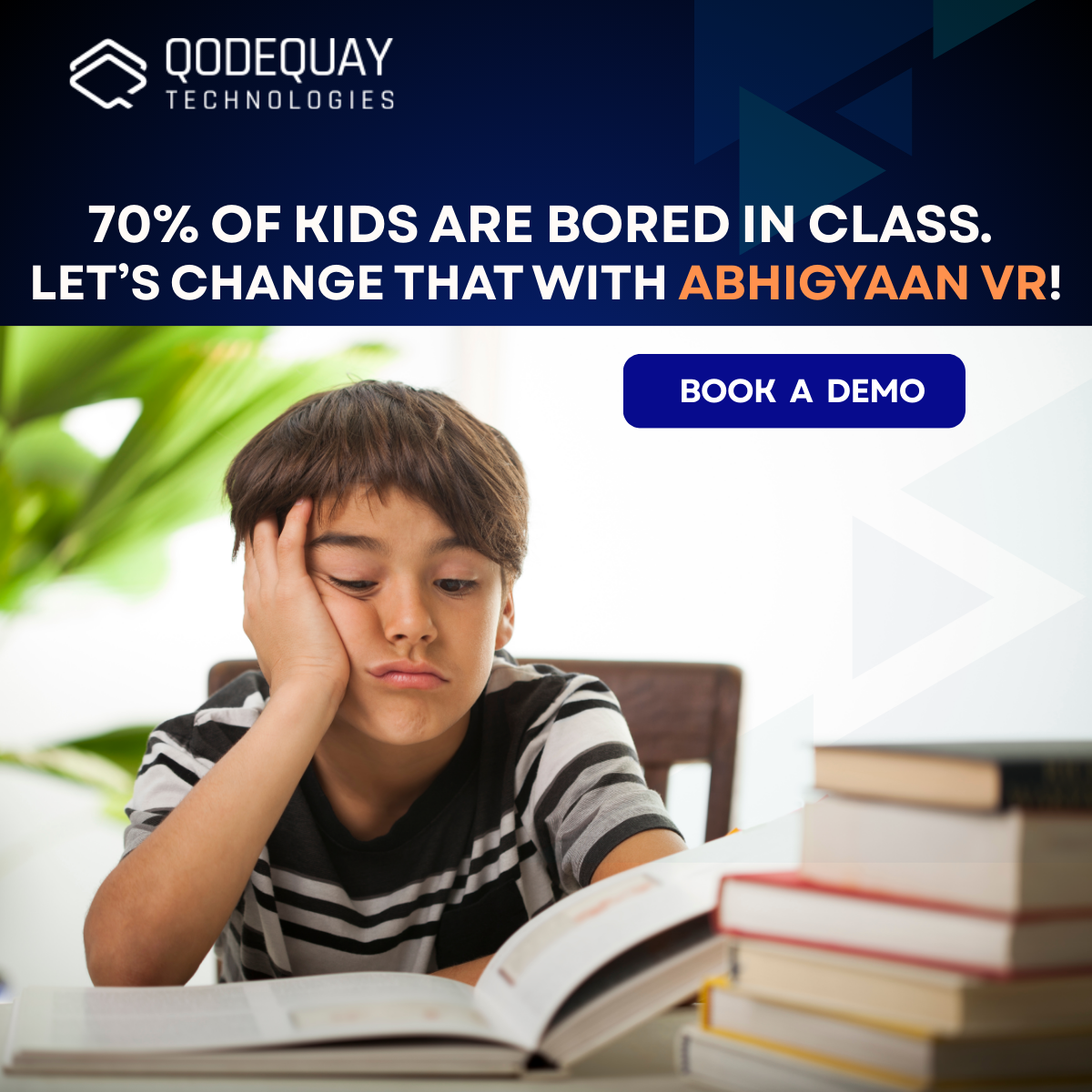
If you are a school leader, a teacher, or a parent, this matters because traditional classroom methods are increasingly failing to hold children’s attention. Studies show that nearly 70 percent of children feel bored in the classroom, which directly affects learning outcomes, confidence, and curiosity.
VR addresses this problem by turning lessons into experiences. Instead of asking children to imagine complex ideas, VR allows them to step inside those ideas. This shift is changing how schools teach and how children learn.
In this article, you will learn how VR works in schools, why children respond so positively to it, how teachers can use it effectively, what parents should know, real classroom examples, best practices, and what the future of VR powered education looks like.
Children feel bored because traditional learning relies heavily on passive listening and rote memorization. Most classrooms still depend on textbooks, lectures, and static visuals. While this approach worked in the past, today’s children grow up surrounded by interactive digital experiences.
Key reasons boredom increases include:
Limited visual and hands on learning
One pace fits all teaching styles
Minimal real world connection to concepts
Pressure to memorize instead of understand
When engagement drops, attention follows. VR helps reverse this by aligning learning with how children naturally explore and absorb information.
Virtual reality makes learning engaging by transforming lessons into interactive experiences children actively participate in. Instead of reading about a topic, students experience it.
For example:
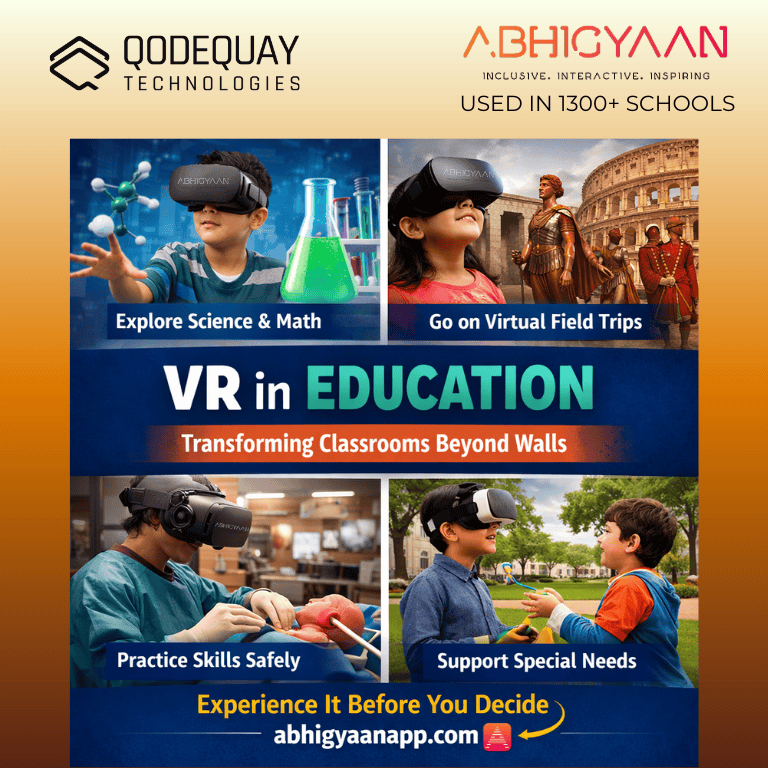
A science lesson becomes a virtual journey inside the human body
A history chapter turns into a walk through ancient civilizations
A geography class becomes a guided exploration of continents and ecosystems
This interactivity keeps students focused, curious, and motivated to learn. Learning feels less like a task and more like discovery.
VR helps children understand complex topics by showing them in 3D and allowing exploration from multiple angles. Many school subjects include ideas that are hard to visualize using textbooks alone.
With VR:
Solar systems can be explored in scale
Mathematical shapes can be rotated and examined
Scientific processes can be slowed down and observed
When children see how things work instead of imagining them, understanding becomes clearer and faster.
Yes, VR improves learning outcomes by increasing attention, retention, and concept clarity. Research consistently shows that experiential learning helps students remember information longer and apply it better.
Schools using VR report:
Improved test performance in science and math
Higher classroom participation
Better long term recall of concepts
When children are emotionally and mentally engaged, learning becomes more effective.
VR supports visual, auditory, and kinesthetic learners by combining multiple modes of learning in one experience. Every child learns differently, yet traditional classrooms often follow a single teaching approach.
VR adapts by:
Offering visual explanations for visual learners
Guided narration for auditory learners
Interactive exploration for hands on learners
This inclusivity helps more children succeed without feeling left behind.
Teachers can use VR as a teaching aid that enhances lessons rather than replacing traditional instruction. VR works best when integrated thoughtfully into the curriculum.
Teachers can use VR to:
Introduce new topics visually
Reinforce difficult concepts
Encourage discussion after immersive sessions
Assess understanding through observation and interaction
VR also helps teachers explain topics that are otherwise time consuming or difficult to demonstrate physically.
Yes, VR increases participation by creating a safe and engaging learning environment for all students. Some children hesitate to ask questions or participate in traditional classrooms.
VR helps by:
Reducing fear of making mistakes
Encouraging exploration at one’s own pace
Building confidence through repeated practice
Students who struggle with attention or confidence often show noticeable improvement when VR is introduced.
Parents benefit from VR because it leads to better understanding, improved academic results, and happier learners. When children enjoy learning, homework struggles and resistance decrease.
For parents, VR offers:
Greater confidence in school quality
Safer alternatives to physical labs or risky experiments
Clearer insight into how children are learning
Parents also appreciate that VR focuses on understanding rather than rote memorization.
When used responsibly and in moderation, VR is safe for school aged children. Schools typically follow guidelines related to session duration, age appropriateness, and supervision.
Best safety practices include:
Short, guided VR sessions
Age appropriate content
Teacher supervision at all times
Balanced use alongside traditional activities
Used correctly, VR enhances learning without replacing essential social interaction.
VR supports mental well being by making learning enjoyable and reducing performance pressure. Children often feel anxious about exams, memorization, and keeping up with peers.
VR helps by:
Encouraging curiosity instead of fear
Making mistakes part of exploration
Reducing boredom and frustration
A more positive learning experience leads to improved emotional health and confidence.
Platforms like Abhigyaan make VR accessible to schools by aligning immersive content with school curricula. Abhigyaan focuses on transforming textbooks into interactive VR and 3D learning experiences.
Such platforms help schools by:
Bringing lessons to life visually
Reducing teacher preparation time
Ensuring curriculum relevance
Making advanced technology easy to adopt
They bridge the gap between traditional education and modern learning methods.
The main challenges include cost planning, teacher training, and content selection. While VR technology is becoming more affordable, thoughtful implementation is essential.
Common challenges include:
Initial hardware investment
Training teachers to use VR confidently
Choosing age appropriate, curriculum aligned content
These challenges are manageable with phased rollouts and reliable education focused platforms.
Successful VR adoption in schools requires planning, training, and clear learning goals.
Best practices include:
Start with pilot programs in select classes
Train teachers thoroughly
Integrate VR with lesson plans
Monitor student response and outcomes
Balance VR with traditional teaching methods
VR works best as a learning enhancer, not a replacement.
The future of school education with VR is interactive, personalized, and experience driven. As technology becomes more accessible, VR will move from optional to essential.
Future trends include:
VR aligned tightly with school syllabi
Collaborative virtual classrooms
Personalized learning paths for each child
Greater focus on understanding over memorization
Schools that adopt VR early position themselves as leaders in modern education.
Virtual reality in school education increases engagement and reduces boredom
VR helps children understand complex concepts more easily
Teachers gain powerful tools to explain and inspire
Parents see improved learning outcomes and confidence
Platforms like Abhigyaan make VR practical for schools
Thoughtful implementation ensures safety and success
Education works best when children are curious, confident, and engaged. Virtual reality in school education transforms learning from passive instruction into active exploration. It helps teachers teach better, students learn deeper, and parents feel confident about their child’s progress.
10 Reasons Why Your School Needs an Abhigyaan VR Demo NOW!
👉 Book your Abhigyaan VR demo today: abhigyaanapp.com
At Qodequay, design comes first. Technology follows purpose. By combining thoughtful design with immersive technologies like VR, Qodequay helps education providers solve real human learning challenges, using technology as the enabler, not the distraction.

As the CEO and Founder of Qodequay Technologies, I bring over 20 years of expertise in design thinking, consulting, and digital transformation. Our mission is to merge cutting-edge technologies like AI, Metaverse, AR/VR/MR, and Blockchain with human-centered design, serving global enterprises across the USA, Europe, India, and Australia. I specialize in creating impactful digital solutions, mentoring emerging designers, and leveraging data science to empower underserved communities in rural India. With a credential in Human-Centered Design and extensive experience in guiding product innovation, I’m dedicated to revolutionizing the digital landscape with visionary solutions.
Follow the expert :


July 2, 2026
July 2, 2026
July 2, 2026
July 2, 2026

July 2, 2026
Monthly insights on AI, VR and DPDPA compliance — straight from our team to your inbox.
Free 30-minute consultation with our team — or see our products in action.