Can AI replace user research and design thinking for Indian product teams?
October 24, 2026
January 14, 2026
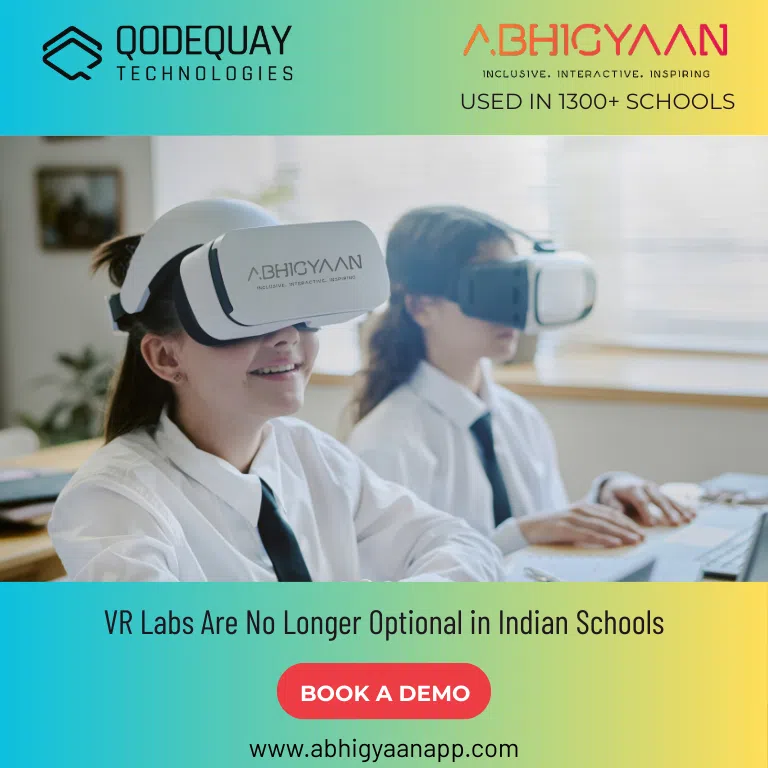
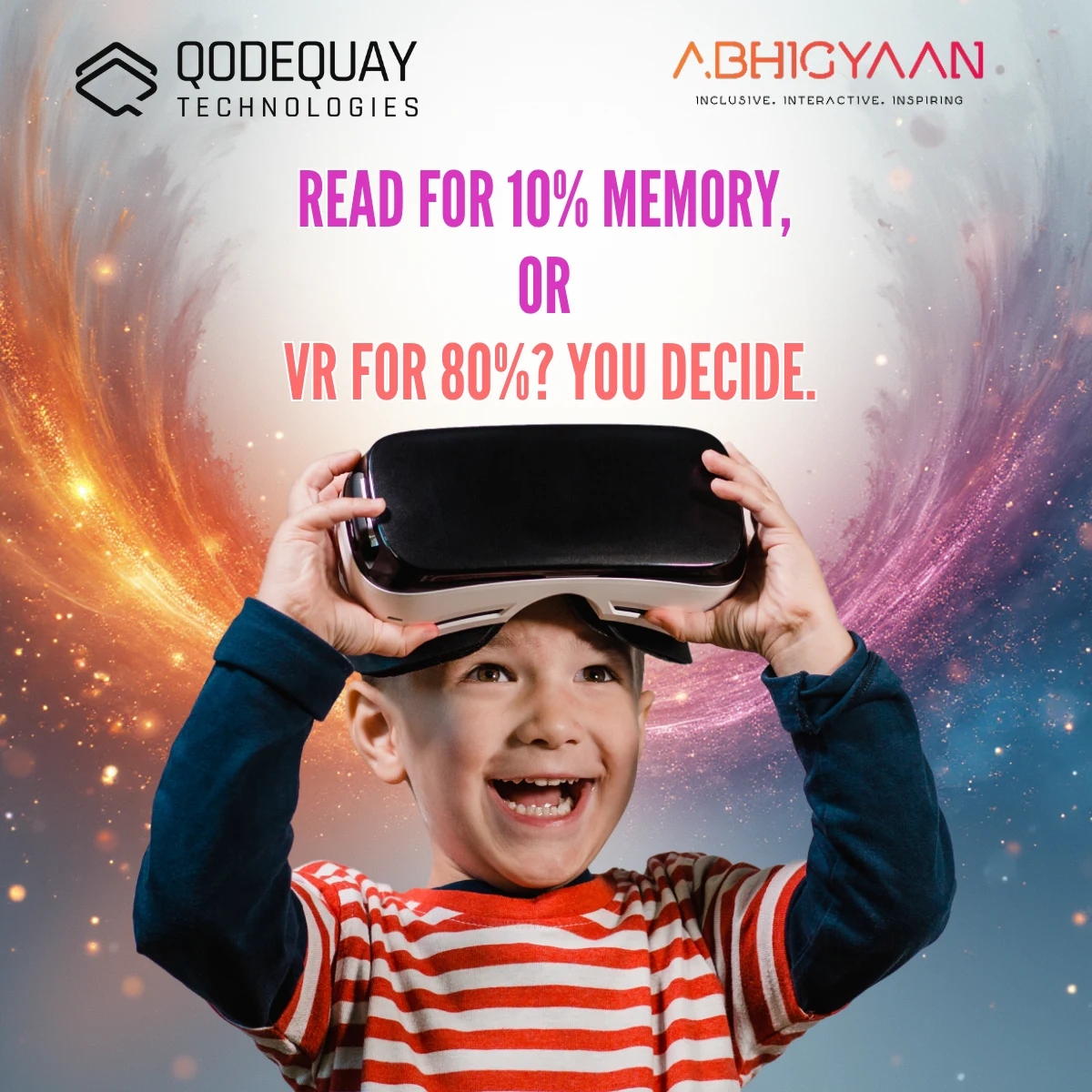
A Virtual Reality Lab in Indian schools is no longer an experiment or a luxury, it is becoming a practical response to the demands of NEP 2020. The policy calls for experiential learning, competency development, inclusivity, and reduced dependence on rote memorization. Traditional classrooms struggle to deliver all this at scale. Virtual Reality steps in as a tool that can.
This article explains how VR labs help Indian schools directly meet NEP 2020 goals, close infrastructure gaps, improve learning outcomes, and prepare students for future skills.
A Virtual Reality lab acts as a centralized experiential learning hub that replaces and enhances multiple traditional resources.
Instead of depending on physical labs, charts, and occasional field trips, schools can use VR to simulate science experiments, historical events, industrial environments, and real-world problem scenarios. One VR lab can support subjects like Science, Mathematics, Social Science, Geography, Biology, and even life skills.
In practice, this means a single space enables hundreds of curriculum-aligned experiences across grades.
A Virtual Reality lab directly supports NEP 2020 by shifting education from memorization to understanding.
NEP 2020 emphasizes competency-based learning, critical thinking, and real-world application. VR enables students to interact with concepts instead of passively reading about them. For example, students explore the human heart in 3D rather than memorizing diagrams, or simulate chemical reactions without safety risks.
This approach aligns with NEP’s focus on experiential learning, reduced syllabus burden, and deeper conceptual clarity.
A Virtual Reality lab helps Indian schools overcome limitations of space, cost, and resources.
Many schools, especially in rural and semi-urban areas, cannot afford fully equipped science labs or frequent educational trips. VR replaces repeated spending on chemicals, equipment repairs, and travel logistics.
Key advantages include:
One-time setup with low recurring costs
No consumables like chemicals or glassware
No safety hazards or supervision risks
Access to global and historical locations virtually
This makes advanced learning experiences accessible regardless of geography or budget.
Virtual Reality strengthens STEM education by making abstract concepts visible and interactive.
Physics, Chemistry, and Biology often fail because students cannot visualize what they cannot see. VR solves this by allowing learners to observe atomic structures, magnetic fields, electrical circuits, and biological systems from the inside.
Schools using VR report higher engagement in STEM subjects and improved problem-solving ability because students learn by experimentation, not repetition.
Yes, Virtual Reality labs significantly improve focus, retention, and confidence.
In high student-teacher ratio classrooms, individual attention is limited. VR creates immersive focus zones where distractions reduce naturally. Studies show immersive learning can increase attention span and concept retention multiple times compared to textbook-only learning.
Students also gain confidence through repeated practice in a risk-free environment. This is especially effective for skill-based learning, presentations, vocational simulations, and practical science.
Virtual Reality labs make inclusive education practical, not theoretical.
Students with physical disabilities can participate in activities that would otherwise be inaccessible. Learners who need more time can repeat simulations without pressure. Multilingual VR content supports regional language learners, aligning with NEP’s emphasis on mother-tongue instruction.
Inclusivity becomes built into the system rather than treated as a separate initiative.
Schools should follow structured implementation to maximize impact.
Best practices include:
Align VR modules with NCERT and state board curriculum
Train teachers as facilitators, not operators
Schedule VR sessions as part of regular timetables
Track learning outcomes through assessments and feedback
Start with pilot grades before scaling school-wide
Virtual Reality will evolve from an enhancement tool to a core learning infrastructure.
Future trends include AI-powered adaptive VR lessons, skill certification through simulations, integration with vocational education, and hybrid models combining physical labs with virtual practice. As NEP implementation deepens, VR labs will become a standard benchmark for progressive schools.
Instead of asking whether your school can afford a Virtual Reality lab, the smarter question is whether your school can afford to fall behind NEP 2020 expectations.
A short, guided VR demonstration can show how one lab transforms multiple subjects, improves engagement, and future-proofs learning. Start with one classroom, one grade, and one experience, then scale with confidence.
Virtual Reality labs directly support NEP 2020 goals
They reduce infrastructure and safety challenges
VR improves STEM understanding and retention
Inclusive and multilingual learning becomes achievable
One VR lab replaces multiple traditional resources
A Virtual Reality Lab in Indian schools is not about technology for its own sake. It is about delivering what NEP 2020 promises: experiential, inclusive, and skill-based education at scale. Schools that adopt VR are not chasing trends, they are building classrooms that match the future India is planning for its students.
A VR lab is not a gadget, it is how Indian schools turn policy into practice.
This is not extra effort for teachers. It is fewer explanations and deeper understanding.
Bring a curriculum-aligned Virtual Reality lab into your school and see concepts finally click.
👉 Experience it first-hand: https://abhigyaanapp.com
When learning becomes immersive, outcomes improve naturally.

As the CEO and Founder of Qodequay Technologies, I bring over 20 years of expertise in design thinking, consulting, and digital transformation. Our mission is to merge cutting-edge technologies like AI, Metaverse, AR/VR/MR, and Blockchain with human-centered design, serving global enterprises across the USA, Europe, India, and Australia. I specialize in creating impactful digital solutions, mentoring emerging designers, and leveraging data science to empower underserved communities in rural India. With a credential in Human-Centered Design and extensive experience in guiding product innovation, I’m dedicated to revolutionizing the digital landscape with visionary solutions.
Follow the expert :

October 24, 2026
October 23, 2026
October 22, 2026
October 21, 2026
October 20, 2026
Monthly insights on AI, VR and DPDPA compliance — straight from our team to your inbox.
Free 30-minute consultation with our team — or see our products in action.