How do you measure whether a school VR lab actually improves learning outcomes in India?
November 26, 2026
February 9, 2026
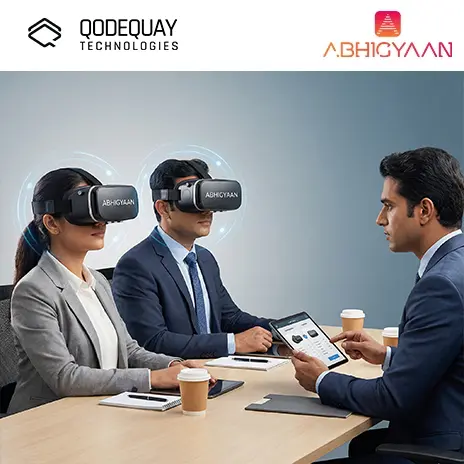
The top VR headsets for business are Meta Quest 3, Apple Vision Pro, HTC Vive XR Elite, Valve Index and Pico 4 Enterprise. Meta Quest 3 is the best all-round choice for most teams, balancing price, performance and ecosystem, while the right headset ultimately depends on your use case, budget and deployment scale: training, collaboration, product demos, learning programmes or industrial safety.
Virtual Reality is no longer just a gaming trend, it’s a serious business tool. Whether you’re a CTO planning immersive training, a CIO exploring digital transformation, a Product Manager building VR experiences, or a Startup Founder pitching an XR product, the headset you choose can decide your success or your failure.
In this guide, you’ll learn what makes a VR headset “top-tier,” which devices are leading the market today, how to evaluate them for enterprise use, and what trends will define the next generation of VR hardware.
The top VR headsets today include Meta Quest 3, Apple Vision Pro, HTC Vive XR Elite, Valve Index, and Pico 4 Enterprise.
These headsets lead because they combine performance, comfort, ecosystem strength, and enterprise readiness.
However, the “best” option depends on what you’re building:
Your choice should match your use case, budget, and deployment scale.
LSI terms used: VR headset comparison, immersive hardware, XR devices, standalone VR, PC VR, enterprise VR, VR training, VR collaboration, spatial computing, mixed reality headset, VR controllers, hand tracking
Choosing the right VR headset matters because it directly impacts adoption, comfort, security, and ROI.
A headset that looks great on paper can fail in real-world deployment if:
For leaders, the headset is not just hardware, it’s a platform decision.
Meta Quest 3 is the best all-around VR headset for most teams because it balances price, performance, and ecosystem.
Meta Quest 3 is widely used in:
This makes it a practical choice for pilots and enterprise rollouts.
Apple Vision Pro is best for premium enterprise experiences where quality, visuals, and spatial computing matter most.
Apple Vision Pro is not a traditional VR headset, it’s closer to a mixed reality computer.
It shines in:
The price and ecosystem maturity make it less suitable for large-scale training deployments today. But for innovation teams, it can be a strategic investment.
Valve Index is one of the best VR headsets for PC-based high performance and precision tracking.
If your VR experience requires:
Then PC VR headsets like Valve Index still lead.
PC VR is harder to scale because it requires:
This is ideal for labs, not for large distributed teams.
Pico 4 Enterprise is a strong option for enterprise deployments because it focuses on business controls and fleet management.
Enterprise buyers care about:
Pico is often considered when organizations want a more business-first ecosystem.
HTC Vive XR Elite is best when you want flexibility between VR and AR-style passthrough.
This headset is positioned for:
HTC has long been present in enterprise VR, and many simulation-based organizations still rely on Vive systems.
You should evaluate comfort, tracking, ecosystem, content support, and enterprise readiness before buying.
A VR headset is only “top” if people actually want to wear it.
Each top VR headset wins in a different scenario.
The biggest hidden costs are content creation, support, accessories, and device lifecycle management.
Hardware is only the entry point. You also need:
For CIOs, VR is both a technology project and an operational project.
The future of VR headsets will be lighter, more AI-powered, and more mixed reality-focused.
Here are the trends shaping the next 3–5 years:
Most headsets will support VR and passthrough MR modes.
Weight reduction will be a major competitive advantage.
Headsets will render high detail only where you look, improving performance.
Device management and policy controls will mature rapidly.
AI will enable smarter training simulations, virtual coaches, and adaptive learning inside VR.
Top VR headsets are no longer niche gadgets, they are becoming strategic tools for training, design, collaboration, and digital innovation. The right headset can improve onboarding speed, reduce operational errors, and unlock immersive experiences that make your product or service stand out.
At Qodequay (https://www.qodequay.com), you take a design-first approach to immersive technology, ensuring every VR experience solves a real human problem, with technology acting as the enabler. That’s how you move from experimentation to scalable business impact.
Meta Quest 3 is the best all-round headset for most teams because it balances price, performance and ecosystem. It is standalone with no PC required, has a strong app ecosystem, good hand tracking and solid mixed reality passthrough, and is easy to deploy at scale, which makes it practical for corporate training, education, walkthroughs, prototyping and multi-user collaboration.
Apple Vision Pro is best for premium enterprise experiences such as high-end product visualisation, executive demos, spatial UI and design, medical visualisation and premium training. Its price and ecosystem maturity make it less suitable for large-scale training deployments today, but for innovation teams it can be a strategic investment. It is closer to a mixed reality computer than a traditional VR headset.
Choose PC VR when the experience needs ultra-smooth motion, high frame rates, premium controllers and precise tracking. The trade-off is scale: PC VR needs VR-ready computers, wired or complex wireless setups and more IT support. That makes headsets like Valve Index ideal for dedicated simulation labs rather than large distributed teams.
Pico 4 Enterprise is a strong option because it focuses on business controls and fleet management. Enterprise buyers typically need device provisioning, app control, kiosk mode, remote updates and security policies, and Pico is often considered when organisations want a more business-first ecosystem for managing many headsets.
Hardware is only the entry point. Budget also for VR content development such as 3D environments and interactions, cleaning and hygiene solutions, replacement straps and face covers, storage and charging stations, staff training and onboarding, and ongoing maintenance and updates. For CIOs, VR is both a technology project and an operational project.

As the CEO and Founder of Qodequay Technologies, I bring over 20 years of expertise in design thinking, consulting, and digital transformation. Our mission is to merge cutting-edge technologies like AI, Metaverse, AR/VR/MR, and Blockchain with human-centered design, serving global enterprises across the USA, Europe, India, and Australia. I specialize in creating impactful digital solutions, mentoring emerging designers, and leveraging data science to empower underserved communities in rural India. With a credential in Human-Centered Design and extensive experience in guiding product innovation, I’m dedicated to revolutionizing the digital landscape with visionary solutions.
Follow the expert :


November 26, 2026

November 25, 2026

November 24, 2026

November 23, 2026

November 22, 2026
Monthly insights on AI, VR and DPDPA compliance — straight from our team to your inbox.
Free 30-minute consultation with our team — or see our products in action.