DPDPA Penalties Up to ₹250 Crore: The Real Cost of Waiting
July 2, 2026
February 9, 2026
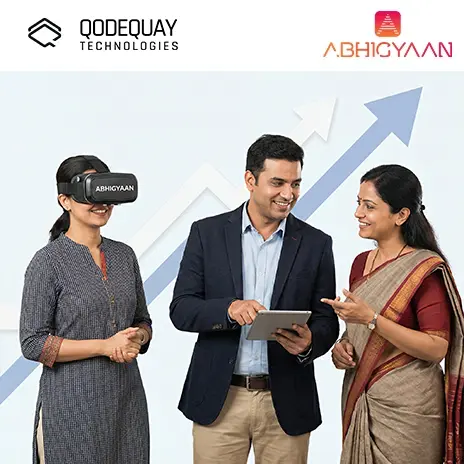
Virtual Reality has officially grown up. It’s no longer just a gaming accessory or a “metaverse” buzzword. It’s becoming a serious platform for training, collaboration, product design, and customer engagement. And the next wave of innovation is coming fast.
If you’re a CTO, CIO, Product Manager, Startup Founder, or Digital Leader, future VR trends matter because they directly influence your technology roadmap, workforce strategy, and competitive advantage. The decisions you make today about immersive technology can either position your organization ahead of the curve or lock you into outdated approaches.
In this article, you’ll explore the most important future VR trends, what they mean for business, real-world applications, and how you can prepare for the next 3–5 years.
The biggest future VR trends include mixed reality convergence, AI-driven experiences, lighter headsets, enterprise adoption, and spatial computing ecosystems.
These trends are reshaping VR from a niche tool into a mainstream computing layer. You are moving toward a world where VR is not a separate category, but part of everyday digital work and learning.
LSI terms used: immersive technology, spatial computing, mixed reality, XR, VR headsets, VR training, VR collaboration, metaverse workplace, haptic feedback, eye tracking, foveated rendering, digital twins
Future VR trends are important because VR is shifting from experimentation to operational value.
In the early phase, VR was mostly pilots and prototypes. Now, enterprises are using VR for:
For leadership teams, the key shift is that VR is becoming measurable. You can track performance, engagement, and productivity improvements with real data.
VR hardware will evolve to become lighter, more comfortable, more powerful, and more mixed reality-focused.
Right now, headsets are still bulky compared to laptops or phones. That will change.
This matters because comfort is one of the biggest blockers in enterprise adoption. When headsets feel natural, usage grows dramatically.
Mixed reality will not fully replace VR, but it will become the default mode for many headsets.
Mixed reality blends:
This gives you flexibility. You can run a training simulation, then instantly switch to a real-world workspace with virtual screens and tools.
For enterprises, mixed reality matters because it reduces friction. You don’t always want full immersion, sometimes you want a blend.
AI will shape the future of VR by making experiences smarter, more personalized, and cheaper to create.
AI will impact VR in three major ways:
Creating 3D environments is expensive. AI will reduce cost by generating:
VR training will include AI instructors that:
VR systems will measure:
This turns VR into a performance platform, not just a learning tool.
Eye tracking and foveated rendering will make VR more realistic while improving performance.
Eye tracking detects where you are looking. Foveated rendering then renders high detail only in that region, reducing GPU workload.
This means:
This is one of the most important technical upgrades for the next generation of VR.
Haptic feedback will become more common, but it will grow first in enterprise training and simulation.
Haptics means physical feedback, such as:
In business use cases, haptics will be valuable for:
Haptics improves realism, but it also adds cost. That’s why adoption will start in high-value scenarios.
VR will transform training by becoming a scalable, analytics-driven, and personalized learning system.
Here’s what will change:
Instead of long sessions, you will deliver:
VR will track:
AI will adjust difficulty based on performance.
This is where VR becomes extremely attractive to enterprises, because training becomes a system, not an event.
VR will impact remote collaboration by enabling spatial workspaces that feel closer to real teamwork than video calls.
In the future, you will see:
The goal is not to replace Zoom or Teams. The goal is to create “remote workshops” where teams can actually build, plan, and solve problems together.
Industries with high training cost, safety risk, or complex operations will adopt VR fastest.
You will see strong adoption in:
These industries benefit because VR reduces real-world risk and improves readiness.
The biggest barriers are content cost, comfort issues, enterprise security, and unclear use cases.
Even with better hardware, challenges remain:
The companies that succeed will treat VR like a product strategy, not like a one-time experiment.
The best way to prepare is to build VR capability around business outcomes, not hype.
VR fails when it is built like a tech demo. It succeeds when it is built like a real tool.
By 2030, VR will feel less like a headset and more like a computing layer that blends with everyday life.
You can expect:
The long-term shift is toward spatial computing, where digital experiences exist in 3D space around you, not inside flat screens.
Future VR trends point toward a world where immersive technology becomes a practical layer of business, not an experimental side project. As hardware improves, AI accelerates development, and enterprise adoption grows, VR will become a standard tool for training, collaboration, and innovation.
At Qodequay (https://www.qodequay.com), you approach the future of VR with a design-first mindset, solving real human problems first and using technology as the enabler. That’s how you create immersive experiences that deliver measurable value today, while preparing for the next generation of digital transformation.

As the CEO and Founder of Qodequay Technologies, I bring over 20 years of expertise in design thinking, consulting, and digital transformation. Our mission is to merge cutting-edge technologies like AI, Metaverse, AR/VR/MR, and Blockchain with human-centered design, serving global enterprises across the USA, Europe, India, and Australia. I specialize in creating impactful digital solutions, mentoring emerging designers, and leveraging data science to empower underserved communities in rural India. With a credential in Human-Centered Design and extensive experience in guiding product innovation, I’m dedicated to revolutionizing the digital landscape with visionary solutions.
Follow the expert :


July 2, 2026
July 2, 2026
July 2, 2026
July 2, 2026

July 2, 2026
Monthly insights on AI, VR and DPDPA compliance — straight from our team to your inbox.
Free 30-minute consultation with our team — or see our products in action.