Can VR train India’s disaster responders between state-wide mock drills?
November 28, 2026
November 28, 2026
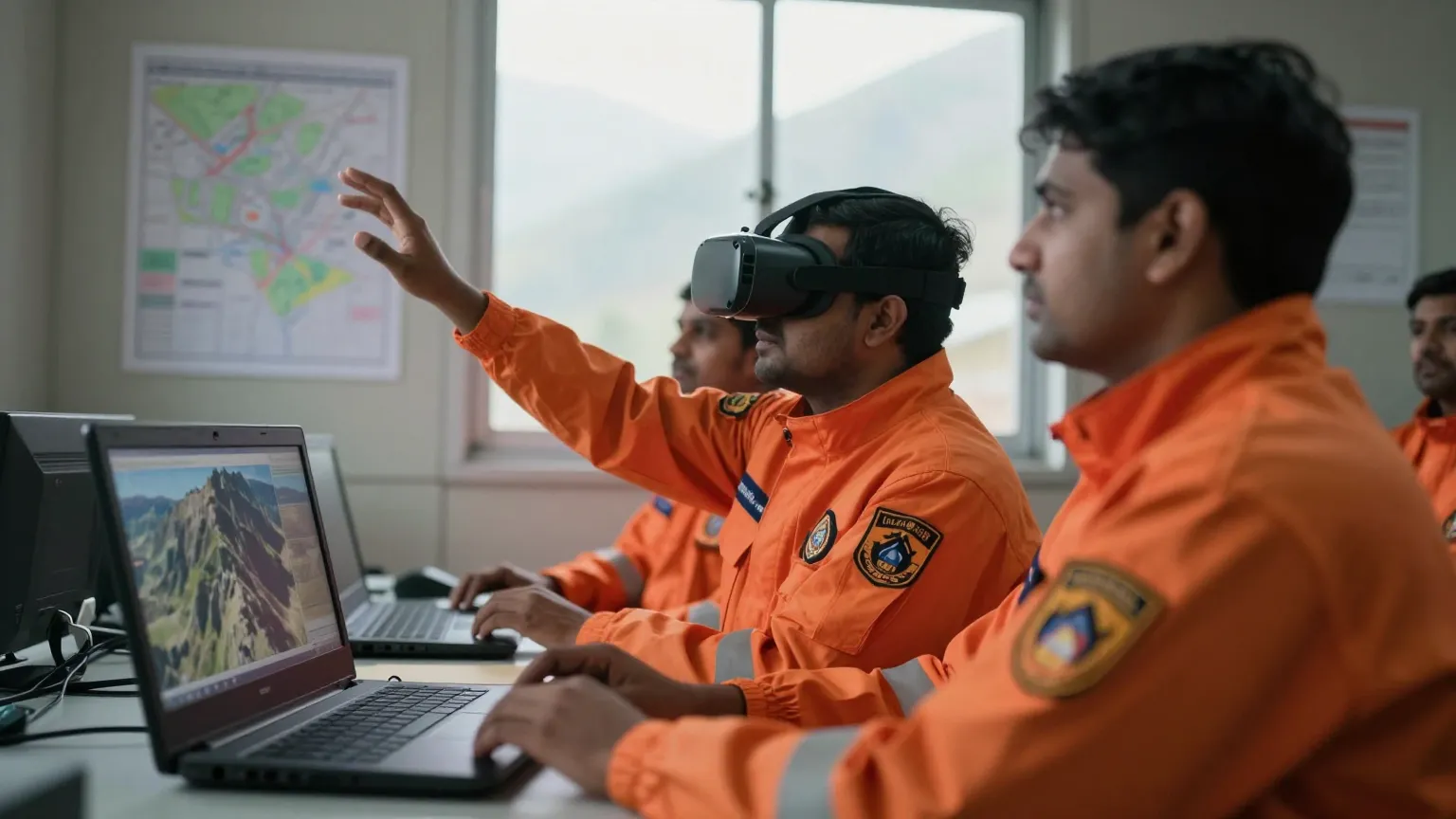
Yes, for the decision and coordination skills a mock drill tests but cannot repeat: incident command, triage, evacuation sequencing and multi-agency communication. A full-scale exercise like Uttarakhand's 28 November 2026 drill at 250 to 300 locations happens once a year; a VR scenario can be run every week by every tehsil team. VR complements the drill and does not replace hands-on rope, cutting and medical skills.
Today, 28 November 2026, Uttarakhand is running what its State Disaster Management Authority (USDMA) describes as the first large-scale simultaneous mock drill in the State: 250 to 300 locations across all 13 districts, from the State Emergency Operations Centre down to tehsil level. The date is deliberate. It marks the anniversary of the Silkyara tunnel rescue, when 41 workers were brought out after 17 days in November 2023, and the Chief Minister has declared it Disaster Management Day, to be observed every year.
A drill on that scale is a serious achievement, and it exposes the central problem of disaster preparedness in India: the exercise that tests the whole system can be staged once a year, while the skills it tests decay in months. In this guide we look at what a state-wide drill measures, which of those skills can be practised in virtual reality between drills, and how a State Disaster Management Authority, SDRF unit or fire service can set that up.
Uttarakhand followed the sequence that NDMA-style mock exercises use across India: an orientation and coordination conference on 17 November, table-top exercises in every district on 25 November, then the full-scale drill on 28 November. Disaster Management Secretary Vinod Kumar Suman listed the scenarios the drill simulates: cloudbursts, flash floods, earthquakes, landslides, avalanches, forest fires, tunnel and road accidents, emergency helicopter landings, building collapses, industrial and chemical accidents, dam-related emergencies and stampede-like situations.
The drill is not primarily a test of rope work or first aid. According to USDMA it tests emergency communication, deployment of resources, coordination among departments, evacuation, medical response, relief distribution and incident command. Participants include SDRF, NDRF, police, fire services, health and revenue departments, local bodies, NGOs, NCC, NSS and community volunteers, and relief camps are set up and checked. As Suman put it at the state table-top exercise, even a few minutes are crucial during a disaster, so each district must know which agency acts on which information, where resources are mobilised and how command and control runs at the site.
Three reasons. Cost and disruption: a simultaneous exercise at 300 locations pulls thousands of officials, responders and volunteers off normal duty, and the planning takes weeks. Safety: the scenarios that matter most, a tunnel collapse, a chlorine release, an avalanche or a crowd crush at a pilgrimage site, cannot be staged realistically without creating the risk being rehearsed, so the drill substitutes a signposted area and a briefing. Staffing: the officers who design and evaluate a drill are the same people who run real incidents.
So an SDRF team or a tehsil-level incident commander rehearses a full multi-agency response once a year, and a dangerous-scenario response almost never. We covered the parallel problem for factories in how often an Indian factory must run an emergency mock drill: the legal minimum rarely keeps skills current, and the same holds for public responders.
VR is strong where the drill is weak, and weak where the drill is strong. The table below is the split we use when scoping a programme with a disaster management authority or a fire service.
| Skill tested in a mock drill | Can VR train it? | Why |
|---|---|---|
| Incident command: who decides, who reports, in what order | Yes, well | The decision tree can be presented as a branching scenario with a timer and a scored outcome, and repeated until the sequence is automatic |
| Multi-agency communication and hand-offs | Yes, well | A multi-user session puts police, fire, health and revenue roles in the same virtual incident with a shared radio channel, without moving anyone to a site |
| Evacuation sequencing and route choice | Yes, well | Routes, blockages and crowd behaviour can be modelled on the real tehsil or building layout and varied each run |
| Hazard recognition in a chemical, tunnel or structural incident | Yes, well | The hazard can be shown at full scale, in daylight and at night, and the responder can make the fatal mistake safely |
| Triage and medical response under load | Partly | Decision logic and prioritisation transfer; hands-on procedures still need manikins and clinical instructors |
| Rope rescue, cutting, lifting, pumping | Not yet | Haptics are not good enough; these stay on the training ground and in the field |
| Relief camp set-up and community coordination | Partly | Layout and checklist training works in VR; the human logistics are learned by doing |
This is why we describe VR as the layer between the table-top exercise and the full-scale drill, not a replacement for either. The table-top tests the plan on paper; VR tests whether teams can execute their part under time pressure; the drill tests whether the whole system holds together in the field. Our earlier posts on VR fire-safety training and confined-space and work-at-height training cover the same division for industrial responders.
The NDRF, constituted under Section 44 of the Disaster Management Act, 2005, is the specialist force that states call in when an incident exceeds local capacity. In March 2026 the Parliamentary Standing Committee on Home Affairs, in its 257th report on the Demands for Grants for 2026-27, noted that no additional NDRF battalion had been raised in the previous three years despite increasing operational responsibilities, and that posted strength stood at 14,837 against an authorised 18,581. The Committee also flagged that only about 10 per cent of the Budget Estimate was earmarked for capital expenditure, and recommended greater emphasis on advanced rescue equipment, ICT-enabled response systems and regional infrastructure to reduce response time.
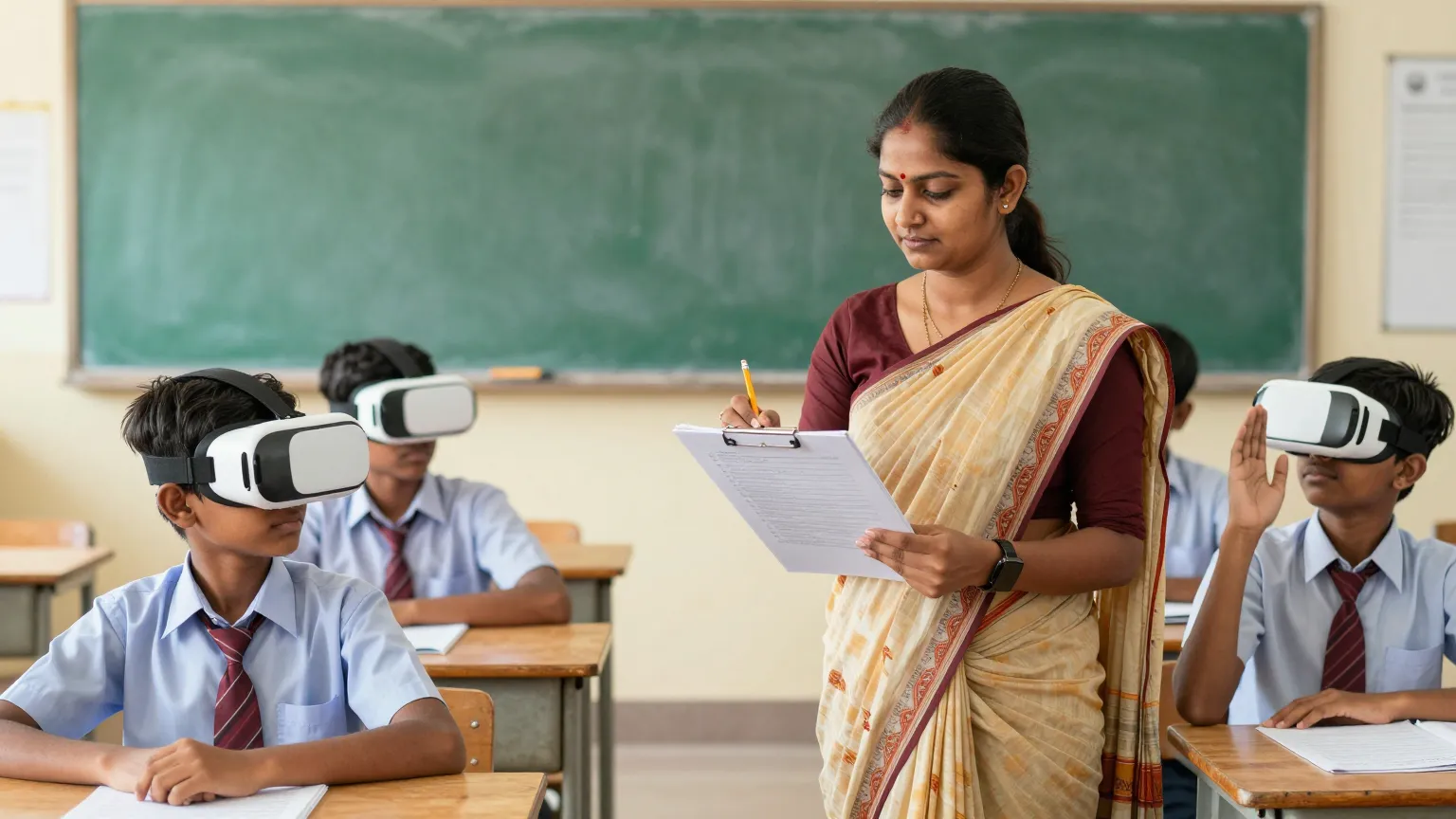
Two conclusions follow for state authorities. First, the NDRF will not be the first responder at most of the 300 locations in a drill like Uttarakhand's; SDRF, fire services, police and revenue staff carry the first hour, so their training matters most. Second, with instructor time scarce, a method that lets one senior officer run a scenario for twenty tehsil teams in parallel and review their recorded performance afterwards multiplies the training capacity that exists. It is the same logic the armed forces apply to simulators, which we examined in whether VR can replace live-fire training.
We built Abhigyaan Pro, our professional VR training platform, around these requirements: collaborative multi-user rooms, scenario-based training simulations, remote assistance and remote tracking, headset and browser participants in the same session, Indian data centres and an air-gapped option. If your authority, SDRF unit or fire service wants to see how a district plan becomes a repeatable VR exercise, book a 30-minute call with our team.
No. A full-scale mock drill tests whether the whole system, from the State Emergency Operations Centre to the tehsil, holds together in the field, and no simulation reproduces that. VR sits between the table-top exercise and the drill: it lets individuals and teams rehearse incident command, communication and evacuation decisions weekly, so the annual drill tests execution rather than first exposure.
The ones a drill cannot stage safely: tunnel collapse, chemical or gas release at an industrial unit, building collapse after an earthquake, avalanche and landslide response, forest fire spread, dam-related flooding and stampede-like crowd situations. Each can be modelled on the district's real terrain and layout, run in daylight or at night, and varied every session so responders do not learn a single script.
Short and frequent works better than long and rare. We recommend 20 to 30 minute sessions once a week or once a fortnight per team, with roles rotated so each responder practises their own Incident Response System position and at least one other. The scored results from these sessions should feed the next table-top exercise and the annual full-scale drill.
It can, if the platform is specified for it. Ask for offline or air-gapped operation, local caching of scenarios, data hosted in Indian data centres and a browser mode so that an office with one headset and several laptops can still train as a team. Content in Hindi and the regional language, including voice prompts, matters as much as connectivity for tehsil-level responders.
It marks the anniversary of the Silkyara tunnel rescue, when 41 workers trapped since 12 November 2023 were brought out on 28 November 2023 after 17 days. The Chief Minister announced the date would be observed every year. In 2026 the State marked it with table-top exercises in all 13 districts on 25 November and a simultaneous full-scale mock drill at 250 to 300 locations on 28 November.

I am a founder director at Qodequay Technologies Pvt. Ltd., a leading digital transformation consulting firm that helps clients across industries to innovate, optimize, and grow their businesses. I have over two decades of experience in the digital domain, spanning product development, e-commerce, user experience, design thinking, web and app development, and business leadership. My core competencies include developing and executing digital transformation strategies, building teams globally, roadmaps, and solutions that leverage data, insights, and emerging technologies such as artificial intelligence, augmented reality, blockchain, and immersive experience. I also have expertise in digital commerce, supply chain integration, and product management, having worked with both B2B and B2C brands in various sectors. My mission is to create value for customers and stakeholders by delivering impactful and engaging digital experiences that drive growth and innovation.
November 28, 2026

November 27, 2026
November 26, 2026

November 25, 2026
November 24, 2026
Monthly insights on AI, VR and DPDPA compliance — straight from our team to your inbox.
Free 30-minute consultation with our team — or see our products in action.