Consent Managers vs Consent Management Platforms Under DPDPA: What’s the Difference?
October 2, 2026
February 12, 2026

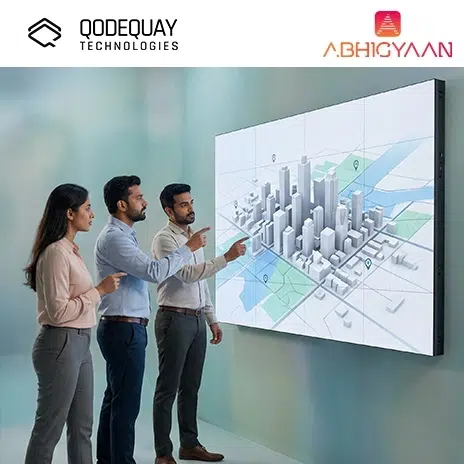
Spatial computing is the shift from flat screens to digital experiences that exist in your physical space. It is not just another tech trend, it is a new interaction model where your environment becomes the interface.
If you are a CTO, CIO, Product Manager, Startup Founder, or Digital Leader, spatial computing matters because it changes how people learn, buy, train, collaborate, design, and operate. It also changes how your business builds products, because spatial experiences require a different blend of UX, 3D design, engineering, and real-world safety thinking.
In this article, you will learn what spatial computing is, how it works, why it matters for leadership, the most valuable enterprise use cases, the technology stack, real-world examples, best practices, common mistakes, and what the future will look like.
Spatial computing is the technology that allows digital content to interact with your physical environment in real time.
Instead of viewing a digital interface on a 2D screen, you interact with 3D objects, spatial UI elements, and contextual information placed around you.
Spatial computing includes:
A useful way to think about it is this: Spatial computing turns your room into a computer.
Spatial computing matters because it will redefine digital experience design and create new competitive advantages across industries.
Just like mobile changed everything in the 2010s, spatial computing is likely to shape the next era of digital products.
For leadership, the value comes from:
If your organization is investing in AI, IoT, or digital twins, spatial computing becomes the interface layer that makes those systems usable and actionable.
Spatial computing is the umbrella, and AR/VR/MR are the experience types under it.
Here is the difference in plain language:
AR overlays digital information on the real world. Example: You point your phone at a machine, and see maintenance steps on top of it.
VR replaces the real world with a fully digital environment. Example: Safety training in a simulated construction site.
MR blends real and digital objects, allowing interaction between them. Example: A digital control panel anchored to a physical machine, where you can grab and move controls using your hands.
Spatial computing covers all of them, plus the underlying systems that understand your environment.
Spatial computing works by mapping the environment, tracking your position, and rendering digital content in real time.
It relies on multiple technologies working together:
The device scans your room and detects surfaces like:
The device tracks:
This is done using SLAM (Simultaneous Localization and Mapping), a method that helps devices build a map and locate themselves within it.
The device renders 3D content at high frame rates (usually 60–90 FPS). If rendering lags, users feel discomfort or motion sickness.
Spatial experiences use:
Sound is placed in 3D space, which makes experiences feel real and directional.
Spatial computing solves problems where 2D interfaces fail, especially in complex, physical, or high-risk environments.
The best problems are:
The best enterprise use cases include training, remote assistance, design review, and operational visualization.
Let’s break them down.
Spatial computing allows you to train people in realistic environments without real-world risk.
Examples:
A major benefit is repeatability. You can train the same scenario 100 times, consistently.
Spatial computing enables a technician to see step-by-step instructions in their field of view while an expert supports remotely.
Example: A field engineer wearing a headset can stream what they see, while a remote expert draws annotations that appear anchored on the machine.
This reduces downtime and avoids travel costs.
Spatial computing is one of the best interfaces for digital twins.
Instead of looking at dashboards, you can:
This becomes extremely valuable for:
Spatial computing lets you review designs at full scale.
Example: A car interior prototype can be reviewed virtually, before physical manufacturing.
This reduces cost and speeds up design cycles.
Spatial computing enables customers to:
This is especially powerful for high-consideration purchases.
Spatial computing is already being used in manufacturing, healthcare, retail, and engineering.
Some well-known examples include:
Boeing has tested AR to guide technicians through complex wiring tasks, reducing errors and speeding assembly.
Walmart has used VR training programs to improve employee readiness for retail operations and customer handling.
Hospitals and medical schools use VR-based simulation for surgical training and patient interaction practice.
Architects and engineers use VR/MR to walk clients through building designs before construction starts.
These examples show the same pattern: Spatial computing works best where physical context matters.
You need a stack that combines 3D design, real-time engines, cloud services, and device deployment.
A practical spatial computing stack includes:
The biggest challenges are user comfort, content complexity, and integration with real systems.
Here are the most common blockers:
Spatial UI is not the same as mobile UI.
Bad spatial UX feels:
Headsets still face constraints:
3D assets are expensive to create and maintain.
People need time and support to adopt new ways of working.
Spatial devices capture real environments. This raises concerns around:
The best practices are to design for comfort, start with high-value workflows, and prioritize usability over novelty.
Use these principles:
Spatial computing becomes dramatically more valuable when connected to AI, IoT, and digital twins.
Here’s how they combine:
Sensors provide:
Digital twins give:
AI adds:
Spatial computing becomes the interface that makes all of this usable.
Instead of reading dashboards, you can see operational truth in 3D.
Spatial computing will shift from “cool demos” to operational systems, driven by better hardware and AI-native interfaces.
Here are the trends you should watch:
More products will move beyond flat screens and into mixed reality workspaces.
You will speak to AI agents that understand your environment.
Example: You look at a machine and ask: “What changed since last week?” The system answers using sensor data, logs, and maintenance history.
As AR glasses become lighter and cheaper, adoption will rise in:
Digital twins will no longer be limited to large enterprises. Mid-sized companies will adopt them through modular services.
Training and onboarding will become more immersive, especially for technical roles.
Spatial computing is not just a new interface, it is a new way to think about digital experiences. It shifts your product strategy from screens to spaces, from clicks to gestures, and from data dashboards to real-world context.
For digital leaders, this is an opportunity to redesign workflows, improve operational intelligence, and create experiences that feel natural, fast, and human.
At Qodequay, you build spatial computing experiences with a design-first approach, where technology is never the hero, it is the enabler. The real focus stays on solving human problems, reducing friction, and creating digital products that deliver measurable impact in the real world.

As the CEO and Founder of Qodequay Technologies, I bring over 20 years of expertise in design thinking, consulting, and digital transformation. Our mission is to merge cutting-edge technologies like AI, Metaverse, AR/VR/MR, and Blockchain with human-centered design, serving global enterprises across the USA, Europe, India, and Australia. I specialize in creating impactful digital solutions, mentoring emerging designers, and leveraging data science to empower underserved communities in rural India. With a credential in Human-Centered Design and extensive experience in guiding product innovation, I’m dedicated to revolutionizing the digital landscape with visionary solutions.
Follow the expert :

October 2, 2026

October 1, 2026

July 2, 2026
July 2, 2026
July 2, 2026
Monthly insights on AI, VR and DPDPA compliance — straight from our team to your inbox.
Free 30-minute consultation with our team — or see our products in action.