Consent Managers vs Consent Management Platforms Under DPDPA: What’s the Difference?
October 2, 2026
February 11, 2026
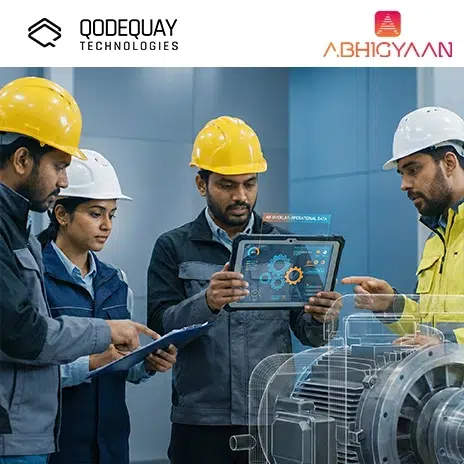
Digital Twins and AR in Industry matter because they turn complex industrial environments into systems you can see, understand, and improve in real time.
If you are a CTO, CIO, Product Manager, Startup Founder, or Digital Leader, you already know the pressure: reduce downtime, increase efficiency, improve safety, and still innovate faster than your competitors. The industrial world is no longer driven only by machines, it is driven by data, simulation, and decision speed.
That’s where Digital Twins and Augmented Reality (AR) become a powerful combo.
In this article, you will learn:
A Digital Twin is a virtual replica of a real-world asset, system, or process that updates using real-time data.
Think of it as a living simulation of a factory machine, a warehouse, a turbine, or even an entire production line. Unlike static 3D models, a Digital Twin is connected to sensors and systems, so it reflects what is happening right now.
A Digital Twin typically includes:
For example, if a motor starts vibrating abnormally, the Digital Twin can show the anomaly, predict failure probability, and recommend action.
AR in industry overlays digital information on physical environments to guide workers in real time.
Instead of reading manuals or calling experts, you can see step-by-step instructions on top of the machine you are repairing. AR can run on:
In industrial environments, AR is used for:
It reduces human error and makes complex tasks easier, even for less experienced technicians.
Digital Twins provide the intelligence, AR provides the interface.
A Digital Twin holds the data and simulation layer. AR becomes the real-world “screen” that delivers that intelligence directly to the worker.
You walk up to a pump in a factory. With AR glasses, you instantly see:
That information is powered by the Digital Twin.
This is where industrial work becomes faster, safer, and far more scalable.
You should care because Digital Twins and AR directly improve operational performance while reducing cost and risk.
This is not a “future tech” concept anymore. Industries are adopting it because it solves real problems.
Digital Twins and AR help you respond with speed and precision.
Digital Twins solve problems related to visibility, prediction, optimization, and decision-making.
Here are the most common industrial pain points they address.
Instead of fixing machines after failure, you predict failure before it happens.
Real-world impact:
You can simulate production changes before applying them.
Example:
Digital Twins can track energy use and identify waste patterns.
Industries using this often see:
AR solves problems related to training, execution accuracy, and expert availability.
Instead of weeks of training, you guide workers live.
A senior expert can support multiple locations without travel.
AR highlights the right component and the correct action.
This is especially valuable in high-risk environments like:
Manufacturing, energy, aerospace, and construction are currently leading adoption because the ROI is easiest to measure.
Use cases include:
Use cases include:
Use cases include:
Use cases include:
The most valuable use cases combine real-time monitoring with AR-driven execution.
A technician sees the Digital Twin data and repair steps directly on the machine.
You run scenarios like:
AR can highlight defects, misalignment, or missing components.
AR can show hazard zones and safety steps.
A Digital Twin architecture usually includes sensors, data pipelines, modeling, and analytics layers.
A typical stack includes:
In industrial environments, latency is expensive. Edge computing allows you to process data closer to the equipment, which is essential for:
Real-world adoption shows measurable improvements in downtime, training time, and operational efficiency.
Siemens has been a strong leader in Digital Twin adoption, especially in manufacturing. They use Digital Twins to simulate production systems and reduce costly errors before physical implementation.
GE has used Digital Twins in aviation and energy to monitor engine performance and predict maintenance needs.
Boeing has explored AR to support complex wiring tasks, reducing assembly errors and speeding up production.
You can expect measurable improvements in productivity, downtime, safety, and training speed.
The biggest challenges are data quality, integration complexity, and change management.
Factories often have multiple systems:
Connecting them is not simple.
A Digital Twin is only valuable if it reflects reality accurately.
AR devices still face:
Workers may resist AR if it feels intrusive or complicated.
You should start small, prove ROI, and scale with strong data foundations.
You measure ROI by tracking downtime reduction, productivity gains, and training efficiency improvements.
If a factory loses even 2 hours per month due to unplanned downtime, and that downtime costs thousands per hour, the ROI becomes visible very quickly.
Digital Twins and AR are foundational technologies for the industrial metaverse.
The industrial metaverse is not about avatars dancing in factories. It is about:
AR becomes the gateway that connects your workforce to that digital layer.
The future will bring more automation, smarter twins, and AR that feels as natural as looking at the world.
Digital Twins will evolve from monitoring tools to decision-making systems.
You will see:
AR hardware will become:
You will see Digital Twins for:
Digital Twins will support “live simulation” where systems predict outcomes continuously, not just during planning.
Digital Twins and AR are not hype technologies, they are practical tools that turn industrial complexity into competitive advantage. When you combine a real-time Digital Twin with an AR interface, you give your workforce superpowers: instant visibility, guided execution, and smarter decisions.
For CTOs, CIOs, Product Managers, Startup Founders, and Digital Leaders, this is a strategic shift. You are not just digitizing operations, you are building a system where physical assets and digital intelligence work together continuously.
At Qodequay (https://www.qodequay.com), you solve human problems first through design, then amplify outcomes using technology as the enabler. That design-first approach is exactly what makes Digital Twins and AR succeed in the real world, because the best industrial transformation is not only technical, it is usable, scalable, and built for the people who run the systems every day.

As the CEO and Founder of Qodequay Technologies, I bring over 20 years of expertise in design thinking, consulting, and digital transformation. Our mission is to merge cutting-edge technologies like AI, Metaverse, AR/VR/MR, and Blockchain with human-centered design, serving global enterprises across the USA, Europe, India, and Australia. I specialize in creating impactful digital solutions, mentoring emerging designers, and leveraging data science to empower underserved communities in rural India. With a credential in Human-Centered Design and extensive experience in guiding product innovation, I’m dedicated to revolutionizing the digital landscape with visionary solutions.
Follow the expert :

October 2, 2026
October 1, 2026

July 2, 2026
July 2, 2026
July 2, 2026
Monthly insights on AI, VR and DPDPA compliance — straight from our team to your inbox.
Free 30-minute consultation with our team — or see our products in action.