DPDPA Penalties Up to ₹250 Crore: The Real Cost of Waiting
July 2, 2026
December 23, 2025
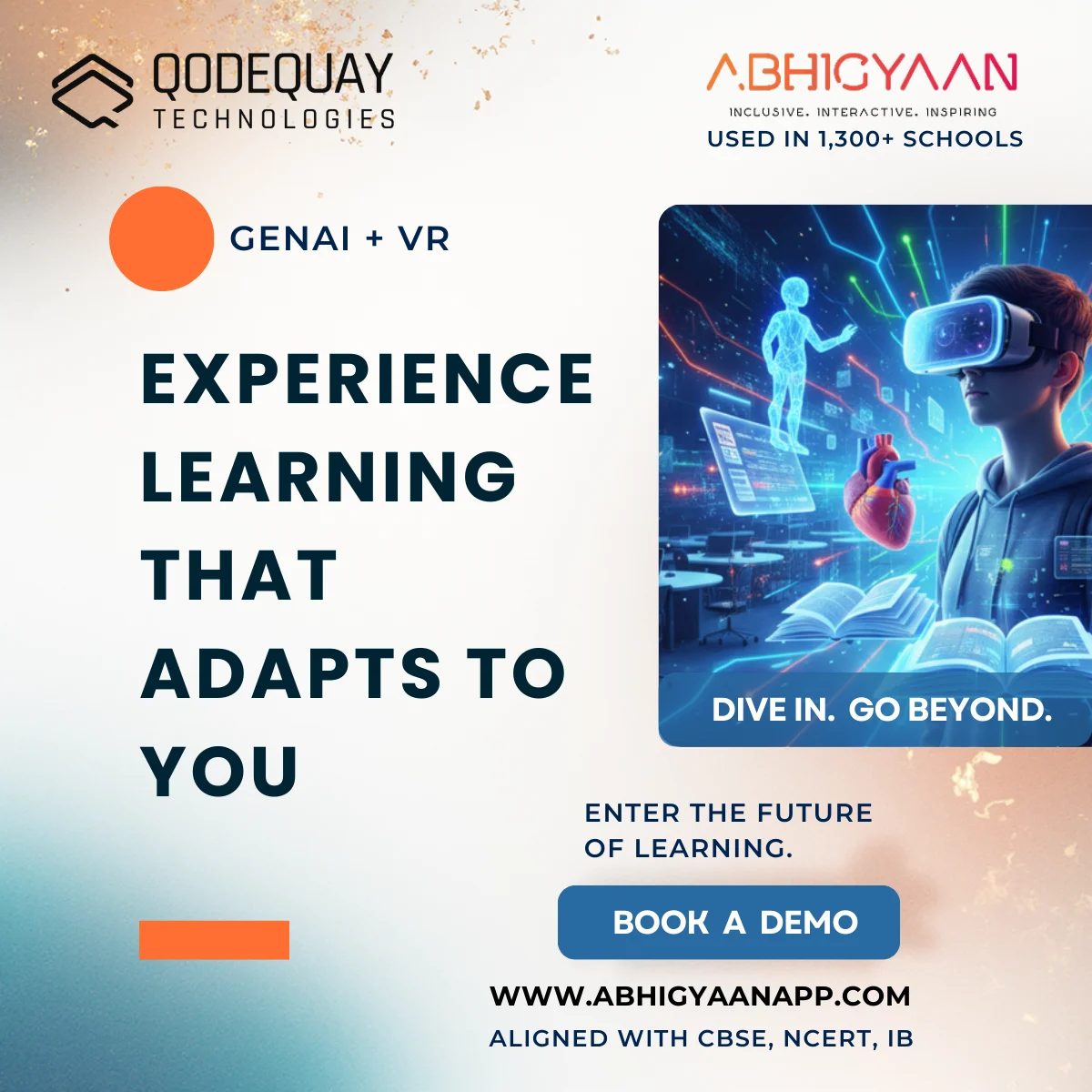
GenAI and VR are changing learning by shifting it from one-size-fits-all instruction to adaptive, experience-driven education.
Traditional classrooms are designed for efficiency, not individuality. One teacher explains. Many students listen. Some keep up, some fall behind, and some wait patiently for the class to move on.
Generative AI and Virtual Reality together challenge that structure. They allow learning environments to respond to each student, not just deliver information.
This is not about replacing teachers or automating education. It is about giving educators tools that adapt to how students learn, at the pace they learn, without disrupting classroom discipline or curriculum goals.
Personalization is difficult because teachers manage many learners with limited time and fixed structures.
Even the most dedicated teacher faces constraints:
Different learning speeds in the same classroom
Limited time to re-explain concepts individually
Difficulty visualizing abstract topics for all students
Pressure to complete syllabus milestones
As a result, teaching often aims for the average student, leaving others either confused or disengaged.
Technology has attempted to solve this through videos, assessments, and dashboards. But without context and experience, personalization remains shallow.
When GenAI and VR work together, learning environments become responsive rather than static.
Virtual Reality provides immersion. Generative AI provides intelligence.
Together, they create intelligent virtual worlds where:
Content adjusts in real time based on learner actions
Explanations change when a student struggles
Scenarios slow down or repeat when needed
Learners explore concepts rather than memorize them
Instead of passively consuming content, students interact with environments that react, guide, and adapt.
This is where personalization moves from theory to practice.
Intelligent virtual environments respond to how students learn, not just what they learn.
In a GenAI-powered VR lesson:
A student who hesitates receives additional guidance
A curious learner can explore deeper without waiting
Explanations shift from text to visuals to storytelling
Feedback is immediate and contextual
The system does not label students as fast or slow. It adjusts quietly, allowing confidence to grow without comparison or pressure.
For educators, this means fewer interruptions and more focused classrooms.
Yes, when designed specifically for education, GenAI and VR environments are controlled, structured, and teacher-led.
School-appropriate platforms:
Align with curriculum standards
Operate within defined learning objectives
Avoid open-ended or unmoderated AI responses
Keep teachers in control of pacing and content
The technology supports instruction, it does not override it.
For principals, this matters. Innovation must never compromise safety, discipline, or accountability.
Immersion increases focus when learning is purposeful and guided.
Unlike general screen-based tools, VR creates a distraction-free environment. Students are not multitasking. They are present inside the lesson.
When combined with GenAI:
Lessons feel conversational, not scripted
Feedback feels personal, not evaluative
Learning becomes active, not passive
Engagement improves not because learning is entertaining, but because it feels relevant and understandable.
GenAI and VR reduce instructional strain while improving learning outcomes.
For teachers:
Less repetition of the same explanation
Better support for mixed-ability classrooms
Tools that complement existing lesson plans
For administrators:
Greater consistency across classrooms
Scalable personalization without staffing changes
Clear visibility into learning progress
The technology works quietly in the background, allowing schools to focus on teaching, not managing tools.
Yes, immersive and AI-supported learning is already being adopted in real classrooms.
Schools using GenAI-powered VR report:
Higher student attention during complex topics
Improved conceptual understanding
More confident participation
Better retention of abstract concepts
Importantly, these results are seen not just in premium institutions, but also in schools operating with limited resources.
This signals a shift from experimental innovation to practical application.
GenAI and VR cannot be fully understood through descriptions.
Their value lies in interaction:
How a lesson adapts
How students respond
How teachers observe engagement change
A short classroom demo answers questions faster than any presentation or brochure.
That is why many school leaders prefer to see one lesson in action before forming an opinion.
Personalized learning should not depend on guesswork or promises.
Give us 30 minutes with one class. See how an intelligent, immersive learning environment responds to different learners in real time.
If it does not add clarity, control, and engagement, there is no reason to continue.
Book a GenAI + VR classroom demo and see how personalized learning can work safely, practically, and effectively in your school.

As the CEO and Founder of Qodequay Technologies, I bring over 20 years of expertise in design thinking, consulting, and digital transformation. Our mission is to merge cutting-edge technologies like AI, Metaverse, AR/VR/MR, and Blockchain with human-centered design, serving global enterprises across the USA, Europe, India, and Australia. I specialize in creating impactful digital solutions, mentoring emerging designers, and leveraging data science to empower underserved communities in rural India. With a credential in Human-Centered Design and extensive experience in guiding product innovation, I’m dedicated to revolutionizing the digital landscape with visionary solutions.
Follow the expert :


July 2, 2026
July 2, 2026
July 2, 2026
July 2, 2026
July 2, 2026
Monthly insights on AI, VR and DPDPA compliance — straight from our team to your inbox.
Free 30-minute consultation with our team — or see our products in action.