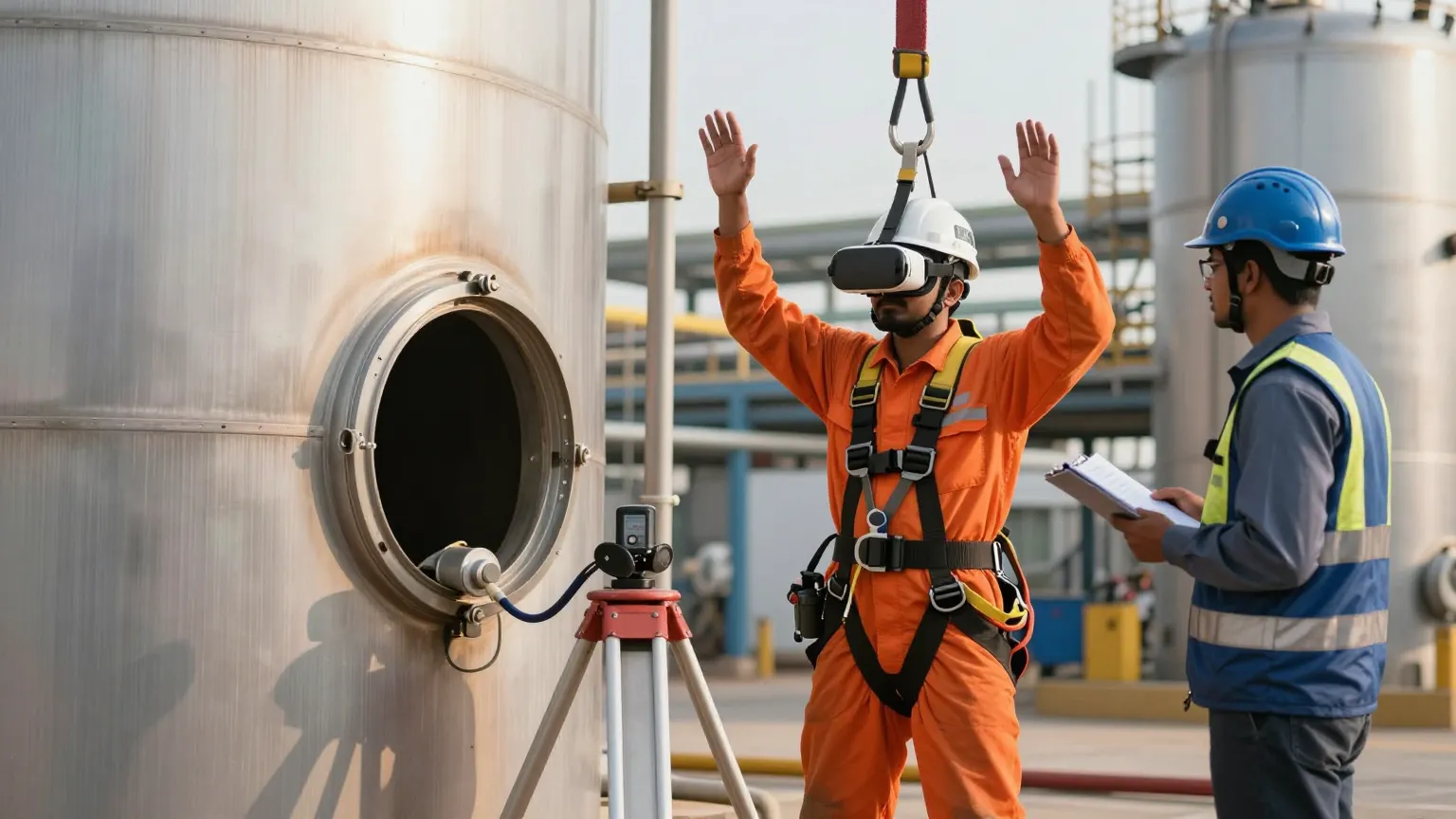
Can VR teach lockout-tagout and electrical safety to Indian plant workers?
November 23, 2026
November 23, 2026
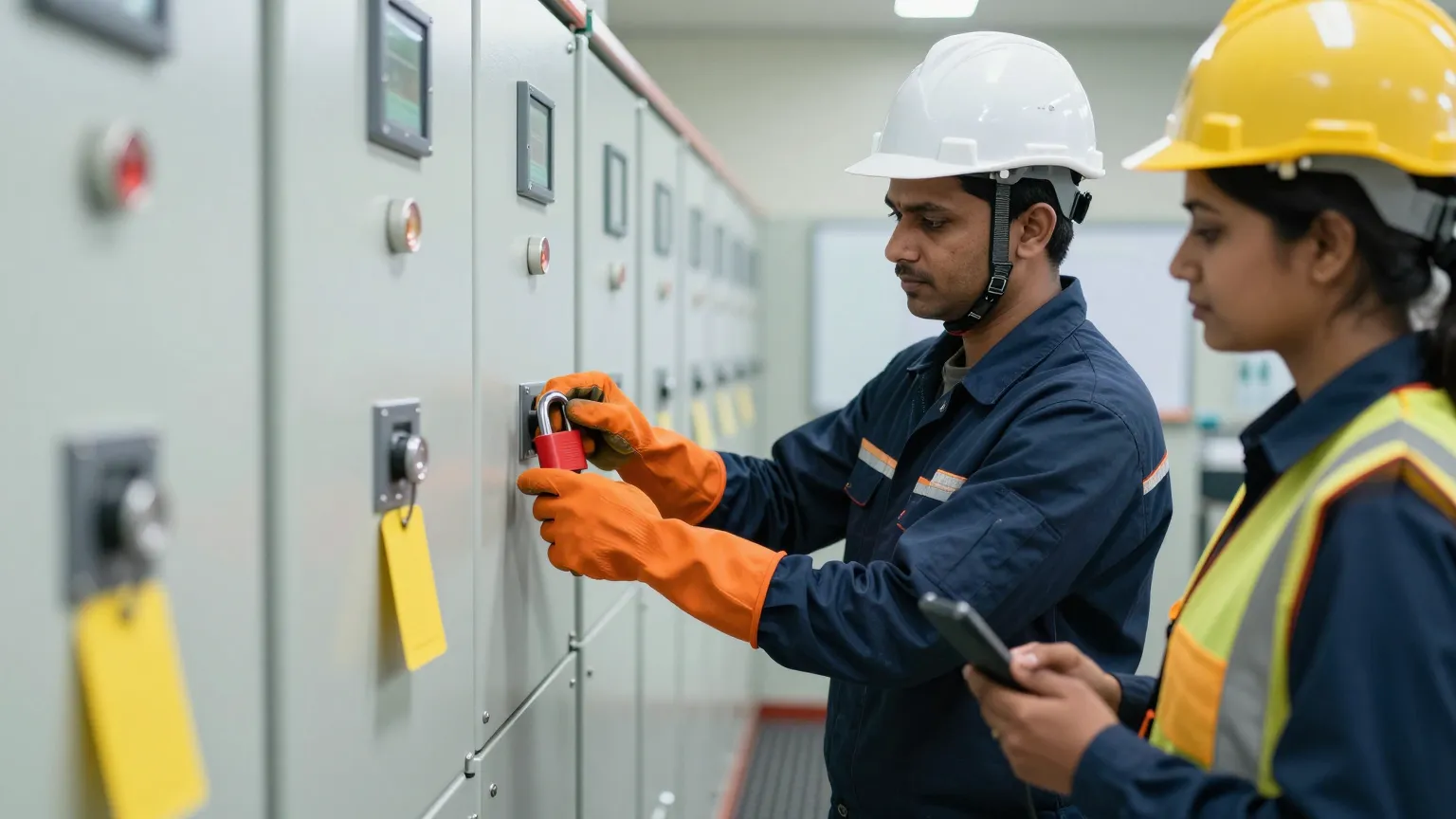
Yes, for the part of electrical safety that fails most often: the sequence. VR lets a worker rehearse isolation, lock-out, tag-out, test-before-touch and earthing on a realistic switchboard, make the mistake that would be fatal on the shop floor, and repeat until it is automatic. It does not replace the certificate of competency, the written permit-to-work or supervised hands-on practice that the CEA Safety Regulations, 2023 require.
On 2 November 2026, eight labourers died in Chhapoli village in Rajasthan’s Jhunjhunu district when an iron pipe on a cement mixer touched an 11,000-volt overhead line. They were road-construction labourers, not electricians, and that is the pattern: most victims of Indian electrical accidents are workers, contractors and members of the public who did not recognise the hazard in front of them.
Three days later the NDRF Director General, Piyush Anand, told state disaster-response teams that life-saving protocols must become “muscle memory” through repeated simulation. The same applies to the electrician opening a 415 V panel at 2 a.m. In this guide we set out what Indian law requires before anyone works on electrical apparatus, where lockout-tagout (LOTO) fits, and what VR can and cannot do to make the safe sequence automatic.
India recorded about 15,500 deaths from electrical accidents in 2023, according to NCRB’s Accidental Deaths and Suicides in India data compiled by Prayas (Energy Group): roughly 1.17 per lakh population, up from 0.90 in 2009, against 0.01 to 0.04 in Japan, Australia, New Zealand, the UK and the US. Shocks account for 77% of these deaths, electrical fires for 9% and lightning for 14%.
The Central Electricity Authority (CEA) attributes 35% of accidents in 2025 to accidental contact with a live wire, 15% to neglect of safety measures or lack of supervision, 11% to unauthorised work and 11% to defective tools or apparatus. More than 70% of accidents, in other words, trace back to someone touching what they believed was dead, or working without the checks that would have told them otherwise. Those are behavioural failures, and behaviour is what training is for.
The Central Electricity Authority (Measures relating to Safety and Electric Supply) Regulations, 2023, notified in June 2023 under the Electricity Act, 2003, apply to every installation and every person who uses electricity, not only to utilities. These are the provisions that matter for a factory, warehouse, hospital or data centre.
| Requirement | CEA Safety Regulations, 2023 | What it means on the shop floor |
|---|---|---|
| Only designated persons | Regulation 3: the owner or contractor designates persons to operate and work on lines and apparatus; each must hold a certificate of competency or electrical work permit from the Appropriate Government and be entered in a register | No certificate and register entry, no panel work |
| Electrical Safety Officer | Regulation 5(3): every factory with more than 250 kW connected load (2,000 kW for mines and oil-fields) must designate an Electrical Safety Officer who inspects the installation at least once a year and keeps records in Schedule II forms | A named engineer owns training records and tests |
| Discharge before handling | Regulation 21(1): before any conductor or apparatus is handled it must be discharged by earthing or other means, and prevented from being accidentally re-charged | Isolate, earth, prove dead: the legal core of LOTO |
| PPE and tools | Regulation 21(2): rubber gloves and footwear for the working voltage, voltage detector, line tester, earthing devices, helmet and arc-flash protection, all to relevant standards | Test-before-touch needs a tester the worker can use |
| Permit-to-work | Regulation 21(3) read with Schedule I: no one may operate or maintain apparatus unless designated and observing the Schedule I precautions, which include a permit-to-work from the operation in-charge, isolation, de-energising and earthing, and no lone working | A signed permit and return-of-permit on every shutdown |
| Licensed contractors | Regulation 31: installation work only by a State-licensed electrical contractor under supervision of a certificate-of-competency holder | Contract crews carry the same duties as staff |
| Periodic inspection | Regulation 32: inspection or self-certification at intervals not exceeding five years | The Inspector can ask for training and designation records |
Behind the regulations sits the Electricity Act. Section 161 requires any electrical accident causing, or likely to have caused, death or injury to be notified to the Electrical Inspector, who holds an inquiry. Section 146 punishes contravention of the regulations with up to three months’ imprisonment, a fine of up to ₹1 lakh, or both, plus up to ₹5,000 for each day a failure continues. For factories, the employer duties under the OSH Code requirements run in parallel.
Lockout-tagout is the American term, from US OSHA standard 29 CFR 1910.147, for a procedure Indian regulations describe differently but require in substance: isolate every energy source, lock the isolator off, tag it with the worker’s name, release stored energy, prove dead and earth, and restore power only when the same person removes the lock. In India it sits inside the Schedule I permit-to-work. A typical sequence for a low-voltage motor control centre looks like this.
Each step is a place where a worker under time pressure takes a shortcut. Skipping step 6 is how a “dead” panel kills; skipping step 2 is how a UPS-backed control circuit does.
The published evidence is small but consistent. A US electrical utility ran a three-day VR programme for 20 technicians on a seven-step lockout-tagout task, scored on whether each step was performed, in order and correctly. Between day one and day three it recorded a 59% increase in knowledge retention, a 40% increase in procedural compliance and a 20% reduction in task time, with eye-tracking confirming trainees looked at hazards and tools before acting (Training Industry, 2020). Only 30% had used VR before and the first day was the hardest, a useful warning about onboarding.
In India the public sector moved first: Mahanadi Coalfields’ 18-module VR programme for about 17,000 workers includes electrical safety, as we noted in our guide to mine-worker training under the 2026 OSHWC Rules. What VR adds over a classroom is simple. A worker can open the wrong isolator, touch an untested busbar and see the consequence, then repeat the task correctly until the sequence is the muscle memory the NDRF chief described.
Budgeting follows what VR safety training costs an Indian factory: a few headsets shared across shifts, with electrical isolation usually bundled with confined-space and work-at-height training and emergency mock drills into one programme. We build these on Abhigyaan Pro, our professional training platform developed to professional grade with AFMC, which runs the same scenario on a VR headset and in a browser, records each trainee action, and keeps data in Indian data centres by default with an air-gapped option. If your plant is reviewing its permit-to-work training, book a 30-minute call with our team and we will map your isolation procedures to a scenario set.
Not by that name. Indian law does not use the US term, but Regulation 21 of the CEA Safety Regulations, 2023 requires apparatus to be discharged and earthed before handling and, read with Schedule I, requires a permit-to-work, isolation, de-energising and earthing before maintenance. That is lockout-tagout in substance, enforceable under Section 146 of the Electricity Act, 2003.
Only a designated person under Regulation 3 of the CEA Safety Regulations, 2023: someone holding a certificate of competency or electrical work permit issued by the Appropriate Government, whose name is entered in the owner’s register of designated persons. Installation work must also be done by a State-licensed electrical contractor under Regulation 31.
Every factory with more than 250 kW connected load must designate one under Regulation 5(3) of the CEA Safety Regulations, 2023; the threshold for mines and oil-fields is 2,000 kW. The officer needs an electrical engineering degree with five years’ experience or a diploma with ten, must inspect the installation at least yearly and keep records in Schedule II forms.
About 15,500 people died in electrical accidents in India in 2023, according to NCRB Accidental Deaths and Suicides in India data compiled by Prayas (Energy Group). That is roughly 1.17 deaths per lakh population, compared with 0.01 to 0.04 in the UK, US, Japan, Australia and New Zealand, and the rate has risen since 2009.
No. VR prepares workers for the isolation and permit-to-work sequence and lets them rehearse the mistakes that are fatal on real equipment, but the certificate of competency comes from a State examination, and the CEA Regulations expect supervised practical work and records. VR works best as the rehearsal and assessment layer inside that framework.
This article is for general information and is not legal advice. Confirm obligations against the official text of the Electricity Act, 2003, the Central Electricity Authority (Measures relating to Safety and Electric Supply) Regulations, 2023, the Occupational Safety, Health and Working Conditions Code, 2020 and its Rules, and the orders of your State Electrical Inspector, and consult qualified counsel for your situation.

I am a founder director at Qodequay Technologies Pvt. Ltd., a leading digital transformation consulting firm that helps clients across industries to innovate, optimize, and grow their businesses. I have over two decades of experience in the digital domain, spanning product development, e-commerce, user experience, design thinking, web and app development, and business leadership. My core competencies include developing and executing digital transformation strategies, building teams globally, roadmaps, and solutions that leverage data, insights, and emerging technologies such as artificial intelligence, augmented reality, blockchain, and immersive experience. I also have expertise in digital commerce, supply chain integration, and product management, having worked with both B2B and B2C brands in various sectors. My mission is to create value for customers and stakeholders by delivering impactful and engaging digital experiences that drive growth and innovation.
November 23, 2026

November 22, 2026

November 21, 2026

November 20, 2026

November 19, 2026

Monthly insights on AI, VR and DPDPA compliance — straight from our team to your inbox.
Free 30-minute consultation with our team — or see our products in action.