DPDPA Penalties Up to ₹250 Crore: The Real Cost of Waiting
July 2, 2026
January 5, 2026
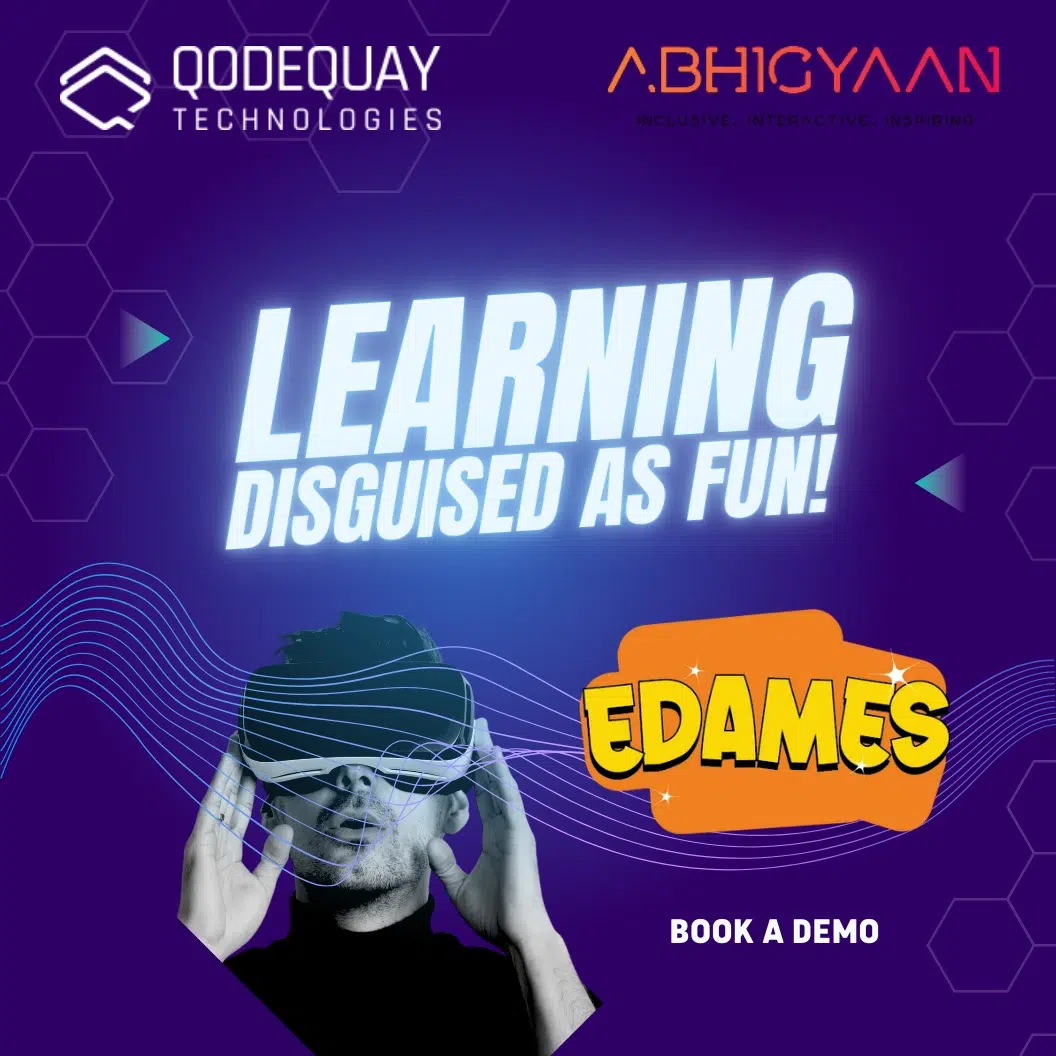
Learning disguised as fun works because your brain learns best when curiosity, emotion, and action come together, and virtual reality makes that possible in ways traditional education cannot. For decades, education has struggled with engagement. Worksheets feel dull, lectures fade fast, and motivation drops the moment learning feels forced. Virtual reality changes this dynamic by placing you inside the lesson itself, not as a passive observer but as an active participant.
At Qodequay, education is treated like an adventure, not an obligation. Their VR mini-games are designed by educators and game designers working together, which means every experience balances excitement with academic purpose. You are not just playing, you are building skills, exploring concepts, and applying knowledge in real time.
Virtual reality helps you learn new skills by immersing you in realistic, interactive environments where learning happens through doing, not memorizing. When you solve a math puzzle inside a virtual world or explore a science concept through simulation, your brain forms stronger connections. This is known as experiential learning, and it is proven to improve retention, understanding, and confidence.
VR learning environments allow you to:
Practice without fear of failure
Learn at your own pace
Visualize abstract concepts
Apply knowledge in context
Instead of reading about a concept, you experience it. Instead of watching someone else solve a problem, you solve it yourself.
Learning through play is powerful because play naturally triggers curiosity, focus, and intrinsic motivation. Games create a sense of challenge and reward. When learning feels like a game, you stay engaged longer and push yourself further without external pressure.
Qodequay’s VR mini-games are carefully structured so that:
Every challenge maps to a learning outcome
Progress reflects real skill development
Fun never replaces learning, it amplifies it
From logic-based math puzzles to immersive science explorations, play becomes the vehicle through which meaningful learning happens.
Qodequay’s VR educational games are different because they are curriculum-aligned, educator-approved, and designed to teach skills, not just entertain. Many educational games fail because they either feel like boring lessons in disguise or fun games with no learning depth. Qodequay avoids both extremes.
Their approach focuses on:
Alignment with educational standards
Skill-based progression rather than random gameplay
Clear learning objectives in every experience
Age-appropriate design for different learning levels
This ensures that whether you are exploring math concepts or diving into science simulations, the learning remains structured, measurable, and effective.
VR mini-games improve skill development by combining problem-solving, decision-making, and spatial understanding in immersive environments. When you interact with virtual objects, navigate challenges, and respond to feedback, you are actively training cognitive and practical skills.
Key skills developed through VR learning include:
Critical thinking
Logical reasoning
Creativity and experimentation
Conceptual understanding
Collaboration and communication
Because these skills are practiced in context, they transfer more easily to real-world situations.
Yes, VR makes complex subjects easier to understand by turning abstract ideas into visual and interactive experiences. Subjects like mathematics and science often feel intimidating because they rely on invisible processes or abstract symbols. VR brings these concepts to life.
For example:
Mathematical relationships can be visualized spatially
Scientific processes can be explored step by step
Cause-and-effect becomes immediately visible
This reduces cognitive overload and helps you grasp concepts faster and with greater clarity.
Engagement is important because learning without attention rarely leads to understanding or retention. In traditional classrooms, distractions are everywhere. VR removes many of these distractions by fully immersing you in the learning environment.
When you are inside a VR experience:
Focus increases naturally
External distractions fade
Learning feels purposeful and exciting
This level of engagement leads to deeper learning and better outcomes over time.
VR supports learners of different ages and abilities by offering adaptable experiences that respond to individual pace and progress. Not everyone learns the same way or at the same speed. VR allows for personalized exploration without pressure or comparison.
Benefits include:
Self-paced learning
Safe environments for trial and error
Inclusive design for diverse learning needs
This makes VR a powerful tool for building confidence alongside competence.
Educator expertise ensures that VR learning experiences remain meaningful, structured, and aligned with real educational goals. At Qodequay, educators work alongside game designers to ensure that fun never comes at the cost of learning quality.
This collaboration ensures:
Accurate content
Pedagogically sound progression
Clear assessment of skill development
The result is learning disguised as fun, not fun pretending to be learning.
The future of education lies in immersive, interactive experiences that adapt to how you learn best. Virtual reality is no longer a novelty. It is becoming a core tool for teaching new skills, improving engagement, and preparing learners for real-world challenges.
As VR technology evolves, you can expect:
More personalized learning journeys
Smarter adaptive challenges
Deeper integration into formal education
Learning will continue to feel less like a task and more like an adventure.
If you believe learning should be exciting, immersive, and skill-focused, VR educational games are the next step. Qodequay’s VR mini-games transform lessons into thrilling journeys where learning and play coexist seamlessly.
Explore the VR educational games here: 🔗 https://abhigyaanapp.com/edames
Do not just play. Learn while you play. Start your immersive learning adventure today.

As the CEO and Founder of Qodequay Technologies, I bring over 20 years of expertise in design thinking, consulting, and digital transformation. Our mission is to merge cutting-edge technologies like AI, Metaverse, AR/VR/MR, and Blockchain with human-centered design, serving global enterprises across the USA, Europe, India, and Australia. I specialize in creating impactful digital solutions, mentoring emerging designers, and leveraging data science to empower underserved communities in rural India. With a credential in Human-Centered Design and extensive experience in guiding product innovation, I’m dedicated to revolutionizing the digital landscape with visionary solutions.
Follow the expert :


July 2, 2026
July 2, 2026
July 2, 2026
July 2, 2026

July 2, 2026
Monthly insights on AI, VR and DPDPA compliance — straight from our team to your inbox.
Free 30-minute consultation with our team — or see our products in action.