DPDPA Penalties Up to ₹250 Crore: The Real Cost of Waiting
July 2, 2026
December 22, 2025
Every school has bright students. Every school has qualified teachers. Every school follows a structured curriculum.
And yet, something is off.
Students score marks, but struggle to explain concepts without memorized lines. They perform experiments on paper they never truly perform. Learning works, but it feels thin, fragile, and easily forgotten.
If this sounds familiar, it is not a failure of teaching. It is a limitation of how learning has been delivered for decades.
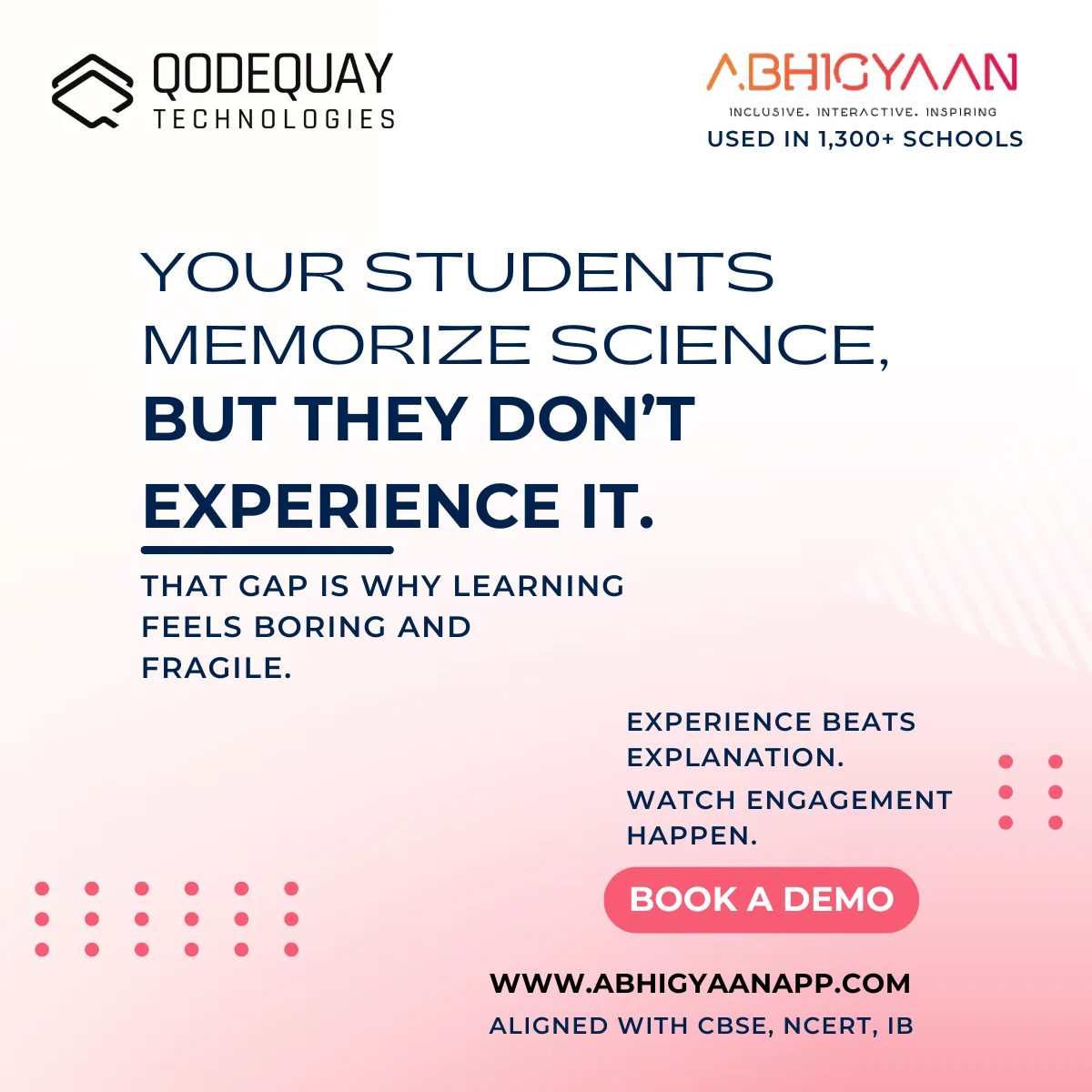
Science, history, and geography describe a three-dimensional world, but classrooms still teach them in two dimensions.
That mismatch is quietly shaping how students learn.
When students only read or watch:
Concepts stay abstract
Curiosity fades quickly
Confidence collapses during exams
Learning becomes about recall, not understanding
This is why students ask, “Why do we need this?” This is why teachers repeat explanations. This is why principals worry about engagement despite doing everything right.
The issue is not syllabus coverage. It is the experience gap.
Physical labs are expensive, fragile, and limited. Many experiments are skipped because they are unsafe, time-consuming, or impractical.
Now imagine this instead:
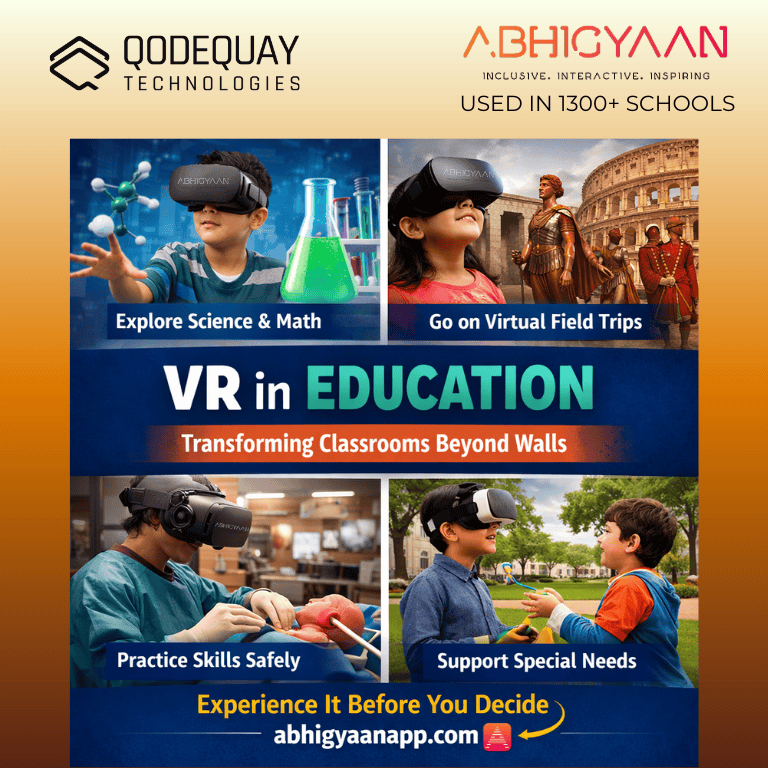
A student stands inside a magnetic field and observes force lines forming around a conductor. Another performs a chemistry experiment with zero chemicals and zero risk. A biology lesson takes place inside the human heart, not on a diagram.
No broken equipment. No safety concerns. No dependence on perfect infrastructure.
This is not replacing teachers or labs. It is extending what schools already try to do, without the constraints.
Virtual Reality works in education for one simple reason:
It turns learning from explanation into experience.
Students do not just listen. They interact. They explore. They remember.
When learning feels lived rather than described:
Engagement rises naturally
Retention improves
Distractions drop
Questions become deeper, not repetitive
This is not theory. Schools using immersive learning consistently report higher focus and stronger conceptual clarity.
Abhigyaan is not a headset-first product. It is a learning-first platform built specifically for schools.
What sets it apart:
Curriculum-aligned virtual labs for Physics, Chemistry, and Biology
Teacher-led sessions, not self-guided chaos
Works on VR headsets, laptops, and smart boards
Integrated LMS for teachers and administrators
Supports CBSE, NCERT, IB, and international boards
Proven deployments in 1,300+ government schools in Maharashtra
This is not an experiment. It is already working in real classrooms, including those with limited resources.
A common concern principals have is disruption.
The Abhigyaan demo is intentionally simple:
One class
One concept
About 30 minutes
Teachers observe
Students experience
No changes to timetable. No installation headaches. No commitment.
You do not need to imagine outcomes. You see them.
Every principal eventually asks this, even if they do not say it aloud:
“Will this genuinely improve how my students learn, or is it just impressive to watch?”
That is exactly why a demo matters.
VR cannot be evaluated through brochures or presentations. It only makes sense once you see how students respond inside the experience.
Some lean forward. Some ask better questions. Some stop looking at the clock.
That moment answers the question better than any pitch ever could.
Schools that adopt immersive learning rarely do so because of trends. They do it because they witnessed a shift in attention, curiosity, and confidence.
The decision does not come from excitement. It comes from clarity.
And clarity comes from experience.
You do not need to believe claims. You do not need to commit budgets. You do not need to redesign your school.
Just allow one class to experience learning differently.
If engagement does not visibly change, the conversation ends.
If it does, you will know exactly why this matters.
Sometimes the most powerful decision a school leader makes is not adopting something new, but being willing to see what learning can become.

As the CEO and Founder of Qodequay Technologies, I bring over 20 years of expertise in design thinking, consulting, and digital transformation. Our mission is to merge cutting-edge technologies like AI, Metaverse, AR/VR/MR, and Blockchain with human-centered design, serving global enterprises across the USA, Europe, India, and Australia. I specialize in creating impactful digital solutions, mentoring emerging designers, and leveraging data science to empower underserved communities in rural India. With a credential in Human-Centered Design and extensive experience in guiding product innovation, I’m dedicated to revolutionizing the digital landscape with visionary solutions.
Follow the expert :


July 2, 2026
July 2, 2026
July 2, 2026
July 2, 2026
July 2, 2026
Monthly insights on AI, VR and DPDPA compliance — straight from our team to your inbox.
Free 30-minute consultation with our team — or see our products in action.