DPDPA Penalties Up to ₹250 Crore: The Real Cost of Waiting
July 2, 2026
January 7, 2026
Virtual Reality is no longer a flashy experiment, it is becoming a practical classroom tool. VR adoption in Indian schools is accelerating at a pace that would have sounded unrealistic just a few years ago. In this article, you will learn how fast VR is spreading, why schools are adopting it, what data proves its impact, and what the future holds for immersive learning in India.
VR adoption in Indian schools is rising because policy support, affordability, and learning outcomes have aligned at the same time. National initiatives like Digital India and NEP 2020 have pushed schools to move beyond rote learning and adopt experiential methods.
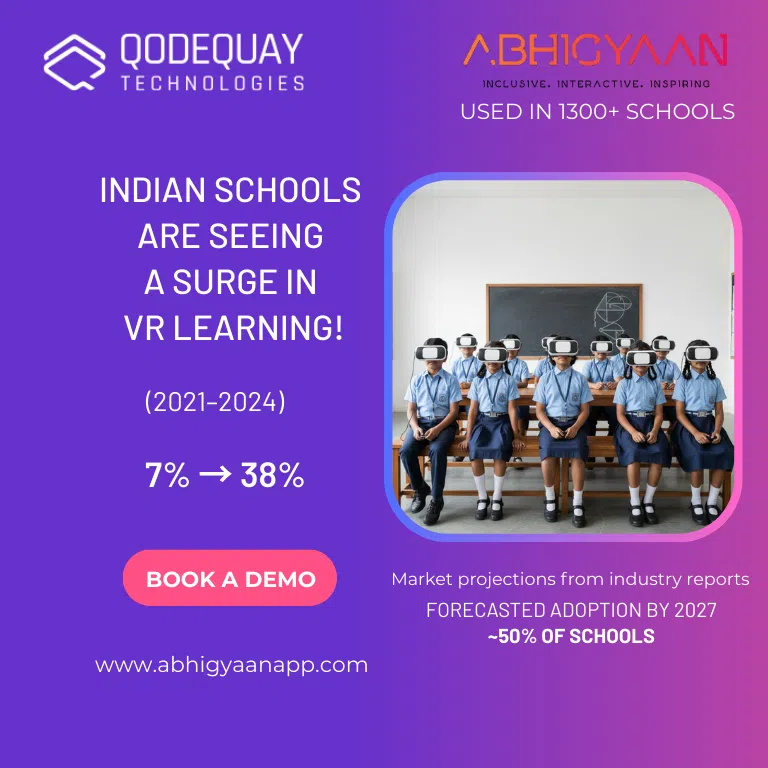
In 2021, only about 7 percent of Indian high schools had VR setups. Today, that number stands at 38 percent, a more than fivefold increase. This growth is not random. Schools are under pressure to modernize classrooms, improve STEM results, and prepare students for future careers.
Real-world example: Government and private schools participating in NCERT’s XR pilot reported stronger engagement in science and geography lessons, especially where physical labs were limited.
Around 50 percent of Indian schools are expected to adopt AR or VR by 2027. This projection comes from multiple education technology deployment studies and market reports.
Several factors are driving this growth:
Education leaders now see VR labs not as luxury add-ons, but as scalable learning infrastructure.
Yes, Indian students are already familiar with VR and expect it to change how they learn. Surveys show that 78 percent of students know what VR is, and 61 percent believe it will revolutionize education.
Students respond particularly well to immersive learning because it:
Case insight: In STEM-focused VR sessions, students demonstrated higher concept retention compared to textbook-only instruction, especially in physics and biology topics.
NCERT’s XR pilot proves that VR works at scale in Indian education. The program reached 89 million students, with an impressive 93 percent educator approval rate.
Teachers reported:
This approval matters because long-term adoption depends on teacher confidence, not just student excitement.
The education VR market is projected to grow from $1.72 billion in 2025 to $5.68 billion by 2031. This growth reflects rising demand for immersive learning tools across schools, colleges, and training institutions.
This expansion also signals:
Schools that adopt early gain a competitive advantage in admissions, outcomes, and reputation.
VR matters because it reduces learning gaps and improves access, especially in rural and underserved areas. Not every school can afford full-scale science labs, field trips, or advanced equipment. VR bridges that gap.
Key benefits include:
For rural schools, VR often becomes the first exposure to advanced scientific environments.
Successful VR adoption in Indian schools depends on planning, alignment, and training. Schools that treat VR as a teaching tool, not a gadget, see the best results.
Best practices include:
The future of education in India is immersive, interactive, and inclusive. Over the next five years, VR classrooms will likely combine AI-driven personalization, real-time analytics, and collaborative virtual environments.
Predicted trends:
Schools that wait too long may find themselves catching up instead of leading.
VR adoption in Indian schools is accelerating because it solves real educational challenges at scale. It improves engagement, strengthens understanding, and makes quality education more accessible. As policies, technology, and demand align, immersive learning is no longer optional. It is becoming essential.
If you want to see how VR can transform your classroom, experience it directly.
👉 Book a VR Lab demo today: 🔗 https://abhigyaanapp.com/
The future of education is already here. The only question is whether your classroom is part of it.

As the CEO and Founder of Qodequay Technologies, I bring over 20 years of expertise in design thinking, consulting, and digital transformation. Our mission is to merge cutting-edge technologies like AI, Metaverse, AR/VR/MR, and Blockchain with human-centered design, serving global enterprises across the USA, Europe, India, and Australia. I specialize in creating impactful digital solutions, mentoring emerging designers, and leveraging data science to empower underserved communities in rural India. With a credential in Human-Centered Design and extensive experience in guiding product innovation, I’m dedicated to revolutionizing the digital landscape with visionary solutions.
Follow the expert :


July 2, 2026
July 2, 2026
July 2, 2026
July 2, 2026

July 2, 2026
Monthly insights on AI, VR and DPDPA compliance — straight from our team to your inbox.
Free 30-minute consultation with our team — or see our products in action.