DPDPA Penalties Up to ₹250 Crore: The Real Cost of Waiting
July 2, 2026
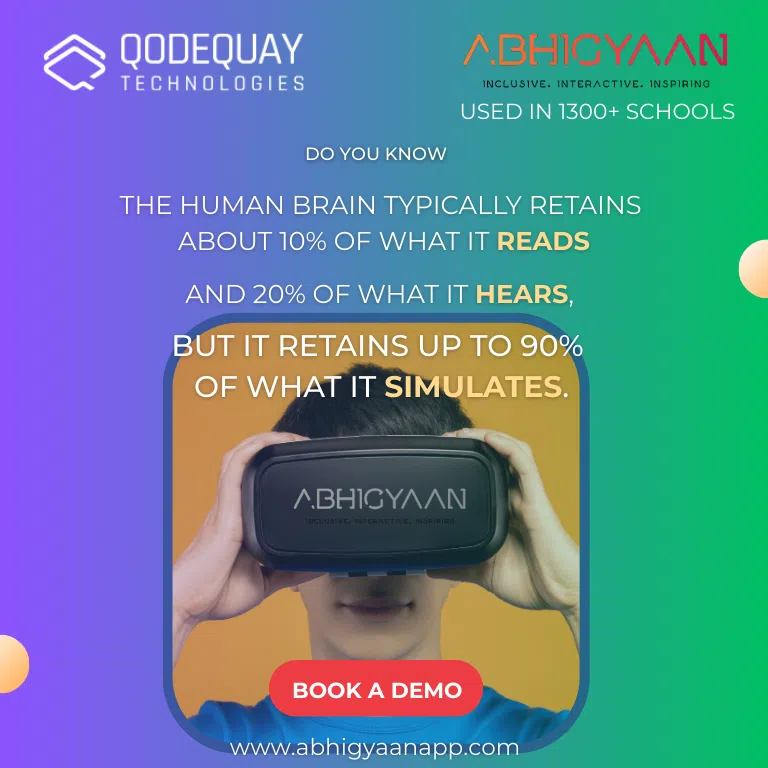
Virtual reality in education is no longer experimental. It is becoming a practical teaching tool that helps students understand, remember, and apply knowledge more effectively. One of the most striking facts about virtual reality is its impact on learning retention. Research suggests that learners can retain up to 75 percent of information when they learn through immersive experiences, compared to much lower retention from reading or listening alone.
This article explains why virtual reality improves learning outcomes, how it works in real classrooms, and what this means for the future of education.
Virtual reality places students inside the learning environment instead of asking them to imagine it.
In traditional classrooms, students rely on textbooks, lectures, and diagrams. These methods require abstract thinking, which can be difficult for many learners. Virtual reality removes that barrier by allowing students to see, hear, and interact with concepts in three-dimensional space.
For example, instead of reading about the solar system, students can explore planets at actual scale. Instead of memorizing anatomy diagrams, they can walk through the human heart. This active involvement changes how the brain processes information.
Virtual reality improves retention because the brain treats immersive experiences like real memories.
When learners engage multiple senses at once, visual, auditory, and kinesthetic, the brain forms stronger neural connections. VR learning closely resembles experiential learning, which has consistently shown higher retention rates than passive methods.
Studies comparing traditional learning with VR-based training found that learners using VR:
Remember information for longer periods
Understand complex topics faster
Show higher emotional engagement with the material
This explains why retention rates can reach up to 75 percent in immersive learning environments.
Virtual reality is already being used across subjects and age groups.
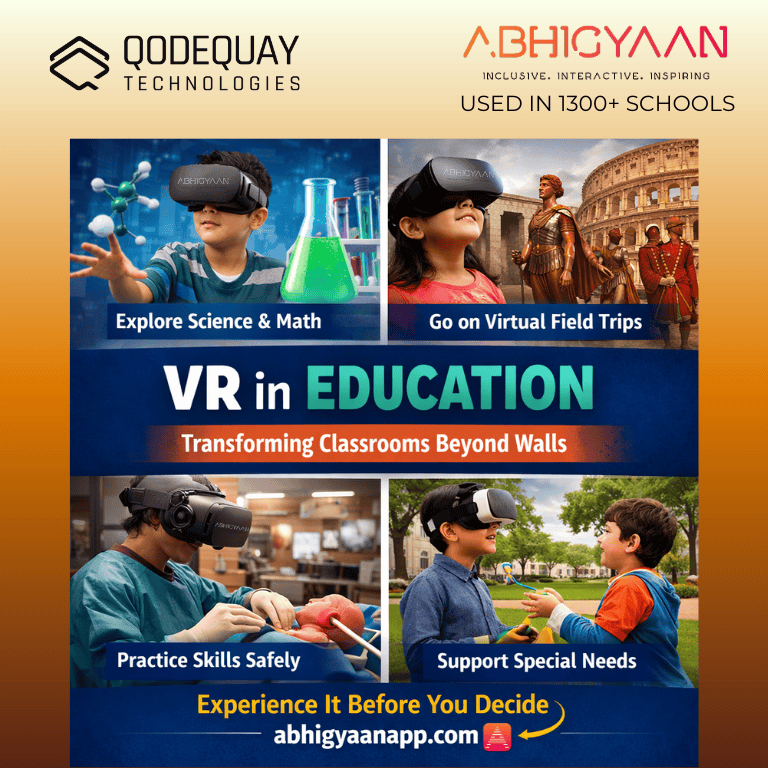
In science classes, students conduct virtual experiments that would be too expensive or dangerous in real life. In history lessons, learners visit ancient civilizations and historical events instead of reading static timelines. In vocational education, trainees practice skills like machine operation, medical procedures, or electrical work in safe, repeatable simulations.
Schools using VR often report increased student participation and fewer discipline issues. When learning feels interactive and meaningful, students pay attention without being forced to.
The benefits of virtual reality in education extend beyond engagement.
For students:
Better concept clarity, especially for abstract topics
Higher confidence through practice-based learning
Improved long-term memory and recall
For teachers:
Easier explanation of complex ideas
Standardized learning experiences across classrooms
Immediate feedback through interactive simulations
VR also supports different learning styles, making education more inclusive for visual and experiential learners.
Yes, multiple studies support the effectiveness of VR in learning.
Research from PwC found that VR learners completed training faster and were more confident applying what they learned compared to classroom learners. Academic studies in medical and engineering education show improved performance and skill transfer when VR is used alongside traditional instruction.
While VR is not meant to replace teachers, evidence shows it works best as a powerful enhancement to existing teaching methods.
Virtual reality is expected to become more accessible and curriculum-aligned in the coming years.
As hardware costs decrease and content quality improves, more schools are adopting VR labs and classroom-ready solutions. The integration of artificial intelligence will further personalize VR learning, adapting content to each student’s pace and progress.
In the future, experiential learning may no longer be a luxury. It may become a standard expectation in modern education systems.
Virtual reality in education works because it transforms learning from passive consumption into active experience. When students learn by doing rather than memorizing, retention improves, understanding deepens, and curiosity increases. The fact that VR can lead to retention rates as high as 75 percent is not surprising. It simply reflects how the human brain was designed to learn.
Education spent decades asking students to imagine complex ideas. Virtual reality finally lets them experience those ideas directly.
PwC, The Effectiveness of Virtual Reality Soft Skills Training
National Training Laboratories, Learning Retention Research
Radianti et al., A Systematic Review of Immersive Virtual Reality Applications for Higher Education, Computers and Education
Makransky and Petersen, Immersive Virtual Reality and Learning, Educational Psychology Review

As the CEO and Founder of Qodequay Technologies, I bring over 20 years of expertise in design thinking, consulting, and digital transformation. Our mission is to merge cutting-edge technologies like AI, Metaverse, AR/VR/MR, and Blockchain with human-centered design, serving global enterprises across the USA, Europe, India, and Australia. I specialize in creating impactful digital solutions, mentoring emerging designers, and leveraging data science to empower underserved communities in rural India. With a credential in Human-Centered Design and extensive experience in guiding product innovation, I’m dedicated to revolutionizing the digital landscape with visionary solutions.
Follow the expert :


July 2, 2026
July 2, 2026

July 2, 2026
July 2, 2026

July 2, 2026
Monthly insights on AI, VR and DPDPA compliance — straight from our team to your inbox.
Free 30-minute consultation with our team — or see our products in action.