DPDPA Penalties Up to ₹250 Crore: The Real Cost of Waiting
July 2, 2026
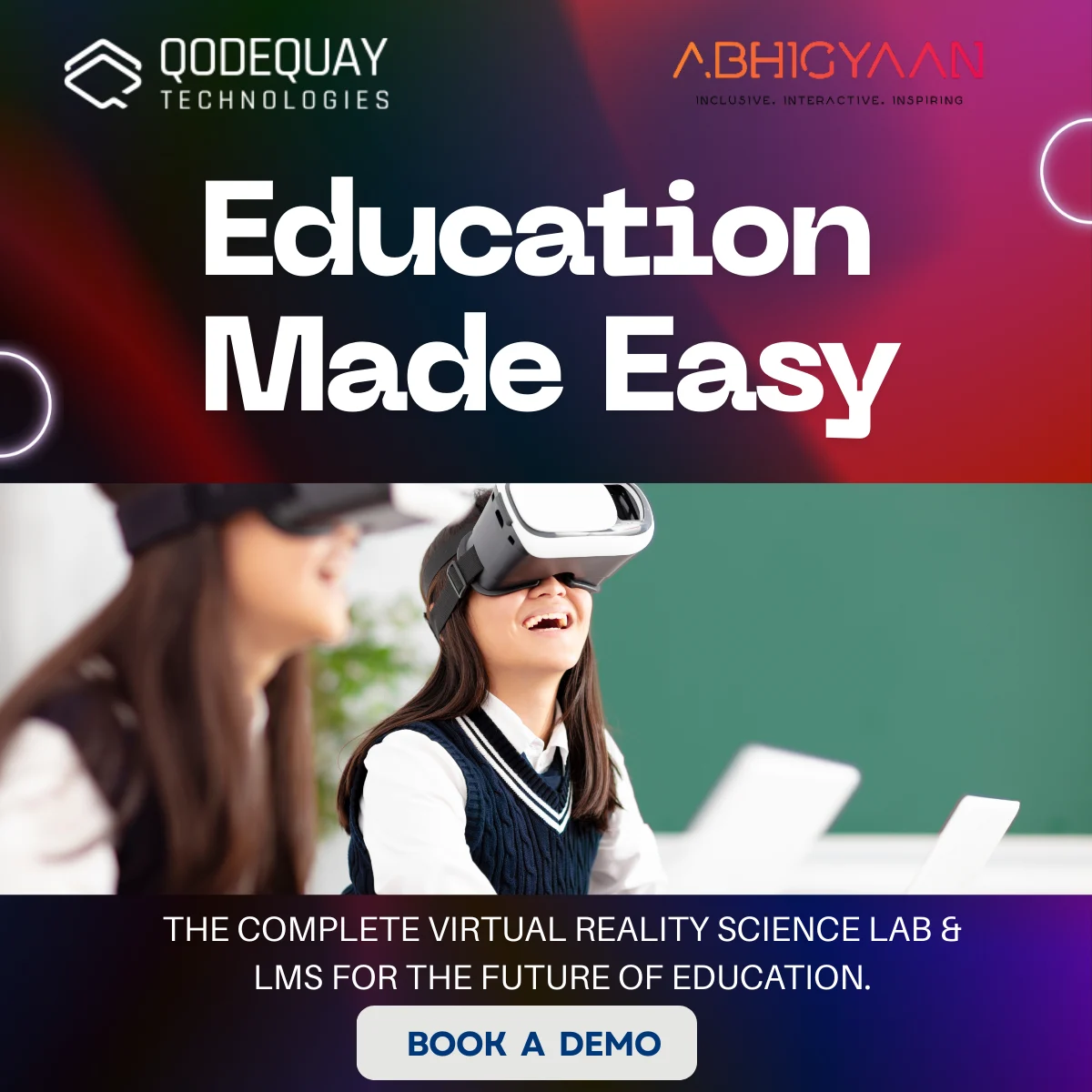
Generic VR content fails in schools because education requires structure, clarity, and age-appropriate learning outcomes, not just visual excitement. A visually impressive VR experience might look impressive, but if it does not align with curriculum goals, learning levels, or classroom realities, it quickly becomes a distraction rather than a teaching tool.
Schools, teachers, and parents need VR content that is intentionally designed for education, not repurposed from gaming, entertainment, or marketing. Educational VR must support understanding, assessment, safety, and inclusion, all at the same time. That is a higher bar, and for good reason.
This article explains why VR content must be purpose-built for education and how thoughtfully designed VR delivers far better outcomes for students.
Designing VR content for education means building immersive experiences around learning objectives, not visuals alone. Educational VR is structured to support how students learn, how teachers teach, and how schools operate.
Well-designed educational VR includes:
Clear learning goals aligned with curriculum
Age-appropriate pacing and interaction
Guided exploration instead of open-ended distraction
Teacher control and classroom integration
Without these elements, VR becomes impressive but ineffective.
Education-focused VR enhances conceptual understanding by turning abstract ideas into clear, visual experiences. Many school subjects include concepts that are difficult to imagine through textbooks alone.
With properly designed VR content:
Scientific processes are shown step by step
Mathematical concepts are visualized spatially
Historical events are presented with context and accuracy
This leads to deeper learning because students do not have to guess what something looks like, they see it and interact with it directly.
Curriculum alignment ensures that VR experiences directly support what students are expected to learn and be assessed on. Teachers cannot afford to use tools that feel disconnected from syllabus goals.
When VR is designed for education:
Lessons match grade-level requirements
Concepts reinforce textbook learning
Experiences fit into existing lesson plans
This makes VR practical for daily classroom use rather than an occasional novelty.
VR designed for education prioritizes safety, predictability, and teacher supervision. This matters deeply to schools and parents.
Education-focused VR allows students to:
Perform experiments without physical risk
Explore dangerous or inaccessible environments safely
Learn through trial and error without fear
Teachers can guide sessions, control content flow, and ensure students stay focused on learning outcomes rather than wandering aimlessly through virtual worlds.
Safety is a priority because physical labs, field trips, and experiments carry real risks and high costs. Educational VR eliminates many of these concerns.
Parents value:
Risk-free exploration
Supervised digital environments
Reduced exposure to hazardous materials
Schools benefit from fewer accidents, lower insurance concerns, and safer learning alternatives that still feel hands-on.
Purpose-built VR boosts engagement by combining immersion with structured interaction. Students are naturally drawn to immersive experiences, but without educational design, that attention is easily wasted.
Designed-for-education VR:
Keeps students focused on learning tasks
Reduces classroom distractions
Turns lessons into guided experiences
Teachers can transform topics into interactive journeys, making learning feel active instead of passive.
Engagement without structure leads to excitement without understanding. This is where many generic VR tools fail.
Educational VR balances:
Visual excitement with clear instruction
Exploration with learning checkpoints
Fun with measurable outcomes
This balance is what turns attention into retention.
Educational VR supports personalized learning by adapting to different speeds, abilities, and learning styles. Not all students learn the same way, and traditional classrooms often struggle to accommodate this.
Well-designed VR content:
Allows students to repeat experiences as needed
Supports visual, auditory, and hands-on learners
Reduces pressure for students who need more time
Parents appreciate tools that respect individual differences rather than forcing every child to learn the same way.
Yes, VR designed for education can significantly help students who struggle with attention, confidence, or abstraction. Immersive environments reduce external distractions and help students focus.
Students often:
Feel less anxious
Engage more willingly
Understand concepts faster
This builds confidence and encourages participation.
Education-focused VR prepares students by introducing technology in a purposeful, guided way. Students are not just using VR, they are learning through it.
This helps develop:
Digital literacy
Critical thinking
Problem-solving skills
Comfort with emerging technologies
Schools using well-designed VR position themselves as forward-thinking institutions focused on future readiness.
Entertainment-first VR prioritizes excitement over learning outcomes. While it may impress initially, it rarely delivers sustained educational value.
Common problems include:
No curriculum relevance
Overstimulation without understanding
Limited teacher control
No measurable learning progress
Educational VR avoids these pitfalls by design.
They should look for VR content built specifically around learning goals, safety, and classroom usability.
Key indicators include:
Curriculum alignment
Age-appropriate design
Teacher dashboards or controls
Clear learning outcomes
Inclusive interaction models
These features ensure VR becomes a reliable learning tool, not a distraction.
VR content must be designed specifically for education to be effective
Purpose-built VR enhances conceptual understanding
Safety and control are essential for schools and parents
Structured immersion boosts engagement and retention
Personalized learning supports diverse student needs
Educational VR prepares students for future skills
Virtual reality has enormous potential in education, but only when it is designed with learning at its core. Generic or entertainment-driven VR may impress visually, but it does not deliver consistent educational value. VR content designed specifically for education bridges the gap between engagement and understanding, safety and exploration, technology and purpose.
At Qodequay, design comes first. Technology follows intent. By creating education-focused immersive experiences, Qodequay helps schools, teachers, and parents unlock the true power of VR, solving real learning challenges with technology as the enabler, not the distraction.

As the CEO and Founder of Qodequay Technologies, I bring over 20 years of expertise in design thinking, consulting, and digital transformation. Our mission is to merge cutting-edge technologies like AI, Metaverse, AR/VR/MR, and Blockchain with human-centered design, serving global enterprises across the USA, Europe, India, and Australia. I specialize in creating impactful digital solutions, mentoring emerging designers, and leveraging data science to empower underserved communities in rural India. With a credential in Human-Centered Design and extensive experience in guiding product innovation, I’m dedicated to revolutionizing the digital landscape with visionary solutions.
Follow the expert :


July 2, 2026
July 2, 2026
July 2, 2026
July 2, 2026

July 2, 2026
Monthly insights on AI, VR and DPDPA compliance — straight from our team to your inbox.
Free 30-minute consultation with our team — or see our products in action.