How to Budget a VR Lab for a CBSE School: Devices, Content, Training and Hidden Costs
October 6, 2026
February 12, 2026
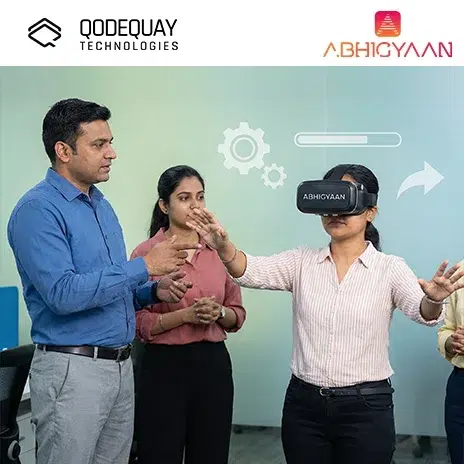
Immersive training is a modern learning approach that uses virtual reality (VR), augmented reality (AR), and interactive simulations to help you practice real-world skills in a safe, repeatable environment.
For CTOs, CIOs, Product Managers, Startup Founders, and Digital Leaders, this topic matters because training is no longer just a “people problem.” It’s a performance problem, a safety problem, and a scaling problem. When you grow fast, expand operations, or adopt new systems, your workforce needs skills quickly, consistently, and without costly mistakes.
In this article, you’ll learn what immersive training is, why it works, where it delivers the biggest ROI, how leading companies use it, what technologies power it, best practices for implementation, and what the future of training will look like.
LSI terms used naturally throughout this guide include: VR training, AR learning, simulation-based training, digital learning, workforce development, experiential learning, safety training, soft skills training, corporate training programs, learning retention, training ROI, and immersive learning platforms.
Immersive training is training where you learn by doing inside a realistic digital environment instead of only reading, watching, or listening.
You step into a scenario using VR headsets, AR overlays, or interactive simulations. You perform tasks, make decisions, and see outcomes in real time. That experience creates deeper memory, better confidence, and stronger job readiness.
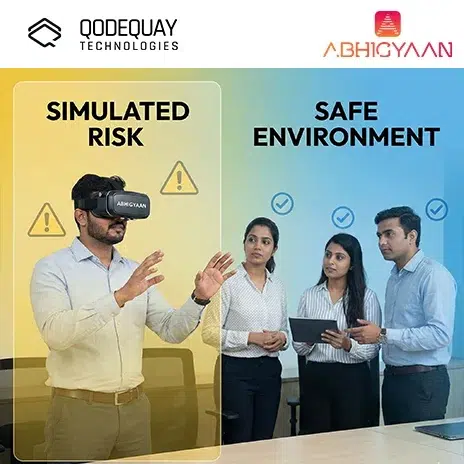
Unlike traditional training, immersive training lets you repeat complex tasks without risk, without travel, and without shutting down real equipment.
Immersive training is becoming essential because traditional training is too slow, too passive, and too expensive for today’s business pace.
When your teams are distributed, your processes change rapidly, and customer expectations keep rising, you need training that is:
This is why immersive training is moving from “innovation project” to “core strategy” in industries like manufacturing, construction, healthcare, energy, aviation, and logistics.
Immersive training works by placing you inside a simulated environment where you perform tasks and receive feedback based on your actions.
A typical immersive training program includes:
For example: operating a machine, handling a safety incident, or performing a customer interaction.
You don’t just watch. You physically move, select tools, follow procedures, and make decisions.
The system tracks your time, accuracy, errors, and safety compliance.
You can repeat the scenario until performance improves, without real-world risk.
Immersive training matters because it connects workforce performance directly to business outcomes.
As a digital leader, you’re judged on:
Training affects all of these.
If your training is weak, your operations suffer. You see more mistakes, more downtime, more safety incidents, and slower onboarding.
Immersive training becomes a strategic lever because it scales skill-building like software scales features.
Immersive training is more effective because it creates experiential memory, not just informational memory.
Traditional learning is mostly passive. You read policies, watch videos, attend sessions, and then hope you remember what to do when reality hits.
Immersive learning is different because:
Multiple studies in learning science show that active practice significantly improves retention compared to passive learning. While exact percentages vary by study design, the direction is consistent: doing beats watching.
In business terms, immersive training reduces “time to competence,” which is one of the most valuable workforce metrics.
Immersive training delivers the biggest ROI in high-risk, high-cost, and high-variation environments.
Here are the strongest use cases:
You can practice hazardous scenarios without real danger.
Examples:
You can train people on complex machinery without stopping production.
Examples:
You can simulate difficult human conversations in a controlled setting.
Examples:
You can train for rare but critical situations.
Examples:
Immersive training has been adopted by global organizations because it reduces training time, improves consistency, and lowers incident risk.
Here are common real-world patterns seen across the market:
Companies use VR modules to train new hires on:
Result: faster onboarding and fewer early-stage mistakes.
Teams use VR simulations for:
Result: better service consistency and lower operational loss.
Immersive simulation is used to train:
Result: fewer errors and stronger compliance.
Even when companies already have training programs, immersive training improves consistency across locations and reduces reliance on a single “expert trainer.”
Immersive training is powered by VR, AR, and simulation software combined with analytics and content management.
VR places you inside a fully digital environment using a headset.
Best for:
AR overlays digital instructions onto the real world using a phone, tablet, or AR glasses.
Best for:
MR blends VR and AR, allowing you to interact with both physical and digital objects.
Best for:
These include tools for:
You implement immersive training successfully by starting with the right training problem, not the coolest technology.
A common failure pattern is building a VR experience that looks impressive but solves no measurable business need.
Here’s a practical approach:
Pick one area where mistakes are expensive.
Examples:
Examples:
Start with one module and validate outcomes.
Once the pilot works, expand to more roles and scenarios.
You should treat immersive training like a product, not like a one-time training video.
Here are best practices that consistently lead to success:
You measure immersive training success by tracking performance improvements, not just training participation.
The best metrics include:
How quickly you can perform the job safely and independently.
How many mistakes happen before and after training.
Reduction in near-misses and safety incidents.
Improvements in speed, quality, and productivity.
Self-reported confidence can be valuable when combined with objective scores.
Immersive training is also easier to measure than classroom training because every action is trackable.
The biggest challenges are content cost, device management, and change resistance.
Here’s what to plan for:
High-quality immersive content requires:
You need a plan for:
Some learners resist VR due to:
Good design and short sessions solve most of this.
Immersive training becomes dramatically more powerful when combined with digital twins and AI.
A digital twin is a living digital representation of a real system, like a factory, building, machine, or process.
When you combine immersive training with a digital twin:
AI adds another layer by enabling:
This is where immersive training becomes a strategic platform, not just a training tool.
The future of immersive training will be defined by lower hardware cost, smarter content creation, and deeper integration with business systems.
Here are key trends you should expect:
More companies will replace classroom onboarding with VR-first learning.
AR will grow in maintenance, field service, and manufacturing because it supports real-time guidance.
AI will speed up scenario creation, voice interaction, and personalization.
Training will shift from completion-based reporting to performance-based reporting.
More training programs will be based on real operational environments.
Immersive training is not just a learning upgrade, it’s an operational advantage.
When your workforce can practice critical skills safely, repeatedly, and consistently, you reduce risk, improve performance, and accelerate growth. You also create a stronger culture of readiness, because people feel prepared before real-world pressure hits.
At Qodequay, immersive training is approached with a design-first mindset. You start with human behavior, real workflows, and real learning barriers, then use technology as the enabler. That’s how you build training experiences that feel natural, measurable, and scalable, and that ultimately solve human problems through the smart use of immersive technology.

As the CEO and Founder of Qodequay Technologies, I bring over 20 years of expertise in design thinking, consulting, and digital transformation. Our mission is to merge cutting-edge technologies like AI, Metaverse, AR/VR/MR, and Blockchain with human-centered design, serving global enterprises across the USA, Europe, India, and Australia. I specialize in creating impactful digital solutions, mentoring emerging designers, and leveraging data science to empower underserved communities in rural India. With a credential in Human-Centered Design and extensive experience in guiding product innovation, I’m dedicated to revolutionizing the digital landscape with visionary solutions.
Follow the expert :

October 6, 2026

October 5, 2026
October 4, 2026

October 3, 2026
October 2, 2026
Monthly insights on AI, VR and DPDPA compliance — straight from our team to your inbox.
Free 30-minute consultation with our team — or see our products in action.