How to Budget a VR Lab for a CBSE School: Devices, Content, Training and Hidden Costs
October 6, 2026
Education has a quiet problem that most schools, universities, and training programs avoid saying out loud. Students forget. Not because they are lazy, not because teachers are failing, but because the learning model itself was built for a different century.
You can sit through a lecture, take notes, and even score well in an exam, then forget most of it weeks later. That is not a student problem. That is a design problem.
This is why immersive learning is becoming one of the most important shifts in modern education. It changes learning from “information delivery” into an experience. It makes education feel real, personal, and unforgettable.
If you are a CTO, CIO, Product Manager, Startup Founder, or Digital Leader, this matters because learning is now directly connected to workforce readiness, digital adoption, customer enablement, and business performance. Schools and enterprises are both under pressure to create learning that produces results, not just attendance.
In this article, you will explore what it means to experience education the way students remember it, why memory works the way it does, what technologies are enabling immersive learning, real-world examples, best practices, measurable outcomes, and future trends shaping the next era of education.
It means you learn through interaction, context, and action, not just through listening, reading, or memorizing.
When education becomes an experience, you are no longer a passive receiver of information. You become an active participant. You make decisions, explore environments, practice skills, and receive feedback.
This is how humans naturally learn in real life. You learned to walk, speak, and solve problems through experience, not lectures. Immersive learning simply brings that same mechanism into modern education using technology.
Students remember experiences because the brain stores action, emotion, and context more deeply than plain information.
Memory is not a recording device. It is a survival system. Your brain prioritizes what feels meaningful, emotional, and connected to real situations.
That is why you may forget a chapter you studied last month, but you remember:
Immersive learning uses this principle. It makes learning feel real, so it becomes memorable.
Immersive learning improves retention by making you actively engage, practice, and apply concepts in realistic environments.
Traditional education often stops at knowledge transfer. Immersive education goes further by building:
Instead of remembering facts, you remember outcomes, cause-and-effect, and real scenarios.
For example:
That kind of learning sticks.
Immersive learning is interactive, experiential education delivered through VR, AR, simulations, and 3D environments, while e-learning is often content-based and passive.
E-learning typically includes:
Immersive learning includes:
The difference is not digital vs non-digital. The difference is passive vs experiential.
VR, AR, simulations, gamification, and AI make education more memorable by creating interactive learning loops.
Here is how the technology stack works:
VR places you inside a fully immersive learning environment. It is ideal for deep focus, spatial learning, and safe simulation.
AR overlays learning content onto the real world. It is great for guided practice and hands-on learning.
Simulations allow you to practice experiments and skills repeatedly without physical risk.
Gamification adds motivation through challenges, progress, and mastery.
AI adapts the learning path based on your performance, helping you learn faster and more effectively.
Together, these tools create learning that feels alive.
Memorable immersive education already exists in schools, universities, and enterprise training programs.
Here are examples you can recognize instantly:
You explore the pyramids, the ocean, or Mars without leaving the classroom.
You perform chemistry experiments without expensive lab equipment.
You practice procedures and emergency response without risk to patients.
You practice communication, leadership, and customer conversations through realistic scenarios.
You train for mechanical, electrical, and industrial work through safe simulations.
These experiences feel real, so they are remembered.
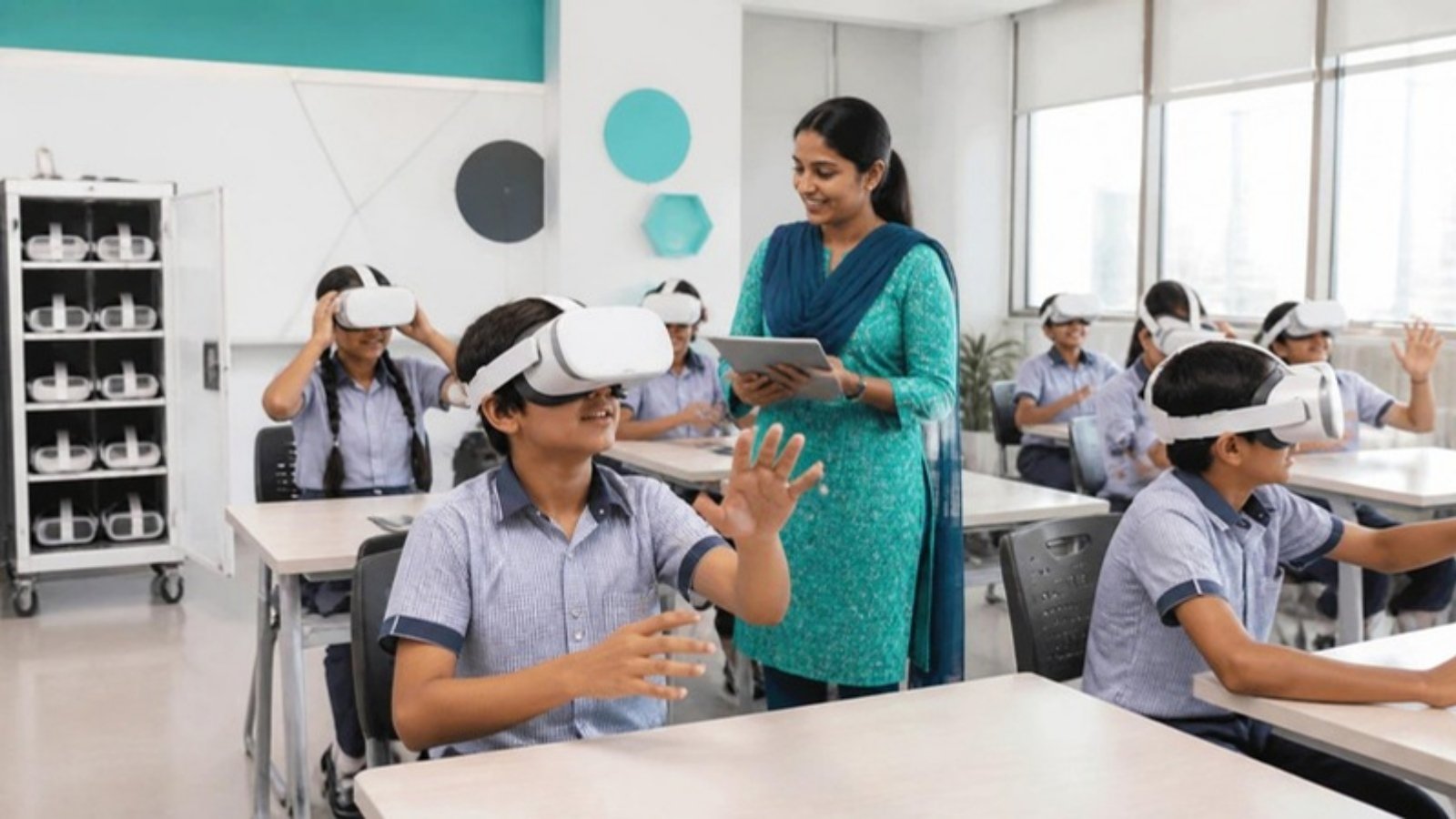
VR classrooms are becoming serious because they solve engagement, access, and learning quality problems at once.
Schools struggle with:
VR classrooms help by offering:
This is why VR is moving beyond pilots into structured education programs.
It helps both because the world now demands skill readiness, not just theoretical knowledge.
Schools want students to:
Businesses want employees to:
Immersive learning supports both goals because it is skill-based and outcome-driven.
That is why immersive education is becoming a bridge between academics and employability.
The biggest challenges are cost, content quality, accessibility, and teacher adoption.
Immersive education is powerful, but you must implement it wisely.
The biggest mistake is buying headsets before planning the learning experience.
Immersive learning succeeds when you design for learning outcomes first and technology second.
Here are best practices that consistently work:
A VR lesson without structure becomes entertainment. A VR lesson with design becomes transformation.
You measure retention through performance, recall, and skill application, not only test scores.
Strong metrics include:
In corporate learning, you also track:
Immersive learning should show measurable impact within weeks.
The future will be more personalized, more collaborative, and powered by AI.
Here are trends shaping the next 3 to 5 years:
You will learn with real-time coaching, not just content.
Headsets will become more comfortable and school-friendly.
Schools will get structured VR lesson plans mapped to learning standards.
Students will work together inside shared virtual environments.
Learning will be measured through performance, not memorization.
VR, AR, classroom teaching, and online learning will blend seamlessly.
The future is not about replacing teachers. It is about empowering them with better tools.
Education becomes unforgettable when it becomes experiential. When you can step inside a lesson, explore it, and interact with it, learning stops feeling like a task and starts feeling like discovery.
This is why immersive learning is the future. It aligns with how your brain actually learns and remembers. It creates understanding, confidence, and real-world capability.
At Qodequay (https://www.qodequay.com), immersive education is approached with a design-first mindset. Human needs come first, and technology becomes the enabler. When you combine thoughtful experience design with immersive tools like VR and AR, you do not just teach information, you create learning that students remember for life.

As the CEO and Founder of Qodequay Technologies, I bring over 20 years of expertise in design thinking, consulting, and digital transformation. Our mission is to merge cutting-edge technologies like AI, Metaverse, AR/VR/MR, and Blockchain with human-centered design, serving global enterprises across the USA, Europe, India, and Australia. I specialize in creating impactful digital solutions, mentoring emerging designers, and leveraging data science to empower underserved communities in rural India. With a credential in Human-Centered Design and extensive experience in guiding product innovation, I’m dedicated to revolutionizing the digital landscape with visionary solutions.
Follow the expert :

October 6, 2026
October 5, 2026
October 4, 2026
October 3, 2026
October 2, 2026
Monthly insights on AI, VR and DPDPA compliance — straight from our team to your inbox.
Free 30-minute consultation with our team — or see our products in action.