DPDPA Penalties Up to ₹250 Crore: The Real Cost of Waiting
July 2, 2026
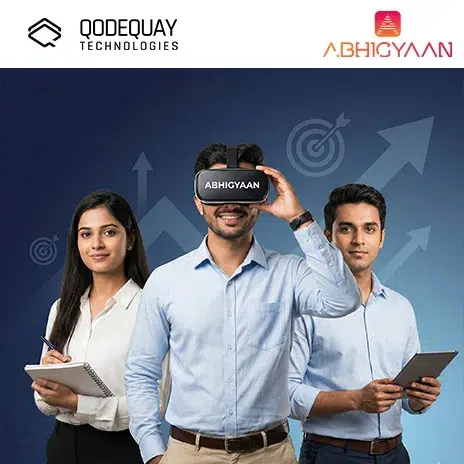
VR classrooms are no longer a futuristic idea. They are becoming one of the most practical, high-impact innovations in modern education. Instead of learning through flat textbooks, static videos, or one-way lectures, you step into immersive environments where concepts become experiences.
If you are a CTO, CIO, Product Manager, Startup Founder, or Digital Leader, VR classrooms matter because they sit at the intersection of education, technology, infrastructure, and measurable outcomes. They are not just “edtech.” They are a platform shift, similar to how smartphones changed communication and cloud changed software delivery.
In this article, you will learn what VR classrooms are, why they work, where they deliver the strongest ROI, real-world examples and case studies, challenges schools must solve, best practices for implementation, and what the next 3 to 5 years will bring.
A VR classroom is a learning environment where you use a virtual reality headset to enter an immersive, interactive educational space.
Instead of watching a lesson, you experience it. You might walk through the solar system, explore ancient civilizations, conduct science experiments in a virtual lab, or practice language skills with realistic social scenarios.
A VR classroom can be:
The goal is not to replace teachers. The goal is to give teachers a new medium for deeper understanding.
VR classrooms are a game changer because they turn abstract learning into direct experience, which improves engagement and retention.
Schools have a persistent challenge: students often struggle to connect concepts with reality. VR solves that by making learning visual, interactive, and memorable.
For example:
This is not just more fun. It is a better learning mechanism.
They improve engagement by creating presence, which means you feel like you are truly inside the lesson.
Engagement is not just attention. It is emotional involvement. VR creates that naturally because it removes distractions and places you inside the learning environment.
When you are in VR:
This is especially valuable for subjects that students often find boring or difficult, like science, geography, or mathematics.
Yes, VR classrooms can improve outcomes, especially for conceptual understanding and skill-based learning.
The strongest learning improvements happen when VR is used for:
The biggest advantage is that VR reduces the “transfer gap” between knowledge and understanding. You do not just memorize facts. You experience cause and effect.
STEM, history, geography, and skill-based learning benefit the most because VR excels at visualizing complex systems.
Here are the highest-impact subject areas:
You can explore cells, organs, ecosystems, and chemical reactions safely.
You can experiment with forces, motion, structures, and machines without needing expensive labs.
You can experience places and time periods instead of reading about them.
You can explore terrain, climate systems, and disasters in a safe environment.
You can practice real conversations in realistic settings.
You can simulate tasks like electrical work, machine handling, and safety procedures.
They help by providing virtual labs, virtual field trips, and virtual equipment that schools cannot afford physically.
Many schools struggle with:
VR can reduce these barriers.
For example:
This makes education more equitable when deployed thoughtfully.
VR is already being used globally in schools and institutions through platforms like virtual labs, immersive content libraries, and simulation tools.
Common real-world implementations include:
The pattern is clear: VR is moving from pilot projects into real programs, especially where schools have strong leadership support.
The biggest challenges are cost, device management, teacher readiness, and content quality.
VR classrooms are powerful, but schools must solve practical problems:
Headsets must be purchased, maintained, sanitized, and replaced over time.
Schools need control over apps, updates, user access, and data privacy.
A VR headset is useless if teachers do not feel confident using it.
VR content must match learning outcomes and lesson plans.
Some students may experience discomfort, motion sickness, or sensory overload.
The good news is that these challenges are solvable with a structured rollout.
You succeed by starting small, focusing on outcomes, and designing VR as part of the learning experience.
Here are best practices schools and digital leaders should follow:
VR works best as a learning booster, not as an all-day replacement.
They support teachers by giving them a new teaching tool that makes complex concepts easier to explain.
Teachers remain essential because:
VR is the medium. The teacher is still the architect of learning.
In fact, VR classrooms often increase teacher effectiveness because students become more curious and ask better questions after immersive sessions.
VR classrooms will become more affordable, more collaborative, and more integrated into standard education systems.
Here are the trends you should expect:
Devices will become more comfortable, durable, and school-friendly.
Publishers and edtech companies will build structured VR lesson plans.
Students will get adaptive VR experiences based on performance.
Virtual group projects will become common, not experimental.
IT teams will get stronger control over security, apps, and data.
Schools will use a mix of technologies depending on learning goals.
VR classrooms are a game changer because they transform education from information delivery into real experience. When you learn through immersion, you understand faster, remember longer, and stay more motivated.
For digital leaders, the opportunity is not just adopting VR. It is designing learning that works. This is where design-first thinking becomes critical. At Qodequay (https://www.qodequay.com), immersive learning solutions are built by solving human problems first, then using technology as the enabler. The future of education will not be defined by devices alone, it will be defined by experiences that make learning truly come alive.

As the CEO and Founder of Qodequay Technologies, I bring over 20 years of expertise in design thinking, consulting, and digital transformation. Our mission is to merge cutting-edge technologies like AI, Metaverse, AR/VR/MR, and Blockchain with human-centered design, serving global enterprises across the USA, Europe, India, and Australia. I specialize in creating impactful digital solutions, mentoring emerging designers, and leveraging data science to empower underserved communities in rural India. With a credential in Human-Centered Design and extensive experience in guiding product innovation, I’m dedicated to revolutionizing the digital landscape with visionary solutions.
Follow the expert :


July 2, 2026
July 2, 2026
July 2, 2026
July 2, 2026

July 2, 2026
Monthly insights on AI, VR and DPDPA compliance — straight from our team to your inbox.
Free 30-minute consultation with our team — or see our products in action.