DPDPA Penalties Up to ₹250 Crore: The Real Cost of Waiting
July 2, 2026
January 13, 2026
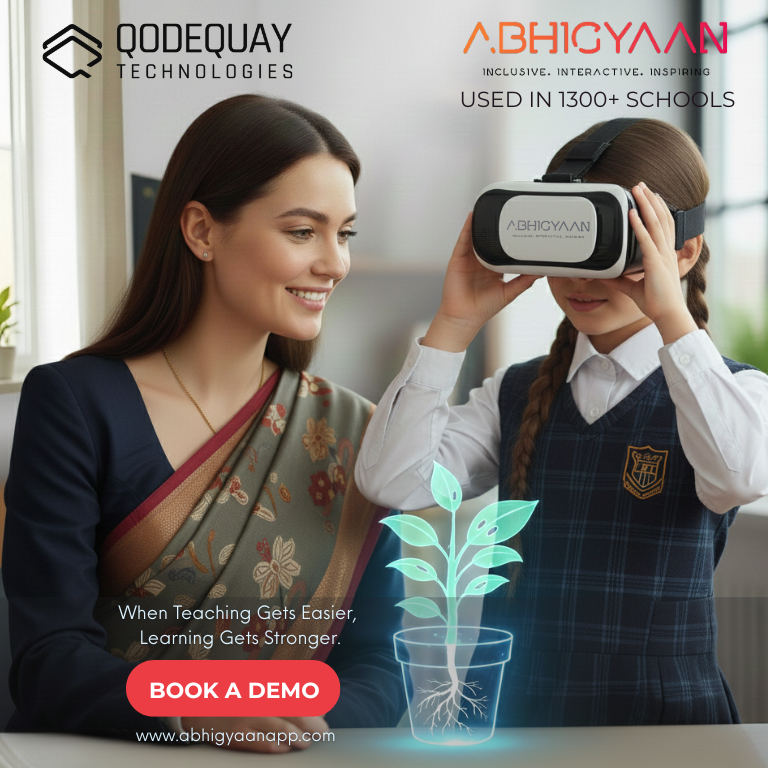
Step into the future of education—where teaching is effortless and learning is unforgettable. Discover how VR transforms classrooms by cutting repetition, boosting clarity, and sparking engagement. See how Abhigyaan makes it real for teachers today.
Every teacher knows this moment. You explain a concept clearly. You repeat it. You simplify it again. Still, blank faces stare back.
That is not a teaching failure. It is a limitation of passive tools.
VR for teachers changes this dynamic by turning explanations into experiences. Instead of struggling to be heard, teachers are understood. When students can see and explore a concept, attention improves and clarity follows. Teaching becomes easier, and learning becomes stronger.
This article explains how Virtual Reality empowers teachers, why it matters in today’s classrooms, and how Abhigyaan makes this shift practical and immediate.
Teachers struggle to hold attention because traditional tools rely heavily on imagination and memorization.
Chalkboards, slides, and textbooks require students to visualize abstract ideas on their own. Many cannot, especially when concepts are complex or unfamiliar. This leads to repeated explanations, classroom fatigue, and learning gaps.
VR addresses this by making learning visible and interactive.
VR empowers teachers by reducing effort while increasing impact.
Instead of explaining the same idea multiple times, teachers can show it once through an immersive experience. Students observe, explore, and understand faster. The teacher shifts from repeating content to guiding insight.
VR for teachers means control, clarity, and confidence, not extra workload.
VR turns explanations into experiences by placing students inside the lesson.
Rather than describing a process, teachers can let students observe it unfold in a 3D environment. Whether it is a scientific phenomenon, a historical setting, or a complex system, VR removes abstraction and replaces it with direct experience.
This leads to faster understanding and fewer doubts.
VR reduces repetition because students understand concepts more quickly and clearly.
When learners grasp ideas visually and spatially, fewer re-explanations are needed. Teachers spend less time correcting misunderstandings and more time supporting deeper learning.
This reduces mental fatigue and improves classroom flow.
VR improves engagement naturally by capturing attention through immersion.
Students focus because they are involved, not because they are forced to listen. This helps teachers manage classrooms with presence and direction rather than constant reminders.
Engagement becomes built into the lesson.
Abhigyaan supports teachers by offering curriculum-aligned, classroom-ready VR experiences.
Teachers do not need to redesign lessons or learn complex systems. Abhigyaan fits into existing teaching plans and supports learning objectives clearly.
With Abhigyaan:
Teachers stay in control of the lesson
VR aligns with academic curriculum
Setup and usage remain simple
Learning outcomes stay measurable
The technology works in the teacher’s favor, not against their time.
VR works best when used as a teaching aid, not a distraction.
Best practices include:
Use VR for difficult or abstract topics
Pair VR sessions with discussion and explanation
Keep experiences short and focused
Prepare teachers before classroom rollout
Align VR use with lesson goals
When used thoughtfully, VR enhances teaching instead of complicating it.
The future of VR for teachers is support-driven, not technology-driven.
As classrooms evolve, teachers will expect tools that reduce effort and improve clarity. VR will become a standard aid for explanation, demonstration, and engagement.
Schools that adopt early give teachers an advantage that lasts.
Teaching becomes harder when tools stay passive
VR helps teachers explain once and explain clearly
Experiential learning reduces repetition and fatigue
Abhigyaan offers curriculum-aligned VR for real classrooms
Empowered teachers create stronger learning outcomes
Teachers should not work harder just to be heard. They deserve tools that help them be understood. VR for teachers removes friction from teaching and restores focus to learning.
This is not about adding another task. It is about making teaching easier and more effective.
Abhigyaan brings experiential VR learning into classrooms today, not someday and not after another academic year is lost to disengagement.
See the difference it makes.
👉 Book your VR demo now: https://abhigyaanapp.com/
Because when teachers are empowered, learning follows.

As the CEO and Founder of Qodequay Technologies, I bring over 20 years of expertise in design thinking, consulting, and digital transformation. Our mission is to merge cutting-edge technologies like AI, Metaverse, AR/VR/MR, and Blockchain with human-centered design, serving global enterprises across the USA, Europe, India, and Australia. I specialize in creating impactful digital solutions, mentoring emerging designers, and leveraging data science to empower underserved communities in rural India. With a credential in Human-Centered Design and extensive experience in guiding product innovation, I’m dedicated to revolutionizing the digital landscape with visionary solutions.
Follow the expert :


July 2, 2026

July 2, 2026
July 2, 2026
July 2, 2026
July 2, 2026
Monthly insights on AI, VR and DPDPA compliance — straight from our team to your inbox.
Free 30-minute consultation with our team — or see our products in action.