Can VR simulators replace live-fire training for India’s armed forces?
October 18, 2026
October 18, 2026
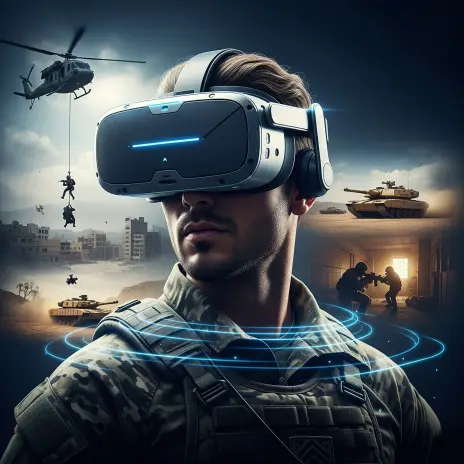
Not entirely, nor are they meant to. VR and mixed-reality simulators replace the repetition, not the final live qualification. The Ministry of Defence's 2021 simulator framework aims to move training across all military domains towards simulation, and a May 2026 TERI assessment estimates that wider simulator use could save the armed forces over ₹1,000 crore a year in ammunition, fuel, logistics and training time, with live ranges kept for certification.
Every training-establishment head in India faces the same arithmetic. Live firing builds a skill nothing else can, but it consumes ammunition, fuel, range days and vehicle life. The question we hear most from defence and security-force buyers is blunt: can VR replace it? Based on the policy, the economics and the recent inductions, our answer is that VR replaces the practice runs, not the proof.
On 23 September 2021, the Ministry of Defence promulgated a framework for the "enhanced and synergised utilisation of simulators" by the Army, Navy, Air Force and Indian Coast Guard. Its stated vision is to "transform to simulation-based training across all military domains", covering combatants, leaders, maintainers, administrators and even procurement and financial staff.
Three points matter for anyone planning a VR programme. The framework asks the Services to reduce live equipment use and plan simulator induction inside capability plans; it asks that simulator needs be built into procurement from the start, so a new weapon arrives with its training system; and it puts indigenous design, development and maintenance at the centre, in line with Atmanirbhar Bharat. It sets no percentage of training to be simulated; that is left to each Service.
The most concrete public numbers come from a TERI (The Energy and Resources Institute) assessment reported in May 2026. TERI examined 13 simulator systems across five arms and modelled savings in four buckets: ammunition, fuel and logistics, equipment maintenance and training time. Its headline estimate is that expanding simulator-based training could save the armed forces more than ₹1,000 crore a year without compromising battlefield readiness. The figures below are TERI's, as reported by ANI.
| Simulator or scenario | TERI figure | What drives it |
|---|---|---|
| Tank Crew Gunnery Simulator | About ₹1,123 crore (roughly ₹3.08 crore a day) | Main-gun ammunition, track and engine hours |
| Infantry Weapon Training Simulators | ₹461.20 crore at 15% induction; ₹3,219.50 crore if induction rises by a further 25% | Small-arms ammunition and range days |
| Artillery Forward Observer Simulator | A 15% cut in live artillery exercises saves about ₹135 crore in ammunition | Shell cost per fire mission |
| Mechanised Infantry training | Nearly 2 lakh litres of diesel a year, about ₹1.7 crore | Vehicle fuel for training runs |
| Live-fire logistics | Some exercises involve round trips of about 1,000 km | Moving units and ammunition to ranges |
One caution: the TERI numbers are modelled projections at assumed induction levels, not audited savings, and they mix annual figures with net-present-value estimates. They remain the best public baseline for an Indian business case, and they show where the money is: ammunition first, fuel and logistics second, training time third.
The Simulator Development Division (SDD) under Army Training Command (ARTRAC) has been the most visible source of indigenous VR systems. Three recent examples show the pattern.
Industry commentary points the same way. A 30 September 2026 opinion piece in The Week described mixed-reality infantry training that overlays digital threats on a soldier's actual AK-203, Sig Sauer 716 or INSAS, with after-action reviews built from field-of-view heatmaps, muzzle-discipline tracking and biometric stress data. That is an industry view, not an official evaluation, but it describes the instrumented training the SDD systems are moving towards.
Here is the honest boundary. A headset does not reproduce recoil, muzzle blast, heat, fatigue after a 20 km approach march, or the discipline of handling live ammunition. Annual range classification, live-fire tactical training and anything that certifies a soldier as safe with a real weapon system stay on the range. The same logic applies in industry: as we found when we looked at VR fire-safety training for Indian factories, the simulator builds the decision-making and the muscle memory, and the live drill confirms it.
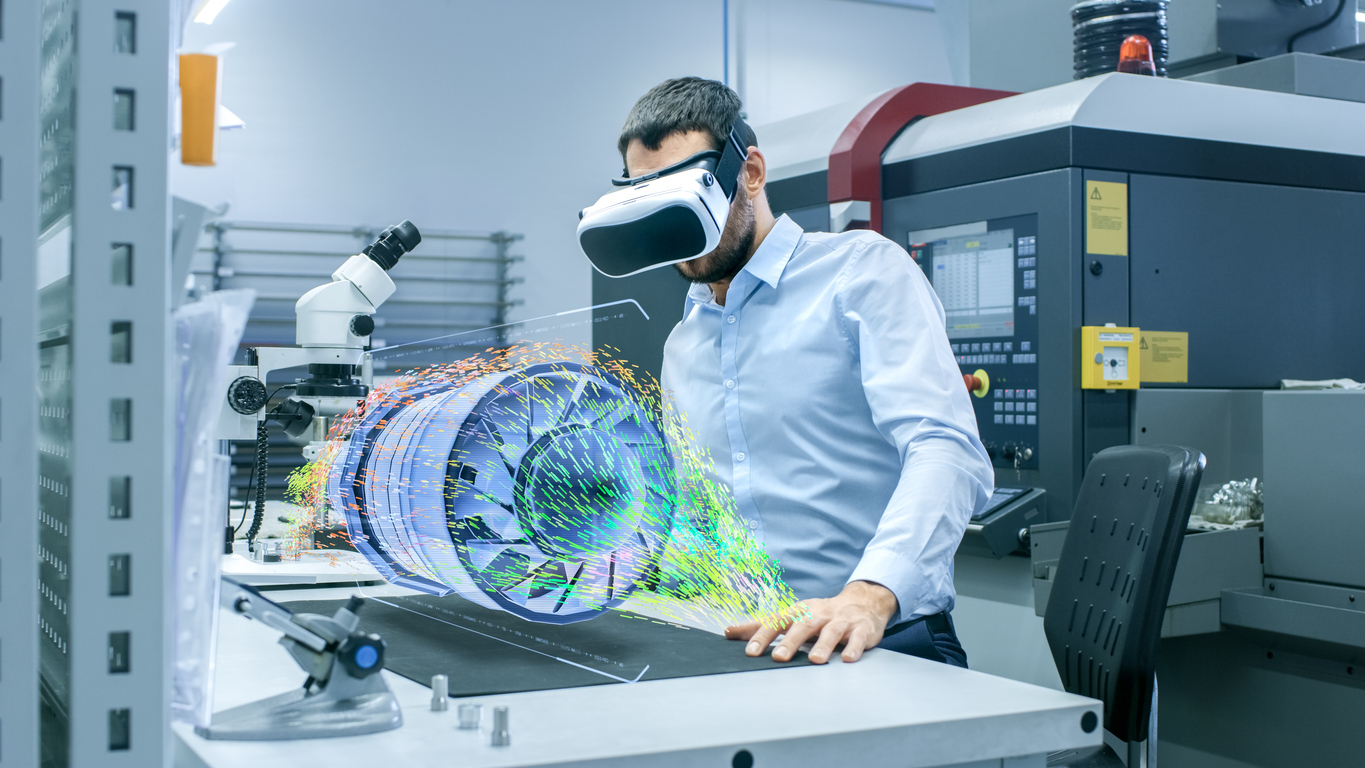
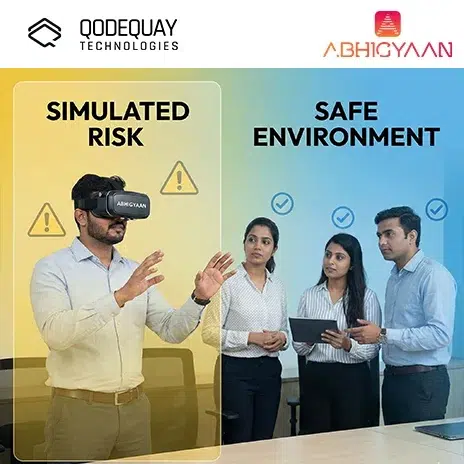
What VR does replace is the long, expensive middle of the training cycle: the second to twentieth repetition of a drill, the scenario a unit cannot build physically (a night blizzard, a drone swarm, a civilian in the doorway), and the measurement an instructor cannot do by eye. Mixed reality goes a step further by keeping the real weapon in the soldier's hands; we covered the trade-offs in our guide to mixed reality for training.
Abhigyaan Pro is Qodequay's professional VR training platform for industrial, fire-safety and defence use cases, built on the same engine that runs Abhigyaan in 1,350 Maharashtra Zilla Parishad schools reaching 1.5M+ students. It supports collaborative multi-user rooms, scenario simulations and remote instructor tracking, runs on a VR headset and in a browser in the same session, and is hosted in Indian data centres by default with an air-gapped option for sensitive establishments. Qodequay is ISO 9001:2015 and ISO 27001:2022 certified and based in Pune. If you are scoping a simulator pilot for a training establishment, book a 30-minute scoping call and we will map your highest-cost drills to a VR-first plan.
Yes. On 23 September 2021 the Ministry of Defence issued a framework for the enhanced and synergised utilisation of simulators across the Army, Navy, Air Force and Coast Guard. It aims to transform training across all military domains towards simulation, reduce live equipment use and prioritise indigenous design, development and maintenance.
A TERI assessment reported in May 2026 estimates that expanding simulator-based training could save more than ₹1,000 crore a year across ammunition, fuel and logistics, equipment maintenance and training time. The figures are modelled projections based on 13 simulator systems across five arms, not audited savings.
ARTRAC's Simulator Development Division handed over an indigenous VR aerial-delivery simulator for the C-17, C-130J and Chinook to the Army Airborne Training School at Agra in May 2026, built with IIT-Hyderabad under the VIGRAHA Centre of Excellence, and unveiled a multi-user VR urban-warfare training system in August 2026.
VR fully immerses the trainee in a headset with simulated weapons and environments, which suits procedures, scenarios and team drills. Mixed reality overlays digital targets and threats on the real world so soldiers train with their actual weapon, keeping handling and recoil realistic. Most programmes use both, with live firing retained for qualification.
Yes, and it should be. Scenario libraries and trainee performance records are sensitive, so establishments should specify Indian data-centre hosting or a fully air-gapped deployment. Abhigyaan Pro, Qodequay's professional VR training platform, is hosted in Indian data centres by default and offers an air-gapped option.
Figures in this article are drawn from the Ministry of Defence's September 2021 simulator framework, TERI's May 2026 assessment as reported by ANI, and published reports on ARTRAC Simulator Development Division inductions. They are provided for general information; confirm current policy and numbers against official sources before relying on them.

I am a founder director at Qodequay Technologies Pvt. Ltd., a leading digital transformation consulting firm that helps clients across industries to innovate, optimize, and grow their businesses. I have over two decades of experience in the digital domain, spanning product development, e-commerce, user experience, design thinking, web and app development, and business leadership. My core competencies include developing and executing digital transformation strategies, building teams globally, roadmaps, and solutions that leverage data, insights, and emerging technologies such as artificial intelligence, augmented reality, blockchain, and immersive experience. I also have expertise in digital commerce, supply chain integration, and product management, having worked with both B2B and B2C brands in various sectors. My mission is to create value for customers and stakeholders by delivering impactful and engaging digital experiences that drive growth and innovation.
October 18, 2026

October 17, 2026

October 16, 2026

October 15, 2026

October 14, 2026
Monthly insights on AI, VR and DPDPA compliance — straight from our team to your inbox.
Free 30-minute consultation with our team — or see our products in action.