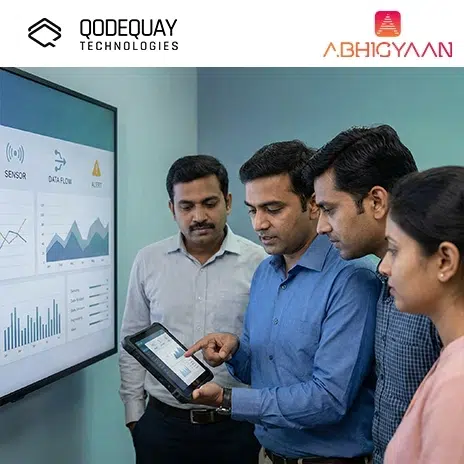
DPDPA Penalties Up to ₹250 Crore: The Real Cost of Waiting
July 2, 2026
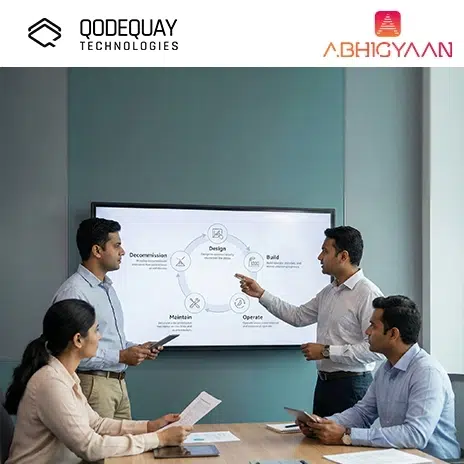
Visualizing performance with simulations matters because it lets you test decisions safely before they become expensive mistakes.
If you are a CTO, CIO, Product Manager, Startup Founder, or Digital Leader, you are expected to move fast, reduce risk, and still deliver measurable results. That is a brutal combination, especially in industries where every decision touches:
Simulations are the closest thing you get to a time machine in business. They allow you to model a system, run “what-if” scenarios, and visualize outcomes before you spend money, change operations, or disrupt customers.
In this article, you will learn:
It means using simulation models and visual outputs to understand how a system behaves under different conditions.
Instead of relying only on:
you use simulation to explore:
The visualization part is key because simulation results are often complex. Visualizing makes them understandable and actionable for decision-makers.
They care because simulation turns digital transformation into measurable operational outcomes.
For technology leaders, the real value is not “cool 3D graphics.”
The value is:
When you can show performance impacts visually, you reduce friction in decision-making.
Simulation reduces risk by allowing you to test changes without disrupting live systems.
This matters most when changes involve:
If you want to increase throughput by 20% on a manufacturing line, you might assume you just need faster machines.
Simulation often reveals:
A simulation helps you avoid spending money in the wrong place.
The most common types are discrete event simulation, agent-based simulation, and physics-based simulation.
This models systems as events happening over time.
It is ideal for:
This models individual “agents” and their behaviors.
It is ideal for:
This models real-world physical behavior.
It is ideal for:
Many modern systems use a mix of methods, especially in digital twins.
The best use cases are bottleneck detection, capacity planning, predictive maintenance strategy, and energy optimization.
Simulation helps you see:
Visualization makes it easy to communicate.
Instead of guessing how much capacity you need, you simulate:
Simulation can compare strategies like:
You can visualize:
Simulation helps you model:
Simulation becomes far more powerful when it is connected to a real-time digital twin.
A traditional simulation uses assumptions.
A digital twin simulation uses:
This creates a loop:
That is how operations become continuously optimized.
Warehouse and logistics simulation is one of the strongest proven examples because it produces fast and measurable ROI.
A fulfillment center wants to reduce order delivery time.
They simulate:
Visualization reveals:
Outcome:
This is exactly why simulation is loved by high-performing operations teams.
It is effective because humans understand complex systems faster through visual patterns than through tables.
Visualization helps you see:
It also makes cross-functional alignment easier.
A CFO might not care about cycle time distribution curves, but they will understand a visual showing “this change reduces bottleneck queues by 40%.”
The best practices are to define the decision first, validate the model, and keep simulations usable for non-experts.
You should avoid building simulations that are technically impressive but disconnected from operational reality.
More detail does not always mean better accuracy.
Too much detail can:
If your input data is wrong, the simulation becomes a fancy lie.
Simulation only delivers ROI when it becomes part of decision-making culture.
You measure ROI by comparing simulated outcomes with real performance improvements after implementation.
The future is real-time simulation, AI-generated scenarios, and immersive interfaces like AR and VR.
Simulations will run continuously, updating based on live operational data.
AI will suggest:
AR and VR will allow you to:
For SaaS and industrial platforms, simulation will become a built-in feature, not a separate tool.
Visualizing performance with simulations is not just a technical exercise. It is a strategic capability. It helps you move from reactive decision-making to predictive and optimized operations.
For CTOs, CIOs, Product Managers, Startup Founders, and Digital Leaders, simulation visualization is one of the clearest ways to reduce risk, accelerate transformation, and invest with confidence.
At Qodequay (https://www.qodequay.com), you approach simulation and digital twin solutions with a design-first mindset, ensuring that complex performance insights are presented in ways that real teams can understand and act on. You solve human problems first, and then use technology as the enabler, which is how simulations become real business advantage.

As the CEO and Founder of Qodequay Technologies, I bring over 20 years of expertise in design thinking, consulting, and digital transformation. Our mission is to merge cutting-edge technologies like AI, Metaverse, AR/VR/MR, and Blockchain with human-centered design, serving global enterprises across the USA, Europe, India, and Australia. I specialize in creating impactful digital solutions, mentoring emerging designers, and leveraging data science to empower underserved communities in rural India. With a credential in Human-Centered Design and extensive experience in guiding product innovation, I’m dedicated to revolutionizing the digital landscape with visionary solutions.
Follow the expert :


July 2, 2026
July 2, 2026
July 2, 2026
July 2, 2026

July 2, 2026
Monthly insights on AI, VR and DPDPA compliance — straight from our team to your inbox.
Free 30-minute consultation with our team — or see our products in action.