How to Budget a VR Lab for a CBSE School: Devices, Content, Training and Hidden Costs
October 6, 2026
February 9, 2026
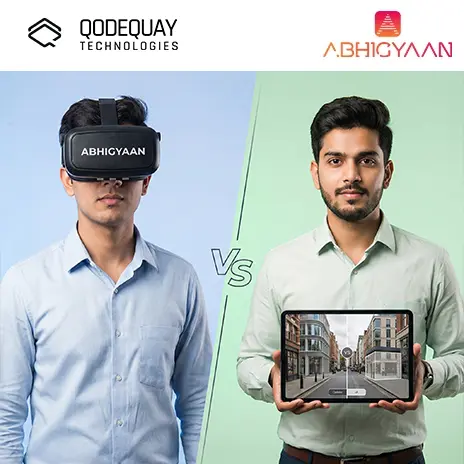
Virtual reality and augmented reality are often grouped together, but they solve very different business problems. As a CTO, CIO, Product Manager, Startup Founder, or Digital Leader, you’re not choosing between “cool tech,” you’re choosing between two different paths of user experience, cost, scalability, training impact, and product strategy.
In this article, you’ll learn what VR vs. AR actually means, how they work, where each one fits best, real-world examples, cost and hardware considerations, and how to choose the right technology based on ROI. You’ll also explore future trends that will shape immersive technology over the next 3–5 years.
VR replaces your world, AR enhances your world.
Virtual Reality (VR) places you inside a fully digital environment using a headset. Augmented Reality (AR) overlays digital elements onto the real world using a phone, tablet, or smart glasses.
Think of it like this:
This difference changes everything, from user adoption to cost, training outcomes, and product scalability.
LSI terms used: immersive technology, mixed reality, XR, virtual reality headset, augmented reality apps, spatial computing, digital overlay, 3D visualization, enterprise training, remote collaboration, interactive learning, simulation technology
VR works by immersing you in a simulated environment where you interact in 3D.
A VR system typically uses:
VR is not just for gaming anymore. It is increasingly used for:
A major reason VR is attractive is that it creates repeatable training experiences without real-world risk.
AR works by layering digital objects onto the real world through a camera or smart glasses.
AR can run on:
AR adoption is often faster because:
AR is extremely powerful for “in-the-moment” guidance, such as:
The biggest difference is immersion: VR is full immersion, AR is contextual enhancement.
Here’s a clear comparison:
For leaders, the real question is not “which is better,” it’s “which fits the business problem.”
AR often delivers faster ROI, while VR delivers deeper ROI in training-heavy industries.
AR typically wins in early ROI because it:
VR delivers strong ROI when:
VR outperforms AR when you need total immersion, repeatable simulation, and deep focus.
VR is best for:
Industries like manufacturing, construction, aviation, and oil and gas benefit heavily.
In VR, you can simulate:
You reduce real-world exposure while increasing training realism.
This surprises many digital leaders.
VR can simulate:
Because VR isolates the learner, the emotional engagement is higher.
VR helps teams walk through:
This reduces rework later, which is where budgets go to die.
AR outperforms VR when you need speed, convenience, and workflow integration.
AR is best for:
AR can guide technicians with:
This can reduce downtime dramatically.
AR enables:
This directly impacts conversion rates and reduces returns.
AR can show:
This improves speed and accuracy without training fatigue.
Mixed Reality (MR) blends VR and AR, but it does not replace them yet.
Mixed Reality combines:
Devices like Apple Vision Pro and Meta Quest 3 are pushing MR forward. But for most enterprises today, MR is still expensive and harder to deploy at scale.
Think of MR as:
VR requires dedicated hardware, while AR usually leverages existing devices.
The hidden cost is not hardware, it’s content creation and maintenance. Immersive experiences need updates, QA, device compatibility testing, and analytics.
The biggest risks are poor use-case selection, low adoption, and underestimating content complexity.
Here are common mistakes:
Immersive technology fails when it is treated as a novelty.
The best way to choose is to start with the workflow and KPI, not the technology.
Both VR and AR have proven success, but in different domains.
Walmart has used VR training to improve employee readiness for real store situations, including customer interaction and operational scenarios.
IKEA’s AR app allows customers to preview furniture placement at home. This improves buyer confidence and reduces return risk.
Many industrial companies use AR-based remote expert support, where a senior technician guides a field worker visually, reducing travel and speeding up repairs.
These examples prove a key point: immersive tech wins when it reduces friction, not when it adds it.
VR and AR can become product differentiators, but only if they solve a real customer pain point.
For product leaders, the strategic advantage comes from:
AR often enhances customer experience directly. VR often enhances training, onboarding, and internal operations.
The future is not VR vs. AR, it’s VR + AR evolving into spatial computing.
Here are key trends you should expect:
Headsets will increasingly support both VR and AR modes.
Smart glasses will become lighter, cheaper, and more enterprise-ready.
You will measure performance in immersive environments like you measure website funnels today.
AI will reduce the cost of building 3D environments, avatars, and interactive scenarios.
Enterprises will use immersive tools not as “extras,” but as part of standard digital operations.
The winners will not be the companies with the coolest VR demos. The winners will be the ones who integrate immersive technology into real work.
VR vs. AR is not a debate about which technology is more advanced, it’s a strategic decision about how you want to solve human problems through experience design. VR gives you immersion and simulation. AR gives you speed and context. Both can deliver serious business value when implemented with clear goals and thoughtful execution.
At Qodequay (https://www.qodequay.com), you approach immersive technology with a design-first mindset, using technology as the enabler. That’s how you move beyond “wow factor” and build solutions that improve learning, reduce friction, and create meaningful digital experiences that scale.

As the CEO and Founder of Qodequay Technologies, I bring over 20 years of expertise in design thinking, consulting, and digital transformation. Our mission is to merge cutting-edge technologies like AI, Metaverse, AR/VR/MR, and Blockchain with human-centered design, serving global enterprises across the USA, Europe, India, and Australia. I specialize in creating impactful digital solutions, mentoring emerging designers, and leveraging data science to empower underserved communities in rural India. With a credential in Human-Centered Design and extensive experience in guiding product innovation, I’m dedicated to revolutionizing the digital landscape with visionary solutions.
Follow the expert :

October 6, 2026

October 5, 2026

October 4, 2026

October 3, 2026

October 2, 2026
Monthly insights on AI, VR and DPDPA compliance — straight from our team to your inbox.
Free 30-minute consultation with our team — or see our products in action.