How to Budget a VR Lab for a CBSE School: Devices, Content, Training and Hidden Costs
October 6, 2026
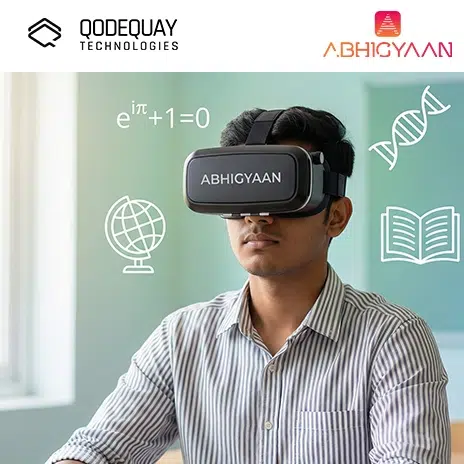
Virtual reality is becoming a powerful learning tool across subjects because it turns abstract concepts into immersive experiences that you can see, explore, and remember.
Traditional learning often depends on textbooks, lectures, and static visuals. That works for some topics, but it struggles when concepts are complex, spatial, dangerous, expensive, or hard to imagine.
For CTOs, CIOs, Product Managers, Startup Founders, and Digital Leaders, VR learning matters because it is no longer experimental. It is becoming a scalable digital capability for education, training, and workforce development.
In this article, you’ll learn how virtual reality enhances learning across multiple subjects, what benefits it delivers, real-world use cases, best practices, and what the future holds.
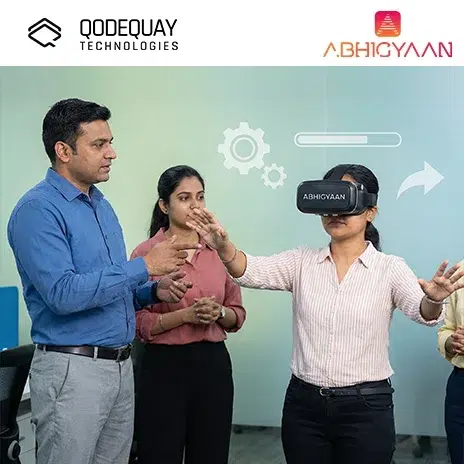
Virtual reality enhances learning by enabling you to interact with content in a 3D environment instead of only reading or watching it.
In VR, you do not just observe. You participate.
This changes learning in three powerful ways:
That is why VR is often called immersive learning or experiential learning.
VR improves learning retention because your brain stores experiences more strongly than passive information.
When you walk through a virtual ancient city, perform a virtual chemistry experiment, or explore the human body in 3D, your brain builds memory pathways similar to real-world experiences.
This is why VR training is often associated with stronger recall and faster skill development.
Even simple VR simulations can improve understanding because they activate spatial memory and emotional engagement.
VR enhances STEM learning by making complex systems visual, interactive, and safe to explore.
STEM concepts often involve:
VR allows you to explore these safely and clearly.
VR turns STEM from abstract to intuitive.
VR improves history and geography learning by allowing you to experience places, events, and cultures instead of only reading about them.
History often fails in traditional formats because it feels distant. VR brings it closer.
You can:
When history becomes an experience, curiosity increases. And curiosity is a learning superpower.
VR helps with language learning because it creates realistic conversations and situational practice, not just vocabulary memorization.
Language learning improves fastest when you practice in context.
VR can simulate:
This improves:
VR is especially powerful for learners who feel anxious speaking in real situations.
VR supports medical education by enabling safe practice of procedures, anatomy exploration, and clinical decision-making.
Healthcare training is expensive and high-stakes. Mistakes can harm patients.
VR helps by enabling:
This does not replace real clinical experience. It improves readiness before real-world practice.
VR enhances vocational and industrial training by allowing you to practice equipment handling and safety procedures without real-world danger.
For example, VR is widely used for:
This is one of the strongest ROI areas for VR because safety incidents are costly and training in real environments is difficult.
VR improves learning because it supports visual, spatial, and kinesthetic learning styles naturally.
Not everyone learns best through reading. Some people learn through:
VR supports all of these.
It can also help learners who struggle with attention by making learning more engaging, structured, and interactive.
The biggest benefits are stronger understanding, higher engagement, safer practice, and scalable training.
VR helps you learn faster, but more importantly, it helps you learn deeper.
The main challenges are cost, content quality, adoption, device management, and accessibility.
VR is powerful, but real implementation requires planning.
Common challenges include:
The solution is to start with a pilot program and scale based on results.
The best practices are focusing on outcomes, designing short sessions, and blending VR with other learning methods.
VR works best as part of blended learning, not as a replacement for everything.
VR learning will expand rapidly as AI-driven simulations improve, hardware becomes lighter, and learning becomes more analytics-driven.
VR will move from novelty to a standard learning tool, especially in workforce development.
Qodequay helps you design VR learning experiences that are engaging, measurable, and aligned with real learning outcomes.
VR succeeds when:
At Qodequay (https://www.qodequay.com), you combine a design-first approach with technology execution. You build immersive learning solutions that solve human problems, with technology as the enabler.
Virtual reality is changing how you learn because it makes learning experiential. Instead of memorizing concepts, you explore them. Instead of imagining scenarios, you step into them. That shift improves understanding, retention, and confidence across subjects.
As learning becomes more digital and outcome-driven, VR will become a strategic advantage for organizations that care about training quality, workforce readiness, and scalable education.
At Qodequay (https://www.qodequay.com), you build VR learning solutions with a design-first mindset, solving real human learning challenges while using technology as the enabler. That is how immersive learning becomes real-world impact.

As the CEO and Founder of Qodequay Technologies, I bring over 20 years of expertise in design thinking, consulting, and digital transformation. Our mission is to merge cutting-edge technologies like AI, Metaverse, AR/VR/MR, and Blockchain with human-centered design, serving global enterprises across the USA, Europe, India, and Australia. I specialize in creating impactful digital solutions, mentoring emerging designers, and leveraging data science to empower underserved communities in rural India. With a credential in Human-Centered Design and extensive experience in guiding product innovation, I’m dedicated to revolutionizing the digital landscape with visionary solutions.
Follow the expert :

October 6, 2026

October 5, 2026
October 4, 2026

October 3, 2026
October 2, 2026
Monthly insights on AI, VR and DPDPA compliance — straight from our team to your inbox.
Free 30-minute consultation with our team — or see our products in action.