DPDPA Penalties Up to ₹250 Crore: The Real Cost of Waiting
July 2, 2026
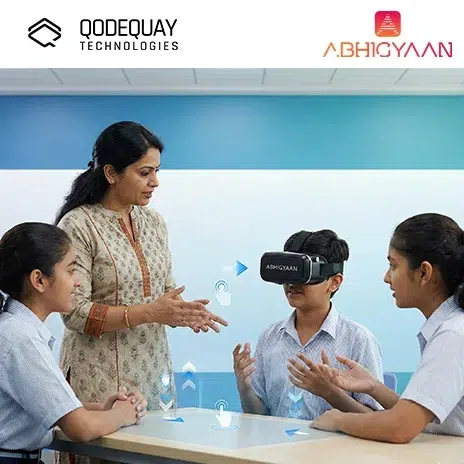
Most organizations already have risk frameworks, safety manuals, cybersecurity policies, and compliance guidelines. The missing piece is rarely documentation. The missing piece is what people do in the moment, when something goes wrong, when they are distracted, under pressure, or unsure.
That is exactly why VR risk management training is gaining serious momentum. Virtual reality does something traditional learning struggles to do: it turns risk education into a lived experience. You do not just learn what risk is. You learn how risk feels, how it develops, what signals appear first, and what decisions matter most.
If you are a CTO, CIO, Product Manager, Startup Founder, or Digital Leader, this matters because risk now touches every part of your business. Cyber risk impacts revenue. Safety risk impacts continuity. Compliance risk impacts market access. Operational risk impacts delivery. And in every case, your outcomes depend on human decisions.
In this article, you will explore how VR improves risk awareness and decision-making, the science behind why it works, real-world examples, best practices, measurable ROI metrics, and future trends shaping immersive risk education.
Risk awareness means you can recognize early warning signs of danger, failure, or threat before it becomes an incident.
This is not limited to physical safety. Risk awareness includes:
In most workplaces, incidents happen because people did not notice risk early enough, or they noticed it but did not act.
VR trains both detection and action.
People make poor decisions because stress changes how the brain processes information.
Under pressure, your brain:
This is why “knowing the procedure” is not enough. You need to practice the procedure under conditions that feel real.
VR creates that practice safely.
VR improves risk awareness faster because it trains your attention inside realistic environments.
In a classroom, risk is explained. In VR, risk is experienced.
For example, in a VR warehouse simulation, you can:
This is not just information. It is situational learning.
That is why VR is often more effective for building hazard recognition skills.
VR improves decision-making because it builds behavioral muscle memory through repeated exposure.
When you experience a risk scenario multiple times, your brain starts to build faster response patterns. You stop hesitating and start executing.
VR training can force you to:
Over time, this creates decision confidence.
And importantly, VR allows failure without real-world consequences, which accelerates learning.
VR is more memorable because your brain stores immersive experiences like real events.
Traditional eLearning is passive. You click, read, and watch. Your brain treats it like low-risk information.
VR is active. You move, decide, and respond. Your brain treats it as a lived experience.
This is why you often remember:
VR bridges the gap between theory and experience.
VR helps you recognize signals earlier by training pattern recognition in context.
Risk signals are often subtle. For example:
VR can train you to spot these cues repeatedly until they become automatic.
This is especially useful for:
VR is already used across industries because it improves readiness and reduces incidents.
Examples include:
You can practice identifying fall risks and deciding when to stop unsafe work.
You can simulate machine malfunctions and practice emergency shutdown procedures.
You can simulate infection control failures and practice correct containment steps.
You can simulate a ransomware incident and train how to isolate systems and escalate properly.
You can simulate aggressive customer behavior and practice de-escalation safely.
These scenarios build decision skill, not just awareness.
VR supports risk culture by making risk feel real, personal, and shared.
A risk-aware culture is not built by policies alone. It is built when people:
VR helps because it creates a shared experience. Teams can go through the same simulation and discuss decisions afterward.
This improves alignment and accountability.
VR reduces incidents by improving hazard detection and correct response behavior.
Most incidents come from:
VR directly targets these issues through:
Over time, fewer mistakes happen in real life because the brain has already practiced the correct response.
You measure impact by tracking behavior in simulations and outcomes in the real world.
Key metrics include:
VR provides training analytics that are far more detailed than standard LMS completion reports.
The best programs focus on realism, repetition, and role relevance.
Best practices include:
VR works best when it becomes part of continuous learning.
You should plan for hardware logistics, content updates, and adoption.
Common challenges include:
These challenges are solvable, especially when VR is treated as a strategic training system.
The future is adaptive, data-driven, and team-based.
Key trends include:
Scenarios will change based on your decisions, making learning more personalized.
Teams will train together, improving coordination in real incidents.
VR will replicate real facilities, workflows, and equipment for higher realism.
Training data will feed into enterprise risk management dashboards.
Headsets will become lighter, cheaper, and easier to manage.
Over time, VR will become a standard tool for risk education, not a special initiative.
Risk is not solved by policies alone. It is solved by people making the right decisions at the right time.
VR risk management training is revolutionizing risk awareness and decision-making because it gives you something traditional training cannot: safe experience. You learn to recognize risk signals, respond under pressure, and build confidence through repetition, without paying the real-world cost of mistakes.
This is where design-first thinking becomes the difference between “training content” and real capability. At Qodequay (https://www.qodequay.com), immersive learning is built around human behavior and real-world decision-making, with technology as the enabler. Because the ultimate goal is not VR itself. The goal is safer organizations, stronger teams, and leaders who are prepared when risk becomes reality.

As the CEO and Founder of Qodequay Technologies, I bring over 20 years of expertise in design thinking, consulting, and digital transformation. Our mission is to merge cutting-edge technologies like AI, Metaverse, AR/VR/MR, and Blockchain with human-centered design, serving global enterprises across the USA, Europe, India, and Australia. I specialize in creating impactful digital solutions, mentoring emerging designers, and leveraging data science to empower underserved communities in rural India. With a credential in Human-Centered Design and extensive experience in guiding product innovation, I’m dedicated to revolutionizing the digital landscape with visionary solutions.
Follow the expert :


July 2, 2026
July 2, 2026
July 2, 2026
July 2, 2026
July 2, 2026
Monthly insights on AI, VR and DPDPA compliance — straight from our team to your inbox.
Free 30-minute consultation with our team — or see our products in action.