How to Budget a VR Lab for a CBSE School: Devices, Content, Training and Hidden Costs
October 6, 2026
September 19, 2025
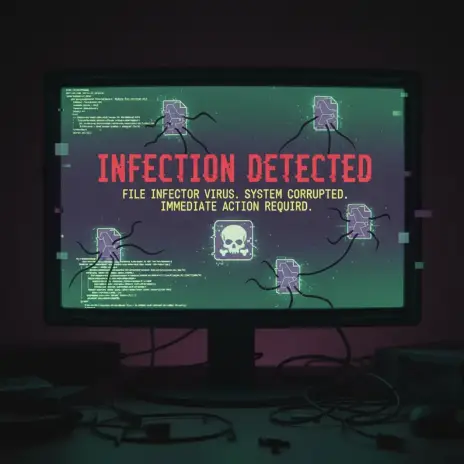
A file infector virus is one of the oldest yet still persistent forms of malware. It attaches to executable files (like .exe or .com), spreads across systems, and can lead to severe data loss, operational downtime, or complete system compromise. For CIOs, CTOs, and CISOs, file infectors matter because they exploit crucial vulnerabilities: human error, outdated legacy systems, and weak endpoint defenses—all of which can derail digital transformation initiatives.
A file infector virus is a category of malicious software that integrates its code directly into legitimate executable files. Once the infected file is run, the virus executes its payload and begins replicating by infecting other files on the system and across the network.
Key Impacts:
File Corruption and Data Loss: Overwrites or modifies vital program and user files.
System Instability: Causes significant slowdowns and crashes.
Backdoor Creation: Opens pathways for additional, more sophisticated malware.
Modern file infectors are highly advanced and often employ evasion techniques, making them relevant threats today.
Notable examples, such as CIH (Chernobyl Virus, 1998) and Sality (2003), demonstrate the long-term destructive potential of this malware class. Today, advanced variants often use polymorphism—changing their code with each infection to bypass signature-based antivirus solutions.
In corporate environments, infections spread primarily through:
Removable Media: Unmanaged USB drives and external hard disks.
Network Shares: Replication across shared drives and storage.
Email Attachments: Infected executables disguised as legitimate files.
BYOD Policies: Personal devices introducing infected files into the network.
Effective defense against file infectors requires a multi-layered, "defense-in-depth" approach.
Regular Patching and Updates: Maintain consistent, immediate updates for all operating systems and software to close known vulnerabilities.
Application Whitelisting: Implement strict policies that permit only approved executable files to run on endpoints, effectively neutralizing unauthorized or infected programs.
Employee Awareness Training: Conduct mandatory, recurring training to educate users on identifying and avoiding suspicious email attachments and downloads.
Network Segmentation: Isolate critical network segments to prevent the lateral spread of a virus should an infection occur on an endpoint.
Traditional antivirus is often insufficient. Enterprises must deploy modern solutions that utilize:
The most significant contemporary risk is the convergence of file infectors with other threats. They now often act as the initial vector for more damaging attacks, such as:
File Infector + Ransomware: Spreads widely before encrypting files for extortion.
File Infector + Trojans/Botnets: Infected files install remote access backdoors or recruit machines into a botnet.
No defense is perfect. The ultimate green flag for resilience is a robust recovery plan:
Relevance: File infectors exploit legacy systems and BYOD, remaining a serious enterprise threat.
Best Defense: A multi-layered strategy including Application Whitelisting and EDR solutions.
Modern Risk: They are often combined with ransomware and Trojans to create blended, highly destructive attacks.

As the CEO and Founder of Qodequay Technologies, I bring over 20 years of expertise in design thinking, consulting, and digital transformation. Our mission is to merge cutting-edge technologies like AI, Metaverse, AR/VR/MR, and Blockchain with human-centered design, serving global enterprises across the USA, Europe, India, and Australia. I specialize in creating impactful digital solutions, mentoring emerging designers, and leveraging data science to empower underserved communities in rural India. With a credential in Human-Centered Design and extensive experience in guiding product innovation, I’m dedicated to revolutionizing the digital landscape with visionary solutions.
Follow the expert :


October 6, 2026

October 5, 2026

October 4, 2026

October 3, 2026

October 2, 2026
Monthly insights on AI, VR and DPDPA compliance — straight from our team to your inbox.
Free 30-minute consultation with our team — or see our products in action.