DPDPA Penalties Up to ₹250 Crore: The Real Cost of Waiting
July 2, 2026
February 13, 2026
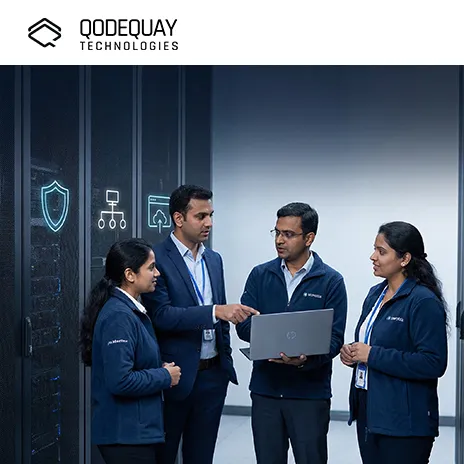
Private AI Infrastructure is the strategy of running AI workloads (training, fine-tuning, inference, and data pipelines) inside your own controlled environment instead of relying fully on public AI platforms. And right now, it is becoming one of the most important decisions you will make as a CTO, CIO, Product Manager, Startup Founder, or Digital Leader.
Because the AI race is no longer only about models.
It is about control.
It is about data ownership.
It is about cost predictability.
It is about compliance.
And it is about whether your organization can safely use AI at scale without turning your customer data into a science experiment.
In this article, you will learn what Private AI Infrastructure is, why it matters, the business and technical drivers, real-world examples, architecture patterns, costs, best practices, common mistakes, and the future outlook for private AI.
Private AI Infrastructure is an AI computing environment that you own or fully control, where you run AI models and data pipelines without sending sensitive data to external AI services.
In practical terms, this can mean:
The key idea is governance and isolation.
You are not “renting intelligence” from a public AI endpoint with unclear data exposure. You are building an AI foundation where you decide:
Private AI Infrastructure matters because it protects your competitive advantage while reducing security and compliance risk.
As a leader, you are facing a brutal reality:
AI is becoming embedded in every product, workflow, and customer interaction. At the same time, regulators and customers are demanding stricter guarantees about privacy, security, and fairness.
If your organization handles:
Then the cost of “just using public AI” can become unacceptable.
Private AI Infrastructure helps you:
And most importantly: it lets you adopt AI without losing control of your crown jewels.
The rise of Private AI Infrastructure is driven by security concerns, regulatory pressure, and the economics of inference at scale.
AI adoption has entered its second phase:
You used ChatGPT or public APIs to test ideas quickly.
You now need:
For many organizations, Phase 2 cannot be solved by a public AI endpoint alone.
Private AI Infrastructure is different because it is optimized for GPU compute, model lifecycle management, and AI governance.
Private cloud is usually designed for:
Private AI Infrastructure must handle:
In short: private AI is not just “Kubernetes plus GPUs.” It is an end-to-end AI operating environment.
Private AI Infrastructure supports training, fine-tuning, inference, and AI data pipelines.
Here is what typically runs inside:
This is the most common and most valuable.
You host:
You adapt a foundation model using your own data.
Example: A legal firm fine-tunes a model on internal contract language.
Full training from scratch is expensive, but some organizations do it.
Typical use cases:
AI is only as good as the data feeding it.
Private AI includes:
The biggest benefits are security, compliance, control, and long-term cost efficiency.
Your data stays in your environment.
This matters for:
You can enforce:
You avoid:
Public AI APIs are great for prototypes.
But when you scale inference across thousands or millions of interactions, costs can explode.
Private AI lets you:
You can switch models, frameworks, and providers without rewriting everything.
The biggest trade-off is that you become responsible for operating a complex AI stack.
Private AI Infrastructure is powerful, but it is not “plug and play.”
Hidden costs include:
This is why many organizations choose a hybrid approach: private AI for sensitive workloads, public AI for non-sensitive ones.
A typical architecture includes compute, storage, orchestration, model serving, and governance.
This is where your GPUs live.
Options include:
You also need CPU nodes for:
AI requires fast storage.
Common components:
Most teams use:
Kubernetes is popular because it supports:
You need optimized inference servers such as:
Most private AI deployments rely heavily on RAG (Retrieval-Augmented Generation).
That includes:
This includes:
Many enterprises are building private AI for internal copilots and secure customer workflows.
You deploy an internal assistant that can answer:
Private AI ensures:
A hospital system uses private AI to summarize:
This is sensitive and must be handled with strict compliance.
A bank deploys AI to:
Private AI ensures no customer financial data is exposed to external services.
Private AI succeeds when you design for governance, efficiency, and trust from day one.
Here are best practices that consistently work:
The biggest risks are not only external hackers, but internal leakage and AI-specific attacks.
Key risks include:
Attackers manipulate prompts to force the model to reveal data or bypass rules.
If you log everything without redaction, you create a new sensitive dataset.
Attackers may attempt to reconstruct training data or replicate your model behavior.
This is the classic cloud security problem, now applied to AI.
AI stacks depend on many libraries.
A compromised dependency can become an attack vector.
You choose Private AI when control and compliance matter more than speed of experimentation.
A simple decision guide:
Most modern organizations land on hybrid AI.
You manage costs by optimizing inference, using the right models, and keeping GPUs busy.
Private AI cost drivers include:
Cost optimization strategies:
The funny truth: Many organizations buy expensive GPUs and then run them at 10% utilization. That is like buying a Ferrari to deliver pizza at 5 km/h.
Private AI Infrastructure is moving toward AI factories, model routing, and enterprise AI operating systems.
Here are the trends you should watch:
You will increasingly route requests to different models based on:
Example: Sensitive HR data goes to private AI, generic marketing copy goes to public AI.
The market is shifting toward:
You will not run a massive model for every task.
Companies will build internal AI platforms like:
AI compliance will become mandatory.
Expect requirements for:
Many organizations will avoid on-prem complexity by using:
This gives you private boundaries without running a full data center.
Private AI Infrastructure is not about rejecting public cloud or modern AI services. It is about building the foundation for AI that your organization can trust, govern, and scale.
As AI becomes embedded in every digital product and internal workflow, your ability to control data, performance, and compliance will define your competitive edge. The winners will not simply “use AI.” They will operationalize it safely.
And when you need to design AI experiences that feel human-first, not tool-first, Qodequay is built for that mission. At Qodequay (https://www.qodequay.com), design leads the strategy and technology becomes the enabler, helping you solve real human problems with AI as a responsible, scalable engine.

As the CEO and Founder of Qodequay Technologies, I bring over 20 years of expertise in design thinking, consulting, and digital transformation. Our mission is to merge cutting-edge technologies like AI, Metaverse, AR/VR/MR, and Blockchain with human-centered design, serving global enterprises across the USA, Europe, India, and Australia. I specialize in creating impactful digital solutions, mentoring emerging designers, and leveraging data science to empower underserved communities in rural India. With a credential in Human-Centered Design and extensive experience in guiding product innovation, I’m dedicated to revolutionizing the digital landscape with visionary solutions.
Follow the expert :


July 2, 2026

July 2, 2026
July 2, 2026
July 2, 2026

July 2, 2026
Monthly insights on AI, VR and DPDPA compliance — straight from our team to your inbox.
Free 30-minute consultation with our team — or see our products in action.