DPDPA Penalties Up to ₹250 Crore: The Real Cost of Waiting
July 2, 2026
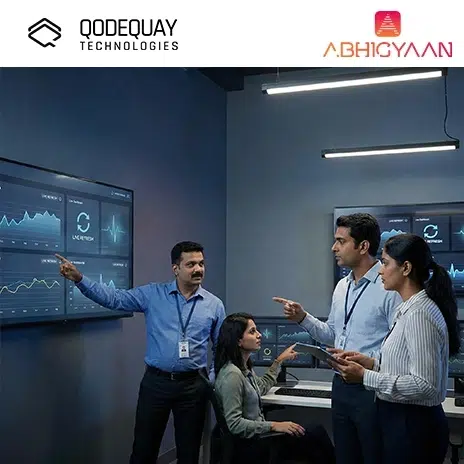
Real-time operational twins matter because they give you a live, decision-ready view of assets and processes, not yesterday’s reports.
If you are a CTO, CIO, Product Manager, Startup Founder, or Digital Leader, you already know the painful truth: most operational decisions are still made using delayed data. Even in advanced organizations, teams often rely on spreadsheets, manual checks, or dashboards that refresh too slowly to prevent failures.
That is a huge problem because modern operations are:
Real-time operational twins solve this by creating a continuously updating digital replica of your operations, powered by IoT data, analytics, and live system integrations.
In this article, you will learn:
Real-time operational twins are digital twins that update continuously using live data from assets, systems, and processes.
Unlike static models, operational twins reflect what is happening right now, including:
This makes them ideal for daily operational decision-making.
Operational twins focus on live operations and action, while traditional digital twins often focus on design, simulation, or planning.
Often used for:
They may not update continuously.
Used for:
Operational twins are designed to be “always on.”
You should invest because operational twins improve uptime, reduce costs, and make operations more predictable at scale.
For leadership teams, the business value comes from:
Operational twins also reduce dependency on a few experts by making knowledge visible and repeatable.
Operational twins solve problems related to visibility, speed, prediction, and coordination.
Without a twin, teams often do not know:
When something breaks, teams waste hours collecting logs and data.
Operational twins centralize this information.
Operational twins enable predictive and condition-based maintenance.
Operations data is often scattered across:
Operational twins unify those layers.
The highest ROI use cases are predictive maintenance, production optimization, energy monitoring, and remote operations.
You detect early warning signals like:
Then you intervene before failure.
Operational twins identify:
Operational twins help you track:
You monitor and manage multiple sites without needing on-site experts for every incident.
Operational twins require a real-time data pipeline, integration layer, and analytics engine.
Edge computing reduces latency and supports:
Operational twins are already used in manufacturing, energy, utilities, and logistics with measurable results.
A plant builds an operational twin for its packaging line.
The twin detects a repeating vibration anomaly in a conveyor motor. Maintenance schedules a fix during planned downtime.
Outcome:
A wind farm uses operational twins to monitor turbine performance.
The twin identifies one turbine producing less power due to blade stress patterns.
Outcome:
A warehouse builds an operational twin for its automation system.
The twin detects growing delays in one section of robotic routing.
Outcome:
You should build operational twins around business outcomes, not technology features.
The biggest challenges are data quality, system integration, and organizational adoption.
Industrial sensors produce noisy signals. Your twin needs filtering and validation.
Legacy OT systems were not designed for modern real-time streaming.
Too many alerts cause teams to ignore the twin.
Operational twins require collaboration across:
You measure success through uptime, repair speed, and operational performance improvements.
Operational twins are successful when they reduce firefighting and increase predictability.
Operational twins will evolve into autonomous systems that predict, recommend, and increasingly act without human intervention.
Instead of only detecting anomalies, twins will explain why they happened.
Twins will trigger:
Companies will manage thousands of operational twins across:
Technicians will access operational twins through AR glasses for:
Real-time operational twins are becoming one of the most valuable tools in modern digital transformation. They help you shift from reactive operations to predictable, optimized, and scalable performance. Instead of relying on delayed reporting, you run your systems with live intelligence.
For CTOs, CIOs, Product Managers, Startup Founders, and Digital Leaders, operational twins are not just a technology investment, they are a strategy for resilience, efficiency, and competitive advantage.
At Qodequay (https://www.qodequay.com), you build operational twin experiences with a design-first mindset, ensuring the technology is not only powerful, but usable by real teams in real environments. You solve human problems first, and then use technology as the enabler, which is exactly how operational twins deliver measurable business impact.

As the CEO and Founder of Qodequay Technologies, I bring over 20 years of expertise in design thinking, consulting, and digital transformation. Our mission is to merge cutting-edge technologies like AI, Metaverse, AR/VR/MR, and Blockchain with human-centered design, serving global enterprises across the USA, Europe, India, and Australia. I specialize in creating impactful digital solutions, mentoring emerging designers, and leveraging data science to empower underserved communities in rural India. With a credential in Human-Centered Design and extensive experience in guiding product innovation, I’m dedicated to revolutionizing the digital landscape with visionary solutions.
Follow the expert :


July 2, 2026
July 2, 2026
July 2, 2026
July 2, 2026
July 2, 2026
Monthly insights on AI, VR and DPDPA compliance — straight from our team to your inbox.
Free 30-minute consultation with our team — or see our products in action.