DPDPA Penalties Up to ₹250 Crore: The Real Cost of Waiting
July 2, 2026
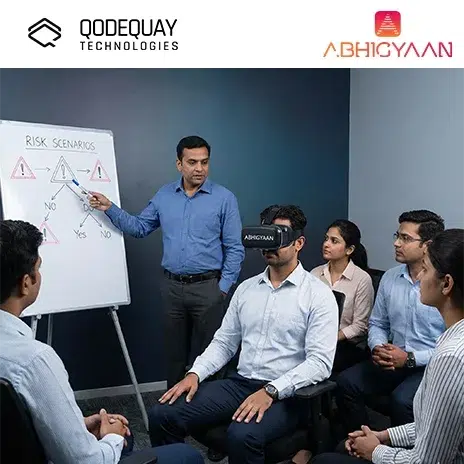
The future of learning is often described with big promises, bold technology, and shiny buzzwords. But as a digital leader, you are trained to be skeptical. You have seen “revolutionary” tools turn into expensive experiments. You have watched platforms launch with excitement and die from low adoption. You have sat through training that looked modern but still felt boring.
So when something truly works, it stands out like a huge green flag.
Immersive learning is that green flag.
It is one of the rare shifts in education and training that aligns with how humans naturally learn. It is not just new. It is better. It combines experience, interaction, and real-world context using technologies like VR classrooms, AR learning, simulations, AI tutors, and gamified learning design.
If you are a CTO, CIO, Product Manager, Startup Founder, or Digital Leader, this matters because learning is no longer an “education problem.” It is a performance problem. It impacts digital adoption, workforce readiness, product onboarding, customer success, and long-term competitiveness.
In this article, you will explore why immersive learning is a huge green flag for the future, what makes it effective, where it delivers measurable value, real-world examples, best practices, risks, and what the next 3 to 5 years will look like.
The green flag is that learning is shifting from passive content consumption to active experience and skill-building.
For decades, education has relied heavily on lectures, textbooks, and tests. Even modern e-learning often repeats the same model, just on a screen.
Immersive learning breaks that pattern. It does not ask you to “pay attention harder.” It redesigns learning so attention happens naturally through interaction.
This is a green flag because it signals a move toward learning that produces capability, not just completion certificates.
Immersive learning is more effective because you remember what you do far more than what you only hear or read.
Traditional learning is good for transferring information. But information is not the same as understanding, and understanding is not the same as performance.
Immersive learning works because it activates:
This is why immersive learning reduces the transfer gap between “knowing” and “doing.”
It aligns because your brain is designed to learn through experience, experimentation, and consequence.
You did not learn to ride a bicycle by reading a manual. You learned by trying, falling, adjusting, and trying again. That cycle is the most natural learning mechanism humans have.
Immersive learning recreates this cycle in a controlled environment.
For example:
Your brain stores these as real experiences, which makes them easier to recall later.
It is strategic because it improves adoption, reduces training time, and strengthens organizational capability.
As a technology leader, you care about outcomes like:
Immersive learning directly impacts these outcomes.
For example, if you roll out a new ERP system and employees struggle, your transformation slows down. Immersive training simulations can accelerate adoption by letting teams practice real workflows before going live.
VR, AR, simulations, gamification, and AI are the main technologies powering immersive learning.
Here is how each contributes:
VR creates full immersion. You step into learning environments where you can practice safely.
AR supports hands-on learning by adding digital guidance to real-world objects.
Simulations allow repeatable practice, experimentation, and exploration.
Gamification increases motivation and progress tracking through challenges and rewards.
AI adapts the learning path based on your performance and provides coaching feedback.
These technologies are strongest when they are designed around learning outcomes, not novelty.
Immersive learning delivers the highest ROI in areas where practice, safety, and skill transfer matter most.
High-ROI use cases include:
In these cases, immersive learning reduces risk, reduces time, and improves performance.
Immersive learning is already used globally because it solves real problems.
Here are strong examples:
Workers practice hazardous scenarios without real danger. This improves readiness and reduces accidents.
Students practice procedures and emergency response before working with patients.
Schools without physical lab equipment still provide hands-on science learning.
Employees practice conversations with realistic virtual characters and get feedback.
Students explore historical sites and natural environments without travel cost.
These examples prove the green flag is real: immersive learning is not theoretical. It is practical.
The biggest challenges are cost, content quality, accessibility, and operational readiness.
Immersive learning is powerful, but it must be implemented responsibly.
Common challenges include:
The good news is that these problems are solvable with smart strategy and phased rollout.
Immersive learning succeeds when you design it like a product, not like a one-time training event.
Here are best practices that consistently work:
Immersive learning is not a one-time rollout. It is an evolving experience.
The future will be more personalized, more collaborative, and more integrated into daily work and classrooms.
Here are the biggest trends shaping the next 3 to 5 years:
You will learn with real-time coaching and feedback.
Headsets will become more comfortable, durable, and accessible.
Students will work together inside shared virtual environments.
Teachers and trainers will build immersive lessons without needing developers.
Instead of testing memorization, systems will measure performance and decision-making.
Learning will move inside platforms like Teams, Slack, and enterprise software, reducing dependency on separate training portals.
The direction is clear: immersive learning will become a standard layer of modern education.
A huge green flag for the future of learning is that education is finally moving toward experience, not just information. Immersive learning is not just a technology trend. It is a design evolution. It is learning that feels real, builds skills, and creates outcomes that matter.
This is where design-first thinking becomes essential. At Qodequay (https://www.qodequay.com), immersive learning is built by solving human problems first, then using technology as the enabler. When you combine empathy, strong experience design, and the right immersive tools, you create learning that is not only modern, but unforgettable.

As the CEO and Founder of Qodequay Technologies, I bring over 20 years of expertise in design thinking, consulting, and digital transformation. Our mission is to merge cutting-edge technologies like AI, Metaverse, AR/VR/MR, and Blockchain with human-centered design, serving global enterprises across the USA, Europe, India, and Australia. I specialize in creating impactful digital solutions, mentoring emerging designers, and leveraging data science to empower underserved communities in rural India. With a credential in Human-Centered Design and extensive experience in guiding product innovation, I’m dedicated to revolutionizing the digital landscape with visionary solutions.
Follow the expert :


July 2, 2026
July 2, 2026
July 2, 2026
July 2, 2026

July 2, 2026
Monthly insights on AI, VR and DPDPA compliance — straight from our team to your inbox.
Free 30-minute consultation with our team — or see our products in action.