DPDPA Penalties Up to ₹250 Crore: The Real Cost of Waiting
July 2, 2026
Books built the modern world. They gave you access to knowledge, imagination, and structured learning for centuries. But here’s the truth modern education can no longer ignore: information is not the problem anymore. Experience is.
Today, you can Google almost anything. You can watch a thousand videos. You can access online courses from top universities. Yet learning outcomes still struggle because reading and watching are not the same as doing. That is exactly why virtual reality learning is becoming one of the most powerful shifts in education and training.
If you are a CTO, CIO, Product Manager, Startup Founder, or Digital Leader, this matters because VR is no longer “experimental tech.” It is a scalable learning platform that improves engagement, accelerates skill development, and reduces training risk. VR is also becoming a strategic investment for schools, universities, and enterprises that want measurable results.
In this article, you will explore why VR makes learning come alive, how it works, real-world examples, the best use cases, implementation best practices, challenges, and what the future holds.
It means you stop relying only on text and lectures, and start learning through experience, interaction, and immersion.
Books are still valuable. They teach theory, language, logic, and deep thinking. But books have limits when the subject requires:
VR fills that gap. It gives you learning that feels real, even when the real thing is expensive, dangerous, or impossible to access.
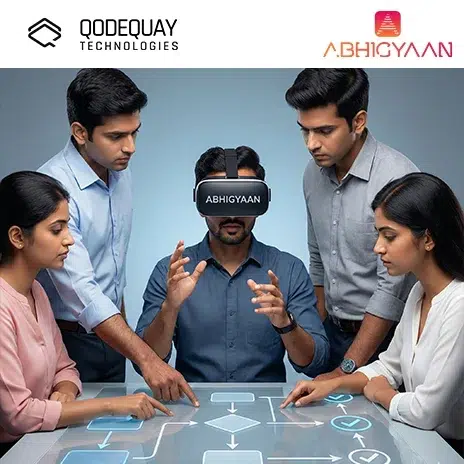
Virtual reality learning is an educational approach where you use VR headsets to enter immersive environments designed for learning and skill practice.
Instead of learning in 2D, you learn in 3D. Instead of observing, you interact. Instead of memorizing, you experience.
VR learning can include:
The purpose is simple: you build understanding through action.
VR makes learning feel alive because it creates presence, the psychological feeling that you are truly inside the environment.
Presence changes how your brain treats information. When you read about something, your brain stores it as knowledge. When you experience something, your brain stores it as memory.
That is the key difference.
For example:
That emotional connection strengthens retention and curiosity.
VR improves learning outcomes by increasing engagement, strengthening memory retention, and reducing the gap between theory and practice.
Traditional learning often creates a “transfer gap.” You understand a concept in class, but you cannot apply it confidently in real situations.
VR reduces this gap because it allows:
This is why VR works especially well for STEM, healthcare, safety training, and vocational education.
You benefit most from VR learning when you learn better through visuals, practice, or experience rather than pure reading.
VR supports multiple learning styles, including:
VR can also help students who lose focus easily because the immersive environment reduces distractions.
Science, history, geography, and skill-based training become dramatically better because VR makes complex concepts tangible.
You can explore cells, organs, and ecosystems as if you are inside them.
You can visualize molecules, forces, motion, and reactions safely.
You can visit ancient cities, battlefields, and monuments.
You can explore landscapes, climate systems, and natural disasters.
You can practice electrical wiring, mechanical repair, or equipment handling.
VR is strongest when learning requires space, movement, and real-world context.
VR learning is already used in schools, universities, and enterprises because it solves practical problems.
Here are common real-world examples:
Instead of reading about the pyramids, you explore them. Instead of watching a museum documentary, you walk through galleries.
Schools without lab equipment can still run experiments safely.
Students practice procedures and emergency response before working with real patients.
Workers practice hazardous scenarios without risk.
You practice communication, leadership, and customer service through role-play simulations.
This is where VR proves its value: real practice, real confidence, zero physical risk.
VR learning is strategic because it improves performance, reduces training cost, and supports scalable transformation.
If you lead technology, product, or innovation, VR learning impacts:
For example, a company can train employees faster and more consistently with VR simulations than with repeated in-person workshops.
For schools, VR can raise engagement and provide resources they otherwise could not access.
VR classrooms strengthen teachers by giving them better tools, not by replacing them.
A teacher remains essential because:
VR is the experience layer. The teacher is still the learning architect.
The best VR learning models are hybrid: VR sessions followed by classroom discussion and assignments.
The biggest challenges are cost, device management, content quality, and accessibility.
VR learning is powerful, but it comes with real operational challenges:
Headsets cost money and need maintenance.
Good VR content must match curriculum and learning outcomes.
Teachers need support and confidence to use VR effectively.
Some learners may experience motion sickness or discomfort.
VR platforms can collect behavioral data, so governance matters.
These are not reasons to avoid VR. They are reasons to implement it strategically.
VR learning succeeds when you treat it as an experience design problem, not just a technology rollout.
Here are proven best practices:
The secret is simple: VR should support learning goals, not distract from them.
The future will be more affordable, more personalized, and more connected to AI.
Here are the trends shaping the next 3 to 5 years:
VR hardware will become more comfortable and more school-friendly.
More content will be mapped directly to school standards.
Students will get adaptive experiences based on performance.
Students will work together inside shared VR spaces.
Schools will use the right immersive tech depending on the subject.
Instead of testing memorization, VR will test performance and decision-making.
The future is not VR replacing classrooms. It is VR making classrooms more powerful.
Beyond books, learning becomes something you can step into. Virtual reality learning transforms education from passive knowledge consumption into active experience. That shift is powerful because the world rewards people who can apply skills, not just remember facts.
This is where design-first thinking makes the difference. At Qodequay (https://www.qodequay.com), immersive learning is built by solving human problems first, then using technology as the enabler. When you combine empathy, great experience design, and the right immersive tools, learning does not just improve, it comes alive.

As the CEO and Founder of Qodequay Technologies, I bring over 20 years of expertise in design thinking, consulting, and digital transformation. Our mission is to merge cutting-edge technologies like AI, Metaverse, AR/VR/MR, and Blockchain with human-centered design, serving global enterprises across the USA, Europe, India, and Australia. I specialize in creating impactful digital solutions, mentoring emerging designers, and leveraging data science to empower underserved communities in rural India. With a credential in Human-Centered Design and extensive experience in guiding product innovation, I’m dedicated to revolutionizing the digital landscape with visionary solutions.
Follow the expert :


July 2, 2026
July 2, 2026
July 2, 2026
July 2, 2026
July 2, 2026
Monthly insights on AI, VR and DPDPA compliance — straight from our team to your inbox.
Free 30-minute consultation with our team — or see our products in action.