DPDPA Penalties Up to ₹250 Crore: The Real Cost of Waiting
July 2, 2026
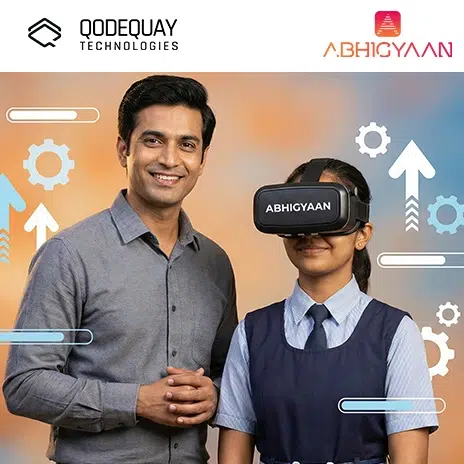
The future of virtual reality in education is a big deal because immersive learning is moving from pilot projects to mainstream adoption, and the institutions that adapt early will shape how learning works for the next decade.
Education is changing fast. Students are more digital than ever. Skills requirements are evolving. Attention spans are shrinking. And classrooms are under pressure to deliver better outcomes with limited resources.
Virtual reality (VR) offers a rare solution that improves engagement, retention, and skill readiness at the same time. It also helps education become more inclusive, more experiential, and more scalable.
For CTOs, CIOs, Product Managers, Startup Founders, and Digital Leaders, this matters because VR is not just an education tool. It is a workforce readiness platform, a training engine, and a product opportunity.
In this article, you’ll explore what the future of VR in education looks like, which trends are driving it, what challenges remain, and how organizations can prepare.
VR in classrooms will become more common, more affordable, and more integrated into everyday lesson plans.
Today, VR is often used as a special activity. Over the next few years, it will become a normal teaching tool, especially in STEM, history, and skill-based learning.
VR will stop being a novelty and start being infrastructure.
VR adoption will accelerate because the cost of hardware is falling while the demand for future-ready skills is rising.
Education leaders are being pushed to deliver:
VR supports all of these goals, especially when combined with AI and analytics.
AI will change VR learning by enabling adaptive, personalized, and conversational experiences inside immersive environments.
Right now, many VR lessons are pre-built experiences. You explore, observe, and complete tasks.
In the future, VR will feel more like interacting with a tutor, a coach, or a role-play character.
This will make VR learning more scalable and more effective.
Mixed reality will not replace VR, but it will become equally important for classroom learning.
VR is best when you want full immersion, such as:
Mixed reality is best when you want digital content layered into the real classroom, such as:
The future is not VR vs MR. It is VR + MR as a learning toolkit.
VR will change STEM education by making virtual labs and simulations widely available, reducing cost and improving safety.
Many schools cannot afford advanced lab equipment. Many experiments are too dangerous, too expensive, or too time-consuming.
VR makes labs scalable.
STEM learning will become more practical and less dependent on physical resources.
VR will reshape vocational training by becoming a standard method for skill practice, safety training, and job readiness.
This is one of the strongest future growth areas.
Industries that will accelerate VR adoption include:
The reason is simple: training errors in these industries are expensive, dangerous, and slow.
VR provides repeatable training at scale.
VR will improve inclusive learning by offering controlled environments, personalized pacing, and alternative learning formats.
VR has strong potential for:
Future VR platforms will include stronger accessibility features such as:
The future of VR in education is not only immersive. It is inclusive.
Learning analytics will evolve by tracking performance inside VR environments, not just test scores outside them.
In traditional learning, data is limited:
In VR, you can track:
This creates a new layer of insight for educators and institutions.
It also helps organizations prove ROI.
The biggest challenges will still include device cost, content quality, teacher adoption, and student comfort.
Even in the future, VR will require thoughtful planning.
The institutions that solve these challenges early will lead the market.
The best strategies are to start with high-impact use cases, build internal capability, and focus on measurable learning outcomes.
Future success will come from execution, not hype.
By 2030, VR will be a mainstream learning tool in many schools, universities, and corporate training programs, especially for STEM and skills training.
The biggest shift will be this: education will become more experience-based than content-based.
Qodequay helps you build VR learning experiences that are scalable, measurable, and designed around real human learning needs.
The future of VR in education will not be led by hardware companies alone. It will be led by teams that understand learning design, user experience, accessibility, and technology execution.
At Qodequay (https://www.qodequay.com), you take a design-first approach to immersive learning. You solve human problems first, then use VR and emerging technology as the enabler.
The future of virtual reality in education is not about replacing classrooms. It is about upgrading them. VR brings experience into learning, helping students understand faster, remember longer, and build skills more confidently.
As hardware becomes easier and AI makes immersive learning more intelligent, VR will become one of the most important education tools of the next decade.
At Qodequay (https://www.qodequay.com), you lead that transformation with a design-first mindset, solving real human learning challenges with technology as the enabler.

As the CEO and Founder of Qodequay Technologies, I bring over 20 years of expertise in design thinking, consulting, and digital transformation. Our mission is to merge cutting-edge technologies like AI, Metaverse, AR/VR/MR, and Blockchain with human-centered design, serving global enterprises across the USA, Europe, India, and Australia. I specialize in creating impactful digital solutions, mentoring emerging designers, and leveraging data science to empower underserved communities in rural India. With a credential in Human-Centered Design and extensive experience in guiding product innovation, I’m dedicated to revolutionizing the digital landscape with visionary solutions.
Follow the expert :


July 2, 2026
July 2, 2026
July 2, 2026
July 2, 2026

July 2, 2026
Monthly insights on AI, VR and DPDPA compliance — straight from our team to your inbox.
Free 30-minute consultation with our team — or see our products in action.