DPDPA Penalties Up to ₹250 Crore: The Real Cost of Waiting
July 2, 2026
February 6, 2026
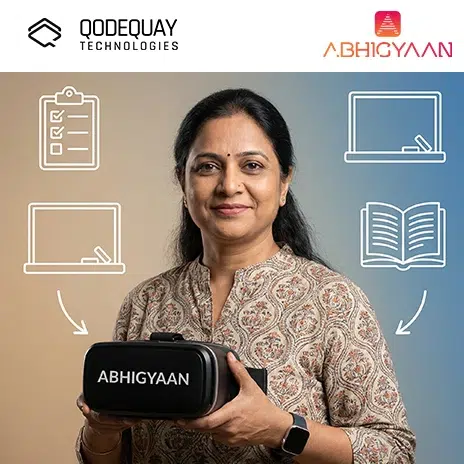
Virtual reality is becoming a game-changer in education because it turns learning into an immersive experience that improves engagement, understanding, and retention.
Education has always been about helping you understand the world. But the tools used in classrooms have often stayed stuck in the past. Many lessons still rely on textbooks, slides, and memorization, even when the subject is visual, complex, or practical.
Virtual reality changes that. It helps you learn by experiencing, not only by listening.
For CTOs, CIOs, Product Managers, Startup Founders, and Digital Leaders, VR in education matters because it is becoming a scalable digital capability. Schools, universities, and training organizations are investing in immersive learning to improve outcomes and build future-ready skills.
In this article, you’ll explore the benefits of virtual reality in education, where it delivers the strongest impact, best practices for implementation, and what the future of classrooms will look like.
Virtual reality in education means using immersive 3D environments to teach concepts, skills, and experiences that are difficult to deliver through traditional learning methods.
Instead of reading about a place, you visit it. Instead of imagining a process, you interact with it. Instead of watching a lab experiment, you perform it.
VR is not just “cool tech.” It is a new learning medium.
VR improves engagement because it makes learning active, interactive, and visually rich.
In a standard classroom, attention is often the biggest challenge. Students are surrounded by distractions, and lessons may feel disconnected from real life.
VR reduces this by placing you inside the lesson.
This creates stronger focus and better participation.
VR increases retention because your brain remembers experiences better than passive information.
When you learn through immersion, your memory works differently. You do not just store facts, you store context.
For example:
This is why VR is strongly connected to experiential learning.
VR enhances STEM education by making abstract concepts visual, interactive, and safe to explore.
STEM is often difficult because it involves:
VR removes these barriers.
STEM becomes less intimidating and more hands-on.
VR improves history and geography because it brings context, culture, and scale into learning.
History often feels like memorizing dates and names. Geography often feels like memorizing maps. VR transforms both into exploration.
You can:
This makes learning feel real, not distant.
VR supports vocational education by enabling safe, repeatable practice for real-world skills.
This is one of the strongest use cases for VR because vocational training requires:
VR provides realistic simulation without real-world risk.
For institutions and training organizations, this can reduce incidents and improve readiness.
VR supports inclusive learning by giving you personalized environments where you can learn at your own pace without social pressure.
Many students learn differently. Some struggle with attention, anxiety, sensory overload, or confidence.
VR can help by:
When designed well, VR becomes an accessibility tool.
The biggest benefits are engagement, retention, accessibility, safety, and scalable learning experiences.
VR improves both learning quality and learning equity.
The main challenges are cost, device management, content quality, teacher training, and accessibility.
VR is powerful, but implementation needs structure.
The best way to manage these challenges is to start with a pilot program.
The best practices are to start small, focus on learning outcomes, and blend VR with traditional teaching methods.
VR works best as part of blended learning, not as a replacement for teachers.
The future of education will include immersive learning as a standard tool, supported by AI, analytics, and mixed reality experiences.
Over time, VR will become as normal as projectors and tablets.
Qodequay helps you design immersive learning experiences that are built around real educational outcomes, not just technology.
Successful VR programs require:
At Qodequay (https://www.qodequay.com), you take a design-first approach to education transformation, solving real learning problems with technology as the enabler.
Virtual reality is reshaping education because it brings learning to life. It turns lessons into experiences, improves understanding, and makes classrooms more engaging and inclusive.
The classrooms of the future will not rely only on textbooks and lectures. They will blend traditional teaching with immersive learning tools that help students explore, practice, and remember.
At Qodequay (https://www.qodequay.com), you build future-ready education solutions with a design-first mindset, solving human learning challenges with technology as the enabler.

As the CEO and Founder of Qodequay Technologies, I bring over 20 years of expertise in design thinking, consulting, and digital transformation. Our mission is to merge cutting-edge technologies like AI, Metaverse, AR/VR/MR, and Blockchain with human-centered design, serving global enterprises across the USA, Europe, India, and Australia. I specialize in creating impactful digital solutions, mentoring emerging designers, and leveraging data science to empower underserved communities in rural India. With a credential in Human-Centered Design and extensive experience in guiding product innovation, I’m dedicated to revolutionizing the digital landscape with visionary solutions.
Follow the expert :


July 2, 2026
July 2, 2026
July 2, 2026
July 2, 2026

July 2, 2026
Monthly insights on AI, VR and DPDPA compliance — straight from our team to your inbox.
Free 30-minute consultation with our team — or see our products in action.