DPDPA Penalties Up to ₹250 Crore: The Real Cost of Waiting
July 2, 2026
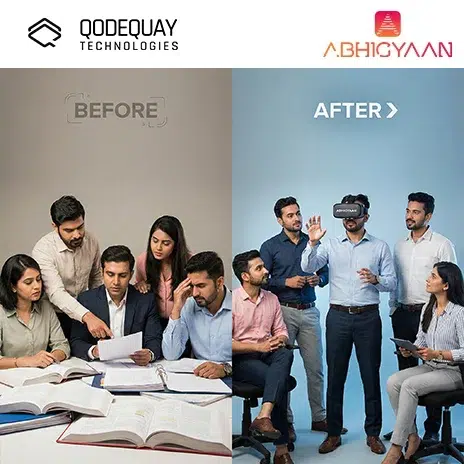
Learning is changing, and you can feel it everywhere. The old model, a trainer talks, you listen, you take notes, you forget, is collapsing under modern work realities. People are distracted, overloaded, and expected to perform faster than ever. If you are a CTO, CIO, Product Manager, Startup Founder, or Digital Leader, this shift matters deeply because learning is no longer “HR’s problem.” It is now a competitive advantage, a product strategy lever, and a performance multiplier.
This article explains what it means when learning becomes an experience, not a lesson. You will learn why experiential learning works better, what neuroscience says about memory and engagement, how top companies apply it, which technologies make it scalable, and how you can design learning that actually sticks.
It means you stop delivering information and start designing transformation through interaction, context, and action.
A lesson is usually one-way. It assumes people will absorb knowledge because it is presented clearly. An experience is two-way. It forces you to think, decide, react, fail safely, and try again. That is how real learning happens.
When you experience learning, you do not just “know” something. You can do it under pressure, in context, and with confidence. That difference is the gap between training and performance.
Because experiential learning directly improves execution, adoption, and ROI across your organization.
If your teams cannot adopt tools, follow security processes, or apply new workflows, your digital transformation slows down. Worse, it becomes expensive shelfware.
For example:
Experiential learning turns training into behavior change, and behavior change is what leaders actually pay for.
Your brain remembers what you do far more than what you hear.
Research in cognitive science consistently shows that active learning improves retention compared to passive consumption. You learn better when you retrieve information, apply it, and connect it to emotion or context.
A well-known industry statistic often referenced in corporate training is that people forget a large percentage of what they hear within days unless they apply it. Whether the exact percentage varies by study, the pattern is brutally consistent: passive learning decays fast.
Experience-based learning works because it activates:
That is why simulations, role-play, scenario-based training, and interactive modules outperform slide decks.
It improves performance because it reduces the “transfer gap” between training and real work.
The transfer gap is the difference between:
Traditional lessons create knowledge. Experiences create capability.
In practical terms, experiential learning improves:
This is why high-performing companies treat learning like a product, not an event.
The best examples look less like “training” and more like controlled reality.
Here are a few strong patterns you see across industries:
Instead of telling employees “don’t click suspicious links,” you run phishing simulations and immediate micro-learning. Employees learn through consequence, but safely.
Instead of teaching a pitch, you practice objection handling with branching scenarios. Sales teams build reflexes, not just knowledge.
Instead of reading safety manuals, workers go through simulated environments. They practice correct actions without risking injury or equipment damage.
Instead of memorizing protocols, nurses and doctors run simulation drills. It reduces errors and improves coordination.
Instead of documentation, users complete tasks inside the product with interactive walkthroughs. This improves activation and reduces churn.
Because attention, time, and motivation are all collapsing under workload pressure.
Traditional learning assumes people will:
Modern reality is different. You are dealing with:
So the lesson model breaks.
Experience-based learning works better because it fits into real work patterns and delivers value in smaller, actionable moments.
You design it like you would design a great product, starting with outcomes, not content.
The biggest mistake in corporate learning is starting with a topic list. The right approach starts with:
Then you design scenarios and feedback loops that build that capability.
Technology makes experiential learning scalable, measurable, and personalized.
Without tech, experiential learning is limited to workshops, trainers, and physical role-play. With tech, you can deliver experiences to thousands of employees consistently.
Key technologies enabling this shift include:
For digital leaders, the opportunity is huge: learning becomes part of the digital ecosystem, not a separate “training portal nobody opens.”
They create immersion, which makes learning feel real and therefore more memorable.
VR and AR are not “cool tech demos” when used correctly. They solve specific problems where real-world practice is expensive, dangerous, or hard to repeat.
Examples where immersive learning is especially valuable:
The key is not the headset. The key is the scenario design and feedback.
You measure performance outcomes, not just training completion.
Completion rates are vanity metrics. Real measurement includes:
A strong learning experience should show measurable business impact within weeks, not months.
The most common mistake is making it interactive, but not meaningful.
A clickable course is not an experience. An experience requires decisions, consequences, and reflection.
Other common mistakes include:
A harsh truth: most training fails because it is designed to be delivered, not designed to be used.
You treat learning as part of your product and culture, not a separate activity.
If you are a startup founder or product leader, experiential learning helps you:
A simple example: instead of giving new hires a Notion page, you give them a mission-based onboarding path with tasks, shadowing, and decision checkpoints.
That is experiential learning in startup form.
It will become more personalized, more immersive, and more integrated into daily work.
Here are trends you should expect over the next 3 to 5 years:
You will see AI coaching that gives real-time feedback during work, not after.
Learning will move into Slack, Teams, CRMs, and product UIs. Training portals will decline.
Scenario engines will become standard for sales, support, leadership, and compliance.
VR will be used more in safety, healthcare, and operations, where ROI is clear.
Companies will map skills, track progress, and assign learning experiences based on skill gaps.
The winners will be companies that treat learning as a designed experience, not a checkbox.
When learning becomes an experience, it stops being a burden and starts becoming a competitive advantage. You are no longer pushing content at people. You are building capability, confidence, and behavior change through design.
This is where design-first thinking matters most. At Qodequay (https://www.qodequay.com), learning is treated the same way great products are treated: with empathy, clarity, and purpose. Technology is not the hero, it is the enabler. The real goal is solving human problems at scale, and experiential learning is one of the most powerful ways to do it.

As the CEO and Founder of Qodequay Technologies, I bring over 20 years of expertise in design thinking, consulting, and digital transformation. Our mission is to merge cutting-edge technologies like AI, Metaverse, AR/VR/MR, and Blockchain with human-centered design, serving global enterprises across the USA, Europe, India, and Australia. I specialize in creating impactful digital solutions, mentoring emerging designers, and leveraging data science to empower underserved communities in rural India. With a credential in Human-Centered Design and extensive experience in guiding product innovation, I’m dedicated to revolutionizing the digital landscape with visionary solutions.
Follow the expert :


July 2, 2026
July 2, 2026
July 2, 2026
July 2, 2026
July 2, 2026
Monthly insights on AI, VR and DPDPA compliance — straight from our team to your inbox.
Free 30-minute consultation with our team — or see our products in action.