DPDPA Penalties Up to ₹250 Crore: The Real Cost of Waiting
July 2, 2026
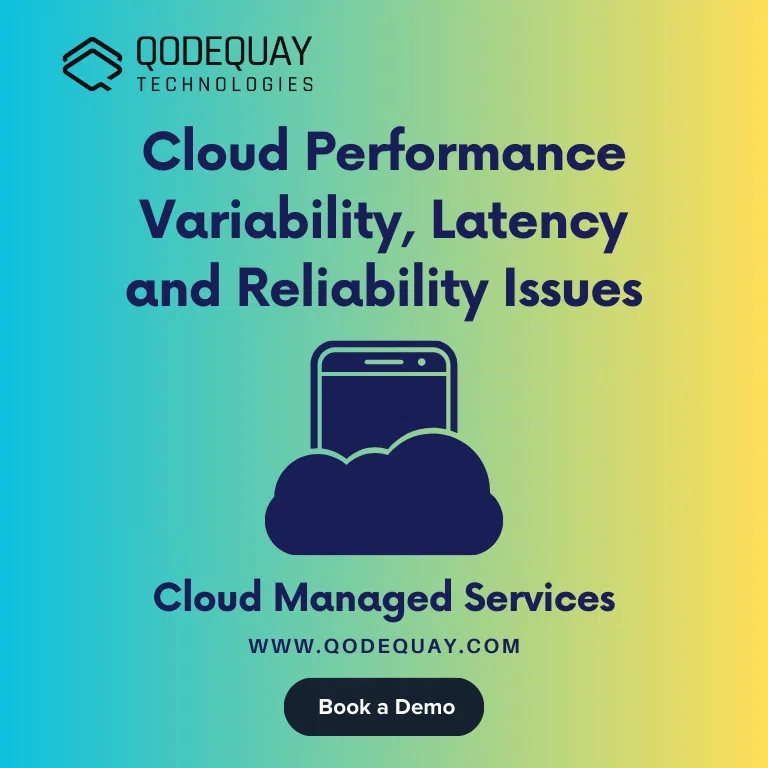
Cloud performance variability is a serious business risk because latency and reliability issues directly impact revenue, retention, and trust.
You move to the cloud expecting consistent performance, global reach, and high availability. In reality, cloud environments are shared, distributed, and dependent on networks you do not fully control. That makes performance less predictable than many teams expect.
For CTOs, CIOs, Product Managers, Startup Founders, and Digital Leaders, the stakes are high. A few seconds of latency can reduce conversion rates. A reliability incident can damage customer confidence. Even small performance inconsistencies can create support tickets, churn, and brand harm.
In this article, you’ll learn why cloud performance varies, what causes latency and reliability issues in AWS, Azure, and GCP, and how to design systems that stay fast and resilient as you scale.
Cloud performance variability means your application’s speed, response time, and stability change unpredictably even when the workload seems similar.
This often shows up as:
Variability is not always a bug in your code. Sometimes it is a characteristic of the cloud environment.
Latency increases because scaling compute does not automatically fix network delays, data distance, or shared service bottlenecks.
Cloud auto-scaling is excellent for handling CPU-based demand. But many latency problems come from:
Scaling more instances may help, but it does not solve architectural latency.
Cloud latency spikes are most commonly caused by network variability, overloaded dependencies, and poorly tuned scaling.
Here are the biggest culprits:
Cloud is multi-tenant. Even with strong isolation, shared infrastructure can introduce variability.
Every extra hop adds latency. A single architectural decision can turn a 20ms call into a 200ms call.
Databases are often the bottleneck, especially under burst traffic.
Serverless and container scaling can introduce delay when new instances spin up.
API gateways, ingress controllers, and L7 load balancers add processing cost.
Small delays multiply when your services make many calls.
Latency spikes usually come from systems, not single components.
Reliability issues happen because your application is built on many dependent services, and each dependency adds failure probability.
Cloud providers offer strong uptime, but your application’s uptime is a product of:
Even if each service is “99.9% reliable,” combining them can create surprising fragility.
This is why cloud-native reliability is about design, not vendor promises.
SLAs are contractual guarantees, while real reliability is what your customers experience.
Cloud providers publish SLAs, but SLAs:
Your customers do not care about SLA credits. They care whether the product works.
This is why you need internal SLOs (Service Level Objectives) that match business expectations.
Microservices increase risk because they multiply network calls and create more points of failure.
Microservices can improve team velocity and scalability. But they also introduce:
A monolith can fail in one place. A microservice system can fail in 50 places, at once.
Multi-region improves reliability by reducing single-region dependency, but it complicates latency due to replication and routing.
Multi-region design is powerful for:
But it adds complexity:
Multi-region is not a free upgrade. It is a strategic trade-off.
Observability is essential because you cannot fix latency or reliability problems you cannot measure.
Many teams track basic metrics but still struggle because they lack:
Without observability, performance tuning becomes guesswork.
You reduce cloud latency by designing for locality, reducing hops, and tuning scaling and caching.
Here are proven best practices used by high-performing cloud teams:
The most important metric is not “average response time.” It is worst-case experience.
You improve cloud reliability by designing graceful failure, redundancy, and safe deployment practices.
Reliability is not only about uptime. It is about staying functional under stress.
Reliability becomes real when you test it, not when you assume it.
A common real-world pattern is that small latency increases cause measurable drops in conversion and engagement.
Large-scale digital businesses have publicly shared that even milliseconds matter. In many ecommerce and SaaS environments, a 1-second delay can reduce conversions and increase abandonment.
A realistic scenario looks like this:
This is why performance engineering is not “technical perfectionism.” It is business protection.
You prevent churn by designing customer-safe failure modes and communicating transparently during incidents.
Customers churn when:
You reduce churn when:
Reliability is trust engineering.
Cloud performance and reliability will be shaped by edge computing, AI workloads, and more complex distributed systems.
In the future, performance and reliability will be competitive advantages, not technical hygiene.
Qodequay helps you reduce cloud performance variability by designing systems that are resilient, observable, and scalable across AWS, Azure, and GCP.
You do not need endless tooling. You need architecture that matches your product goals.
With a design-first and technology-enabled approach, Qodequay supports you in:
You gain speed, stability, and confidence, without the noise.
Cloud platforms give you incredible power, but they do not guarantee consistent performance or perfect reliability. Latency spikes and reliability incidents are not signs of failure in cloud adoption, they are signs that your system is scaling into real-world complexity.
The solution is not to panic or overengineer. The solution is to design intentionally: measure what matters, reduce unnecessary dependencies, and build resilience into the architecture.
At Qodequay (https://www.qodequay.com), you solve these challenges with a design-first approach, leveraging technology as the enabler. You build cloud experiences that stay fast, reliable, and scalable, so your teams can innovate with confidence.

As the CEO and Founder of Qodequay Technologies, I bring over 20 years of expertise in design thinking, consulting, and digital transformation. Our mission is to merge cutting-edge technologies like AI, Metaverse, AR/VR/MR, and Blockchain with human-centered design, serving global enterprises across the USA, Europe, India, and Australia. I specialize in creating impactful digital solutions, mentoring emerging designers, and leveraging data science to empower underserved communities in rural India. With a credential in Human-Centered Design and extensive experience in guiding product innovation, I’m dedicated to revolutionizing the digital landscape with visionary solutions.
Follow the expert :


July 2, 2026

July 2, 2026
July 2, 2026
July 2, 2026

July 2, 2026
Monthly insights on AI, VR and DPDPA compliance — straight from our team to your inbox.
Free 30-minute consultation with our team — or see our products in action.