DPDPA Penalties Up to ₹250 Crore: The Real Cost of Waiting
July 2, 2026
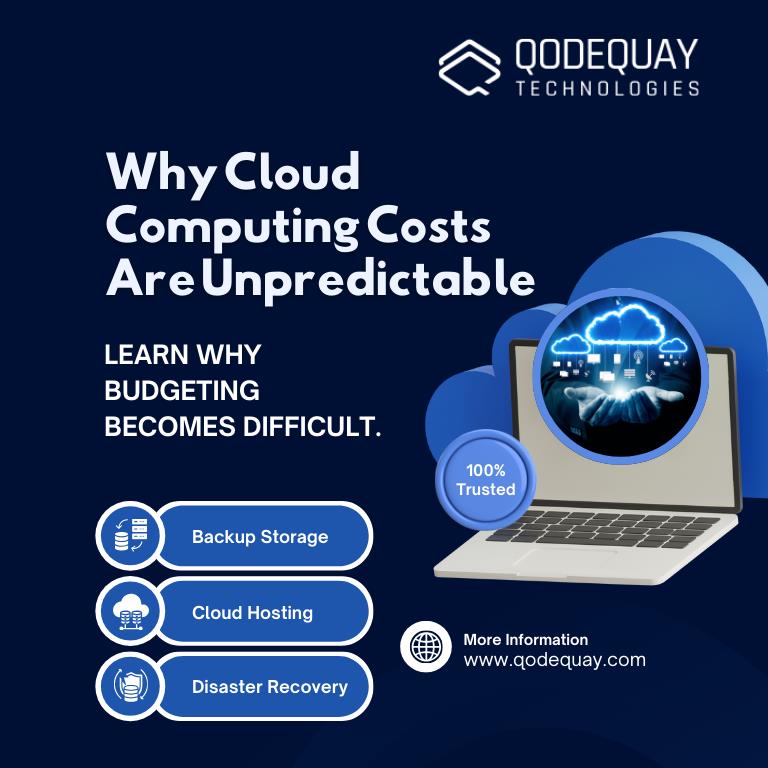
Cloud cost unpredictability is becoming serious because usage scales instantly, while financial controls usually move slowly.
You move to the cloud for speed, flexibility, and innovation. Then one day, you open the billing dashboard and feel like you’re looking at a thriller plot twist. The numbers jump, the services multiply, and nobody is fully sure what changed.
For CTOs, CIOs, Product Managers, Startup Founders, and Digital Leaders, this unpredictability is more than a finance issue. It impacts roadmaps, hiring, investor confidence, and even customer experience. When cloud costs behave unpredictably, your entire operating model becomes reactive.
In this article, you’ll learn what causes cloud costs to become unpredictable, the most common hidden spending risks across AWS, Azure, and GCP, and the best ways to regain visibility, governance, and control without slowing innovation.
Cloud cost unpredictability means your cloud bill changes in ways you cannot quickly explain, forecast, or control.
This can happen even when your product is stable, your customer base is not growing dramatically, and your team has not launched major features. The cost still rises because cloud billing is influenced by dozens of variables that are easy to overlook.
Unpredictability is not always caused by “waste.” Sometimes it is caused by legitimate growth, but the lack of visibility makes it feel like waste.
Cloud bills feel random because cloud pricing is usage-based, distributed across services, and tied to automation.
In traditional infrastructure, you bought servers, installed them, and depreciation was predictable. In cloud, you pay for consumption, and consumption changes constantly.
Cloud is designed for agility. Predictability is not the default.
The biggest hidden spending risks are the ones that grow silently until they hit the invoice.
Cloud cost risk is dangerous because it rarely fails loudly. Your systems keep running, but your bill inflates behind the scenes.
These risks are common in AWS, Azure, and GCP, even for mature organizations.
Data transfer becomes a silent killer because it is easy to trigger and hard to notice until billing arrives.
Many teams focus on compute and storage, but cloud providers often charge heavily for moving data out of a region, across regions, or out to the public internet.
Data transfer is one of the most underestimated drivers of cloud cost unpredictability.
Small services create huge cost spikes because managed cloud services scale automatically and charge per unit.
Serverless, managed databases, streaming pipelines, and AI services are amazing for speed. They also bill in ways that can surprise you.
A single misconfigured loop can trigger millions of requests and a shocking invoice.
Kubernetes makes cloud costs harder to predict because resource requests, node sizing, and cluster sprawl hide true usage.
Kubernetes is a powerful abstraction, but it can hide inefficiencies in plain sight.
Without cost allocation tooling, Kubernetes can turn your cloud bill into a fog.
Cloud cost unpredictability gets worse because more teams create more resources, faster, with less centralized control.
As you scale, you gain:
Each one is a cost surface area. Without a strong cost model, your cloud spend becomes an emergent property of organizational behavior.
This is why cloud cost management is as much about people and process as it is about technology.
Tagging prevents hidden cloud spend by linking every resource to an owner, a product, and a business purpose.
Tagging is one of the simplest ideas in cloud governance, and one of the hardest to enforce.
When tagging is weak:
Tagging is not a “nice-to-have.” It is the foundation of cloud cost visibility.
Cloud budgets fail because they trigger too late, lack context, and don’t drive action.
Budget alerts are useful, but they often become noise:
Cloud cost control needs more than alarms. It needs a system that makes spend explainable and actionable.
FinOps reduces unpredictability by creating a shared operating model for visibility, optimization, and governance.
FinOps is powerful because it does not treat engineering as the enemy. It treats cloud spend as a shared responsibility across:
FinOps makes cloud cost management a discipline, not a panic response.
The fastest ways to reduce hidden risks are to remove idle waste, enforce ownership, and tune scaling.
Here are high-impact actions that typically deliver results in weeks:
These actions reduce waste while keeping your teams shipping.
You build predictable forecasting by tying cloud spend to unit economics and product usage metrics.
Forecasting fails when you only look at last month’s bill. Forecasting improves when you measure:
When you connect spend to demand, cost becomes forecastable. You stop guessing and start modeling.
Cost intelligence means you can see real-time spend patterns, anomalies, and business drivers across all cloud providers.
In multi-cloud environments, you often suffer from:
A cost intelligence layer normalizes all of it so you can:
This is where cost visibility becomes strategic, not administrative.
Cloud cost unpredictability will increase because AI workloads, data platforms, and event-driven architectures scale faster than traditional services.
In the next few years, cloud cost management will become as critical as uptime and security.
Qodequay helps you turn complex cloud usage into clear, actionable cost intelligence across AWS, Azure, and GCP.
You don’t need more dashboards. You need clarity that drives decisions.
With a FinOps-driven analytics approach, you gain:
You reduce unpredictability while protecting innovation speed.
Cloud computing is built for speed, but without visibility, that speed can turn into financial turbulence. When costs become unpredictable, innovation slows, leadership loses confidence, and teams spend more time defending bills than building products.
The winning strategy is not aggressive cost cutting. The winning strategy is cost intelligence: knowing what you spend, why you spend it, and how it maps to business value.
At Qodequay (https://www.qodequay.com), you take a design-first approach to cloud cost management, solving human problems with technology as the enabler. You turn cloud complexity into clarity, so your teams move faster with better control and smarter decisions.

As the CEO and Founder of Qodequay Technologies, I bring over 20 years of expertise in design thinking, consulting, and digital transformation. Our mission is to merge cutting-edge technologies like AI, Metaverse, AR/VR/MR, and Blockchain with human-centered design, serving global enterprises across the USA, Europe, India, and Australia. I specialize in creating impactful digital solutions, mentoring emerging designers, and leveraging data science to empower underserved communities in rural India. With a credential in Human-Centered Design and extensive experience in guiding product innovation, I’m dedicated to revolutionizing the digital landscape with visionary solutions.
Follow the expert :


July 2, 2026

July 2, 2026
July 2, 2026
July 2, 2026

July 2, 2026
Monthly insights on AI, VR and DPDPA compliance — straight from our team to your inbox.
Free 30-minute consultation with our team — or see our products in action.