DPDPA Penalties Up to ₹250 Crore: The Real Cost of Waiting
July 2, 2026
February 5, 2025
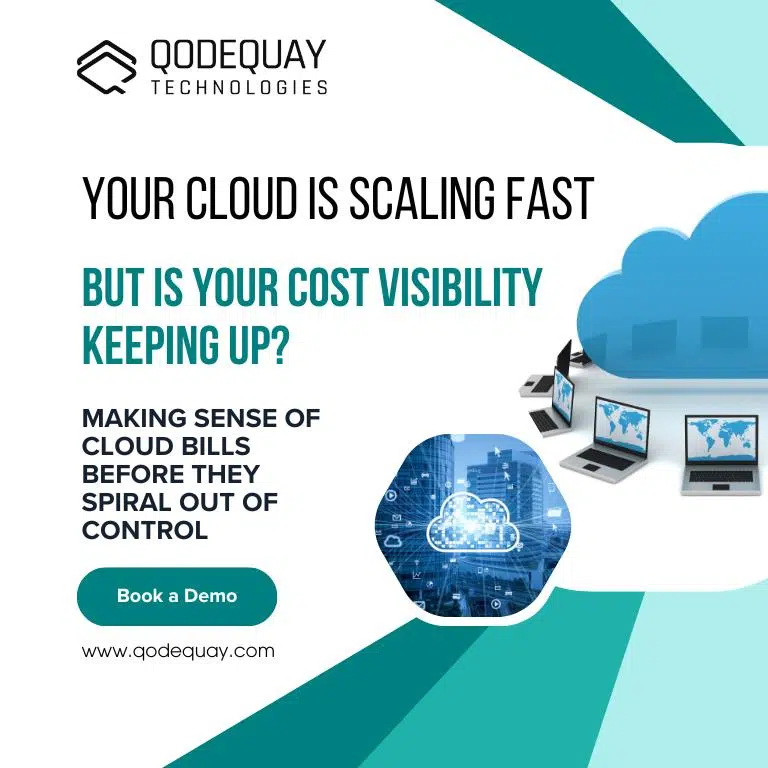
Cloud cost visibility is now a leadership problem because cloud usage scales faster than financial controls.
As a CTO, CIO, Product Manager, Startup Founder, or Digital Leader, you’re expected to move fast, ship features, and scale infrastructure without breaking budgets. The problem is that cloud is not a single bill you can easily audit. It’s a living system where every team, service, environment, and deployment creates cost.
In the early days, your cloud spend looks manageable. Then the product grows, teams multiply, environments expand, and suddenly you’re staring at a bill that looks like it was generated by an alien civilization.
This article will show you why cloud cost visibility often falls behind growth, what the real business risks are, and how a FinOps-driven analytics approach gives you real-time clarity across AWS, Azure, and GCP, without slowing innovation.
Cloud cost visibility means you can clearly understand who is spending, what they are spending on, why it is happening, and what action to take.
Visibility is not just “seeing the bill.” It’s being able to answer questions like:
If you can’t answer those questions quickly, you don’t have cloud cost visibility. You have cloud billing.
Cloud spend grows faster than tracking because cloud is decentralized, automated, and constantly changing.
In traditional IT, procurement was slow and centralized. In cloud, you can spin up hundreds of resources in minutes. That’s great for innovation, but brutal for financial control.
This is why cloud cost visibility becomes a race you can’t win with spreadsheets.
Cloud waste is commonly 20%–30% of total spend, and you should care because it directly reduces your innovation budget.
Industry research from FinOps communities and major cloud cost platforms repeatedly shows a consistent pattern: organizations overspend significantly due to idle resources, overprovisioning, and poor governance.
Here’s the uncomfortable truth: When you waste 25% of your cloud budget, you’re not just losing money. You’re losing product velocity.
That wasted spend could have funded:
Cloud waste is innovation tax.
Poor cloud cost visibility creates business risk because it weakens forecasting, accountability, and decision-making.
The risk is not only “higher cost.” It’s the chaos that follows:
You end up in the worst possible place: you have cloud scale, but you manage it like a mystery box.
Native cloud dashboards feel confusing because they are billing tools, not decision tools.
AWS Cost Explorer, Azure Cost Management, and GCP Billing reports are helpful. But they are designed primarily for finance reporting, not for engineering and product decisions.
They often fail in these real-world areas:
You can technically “see” the cost, but you still can’t manage it.
FinOps is a cross-functional operating model that aligns engineering, finance, and business teams around cloud value.
FinOps is not a tool. It’s not a “cost cutting project.” It’s a system for making cloud spend measurable, explainable, and improvable.
The smartest part of FinOps is this: It doesn’t fight innovation. It makes innovation financially sustainable.
You build real-time visibility by combining cost data, usage telemetry, and business context into one analytics layer.
Cloud cost data alone is not enough. You need:
When those signals connect, you stop asking “Why did our bill go up?” You start asking “Was this spend worth it?”
That is the difference between cost tracking and cost intelligence.
A FinOps-driven analytics approach looks like dashboards, alerts, and governance workflows that map cloud spend to business outcomes.
This approach typically includes:
You pull cost and usage data from:
And normalize it so you can compare apples to apples.
You enforce tagging standards such as:
You detect:
You identify:
You prevent future waste through:
This is where FinOps becomes operational, not theoretical.
You can improve cloud cost visibility fast by focusing on ownership, allocation, and automation first.
Here are the most effective best practices used by high-performing teams:
The key is consistency. Cloud cost visibility is not a one-time cleanup, it’s an operating habit.
Yes, you can get cloud governance without bureaucracy by using automated guardrails instead of manual approvals.
Bad governance feels like:
Good governance feels like:
The best governance is silent until it needs to speak.
A common real-world pattern is that teams reduce cloud spend 15%–30% in 60–90 days once cost ownership becomes visible.
Here’s a realistic scenario you’ve probably lived through:
After implementing a FinOps analytics layer:
Result:
The biggest win is cultural: cost becomes measurable, not emotional.
You measure cloud spend in unit economics, not raw invoices.
Cloud cost becomes meaningful when it connects to product reality.
This is how you shift from “cloud is expensive” to “cloud is profitable.”
Cloud cost visibility matters more in 2026 because AI workloads, data movement, and multi-cloud adoption are increasing complexity.
Your next cost surge will not come from EC2 or VMs alone. It will come from:
These costs are harder to predict and easier to mismanage.
In other words, the cloud bill is evolving into a high-dimensional monster.
The future of cloud cost management will be driven by automation, real-time FinOps, and product-aligned cost models.
Cloud cost visibility will move from “nice-to-have” to “boardroom essential.”
Qodequay Technologies helps you turn complex cloud usage into clear, actionable cost intelligence across AWS, Azure, and GCP.
Instead of dumping raw billing data into yet another dashboard, you get a FinOps-driven analytics approach that focuses on decisions, not distractions.
That means:
Cloud spend should never be the thing that slows innovation. It should be the thing you understand so well that you can safely accelerate.
Your cloud is growing because your business is growing, but if your cost visibility is falling behind, you’re flying blind at scale. The goal is not to spend less at all costs. The goal is to spend intelligently, so your teams can innovate faster with confidence.
At Qodequay Technologies (https://www.qodequay.com), you build that confidence through a design-first approach that blends human-centered strategy with technology as the enabler. You don’t just reduce cloud spend, you create clarity, control, and smarter decisions that keep innovation moving.

As the CEO and Founder of Qodequay Technologies, I bring over 20 years of expertise in design thinking, consulting, and digital transformation. Our mission is to merge cutting-edge technologies like AI, Metaverse, AR/VR/MR, and Blockchain with human-centered design, serving global enterprises across the USA, Europe, India, and Australia. I specialize in creating impactful digital solutions, mentoring emerging designers, and leveraging data science to empower underserved communities in rural India. With a credential in Human-Centered Design and extensive experience in guiding product innovation, I’m dedicated to revolutionizing the digital landscape with visionary solutions.
Follow the expert :


July 2, 2026

July 2, 2026
July 2, 2026
July 2, 2026

July 2, 2026
Monthly insights on AI, VR and DPDPA compliance — straight from our team to your inbox.
Free 30-minute consultation with our team — or see our products in action.